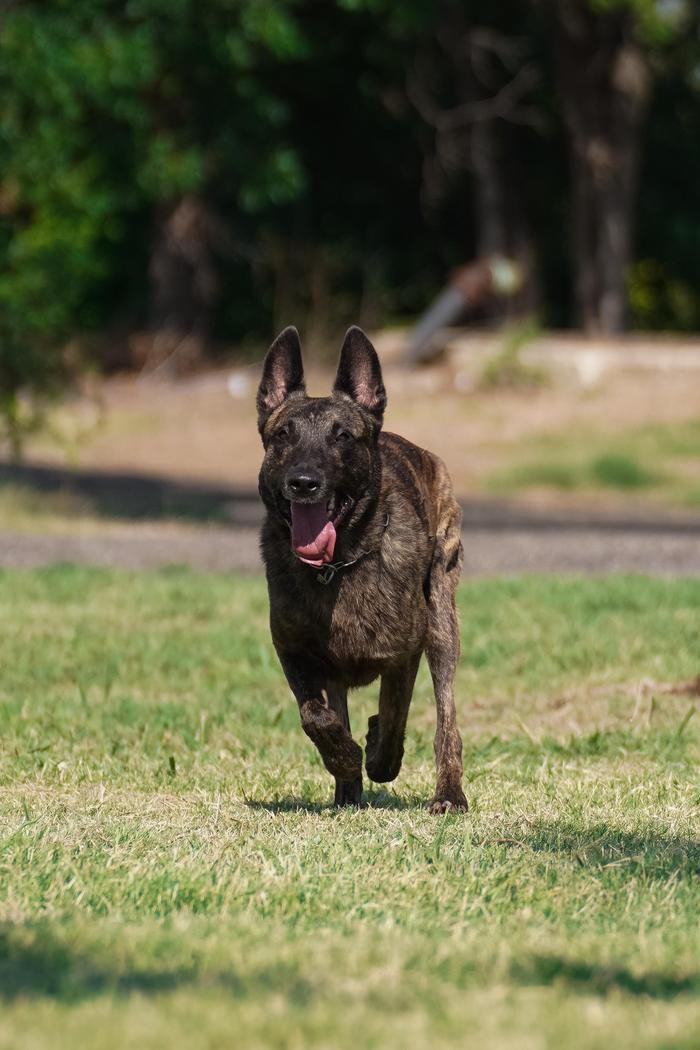
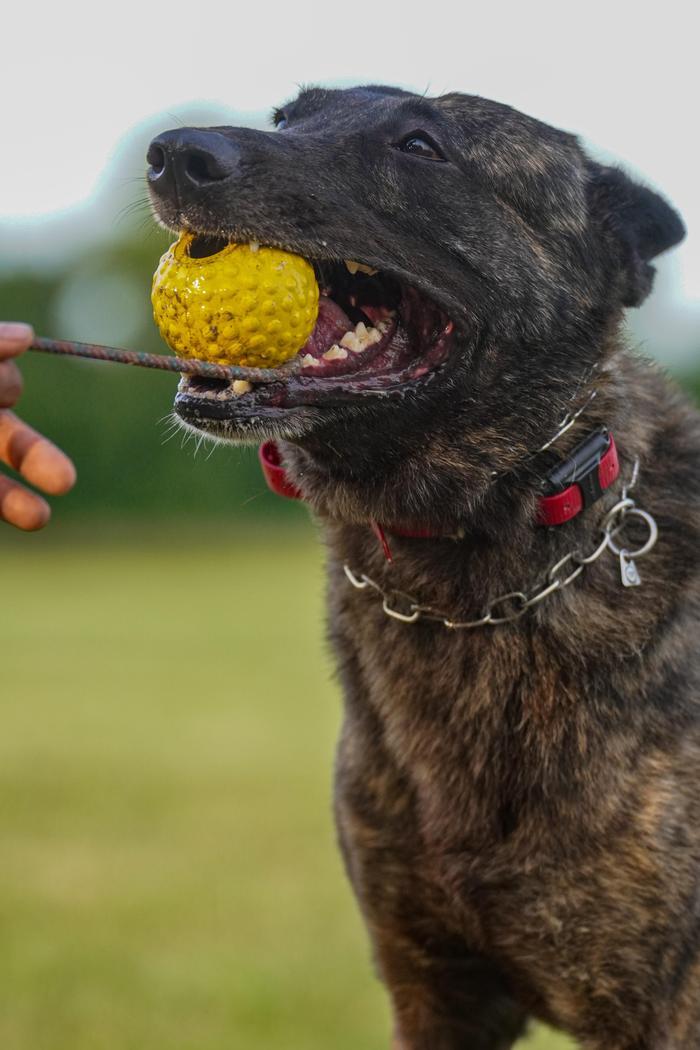
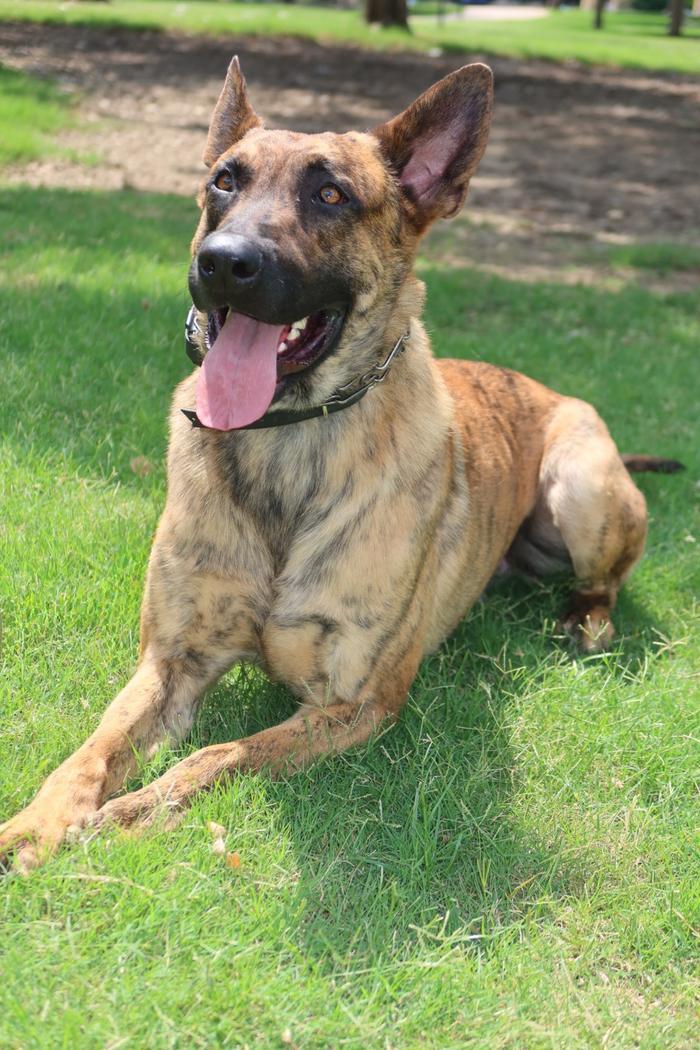
Dutch Shepherd
A versatile and highly adaptable protector. Dutch Shepherds blend natural alertness with a calm, family-friendly temperament, ideal for active households.

The least contested of the three breeds we place, and more often than people expect, the right answer. What follows is what a Dutch Shepherd actually is in protection work today, what it feels like on the receiving end, and the part that decides whether it belongs in a family home: what it does in the minutes after.
A versatile and highly adaptable protector. Dutch Shepherds blend natural alertness with a calm, family-friendly temperament, ideal for active households.
The breeds page gives you the short version, and it is worth stating once before we go past it: most working Dutch Shepherds carry the same engine as a Malinois, and the brindle coat is the difference people notice and the least important one. Everything below is what would not fit in a card.
The name covers at least three different animals, and the distance between them is wider than the distance between any two of the breeds we place. Nobody selling you a dog is obliged to tell you which one you are looking at, so learn to ask.
The working population comes out of Dutch police-dog sport, where dogs have been selected on what they do rather than on what they look like for generations. In that world a pedigree is a performance record. Coat, ear set and the exact shade of brindle are not selection criteria and never have been, which is why working Dutch Shepherds and working Malinois have been bred to one another for a very long time and why the two populations overlap so heavily. A serious Dutch Shepherd is usually a dog from that world, or a few generations off it.
Then there is the conformation and companion population, bred to a written standard and shown — including the long and rough coats you will essentially never meet doing this work. Those are not lesser dogs. Plenty of them are excellent, sound, pleasant house dogs. But they have not been selected for working traits in a long time, and buying one while expecting the other is a mistake that surfaces years later, at the exact moment the dog is asked to do something nobody bred it to do.
And then there is the name used as a label. Brindle is fashionable. To a buyer a few weeks into research, “Dutch Shepherd” reads as rarer and calmer than “Malinois”, and there is no shortage of dogs priced on that difference. We are not going to pretend that is somebody else’s problem — it is one of the most common things we end up unpicking on a first call, usually with someone who has already paid a premium for a coat colour. A brindle coat is not a pedigree, and a pedigree is not a temperament.
The question that cuts through all of it is small and specific: not what the breed is known for, but what this dog’s immediate ancestors actually did, and who watched them do it. If the answer comes back as a paragraph about the breed instead of a sentence about the dogs, you already have your answer.
Both owners are listed decoys at PSA-sanctioned trials — the person in the suit taking the bite, rather than the person holding the camera. That is on our story page with the trials it refers to. We raise it here only because it is the reason the next four paragraphs exist: what follows is felt through equipment, and most of it cannot be judged reliably from twenty feet away.
A good one arrives with its head up and its intent on the person. That is the first thing you feel through the equipment and the hardest thing to fake: whether the dog came for you or came for the suit. A dog that is aimed at equipment looks identical on video and feels completely different — it arrives slightly hedged, it is hunting for the target rather than reading the man, and if the equipment goes somewhere unexpected the dog goes with the equipment. From the receiving end there is no ambiguity about which one you have.
Grip is the second thing. What you want is full, calm and deep — a hold that stops being an argument and becomes a decision the dog has already made. What a lesser dog gives you is a mouth that keeps rearranging itself, or a bite that is technically holding but is all front teeth and nerve, or a grip that gets shallower every time the pressure comes up. When a working Dutch Shepherd is good, it bites hard and then settles into it: it stops fighting your arm and starts pushing through it.
Pressure is where the picture resolves. Anybody looks strong while the exercise is going their way. What we want to know is what happens when it stops going their way — when the reward does not arrive, when the footing is wrong, when we drive back into the dog instead of retreating, when the whole thing happens somewhere strange instead of on the field the dog knows. A dog with real nerve gets quieter and clearer under that. A dog without it gets louder. Noise is not commitment, and it is the single most reliable thing an untrained eye mistakes for it.
The tendency we feel in this breed is a dog that stays switched on while it keeps thinking. It is looking for the answer inside the work rather than blowing through the problem, which is useful, and which also means it is drawing conclusions the entire time. That thread runs straight into the next section, and into your living room.
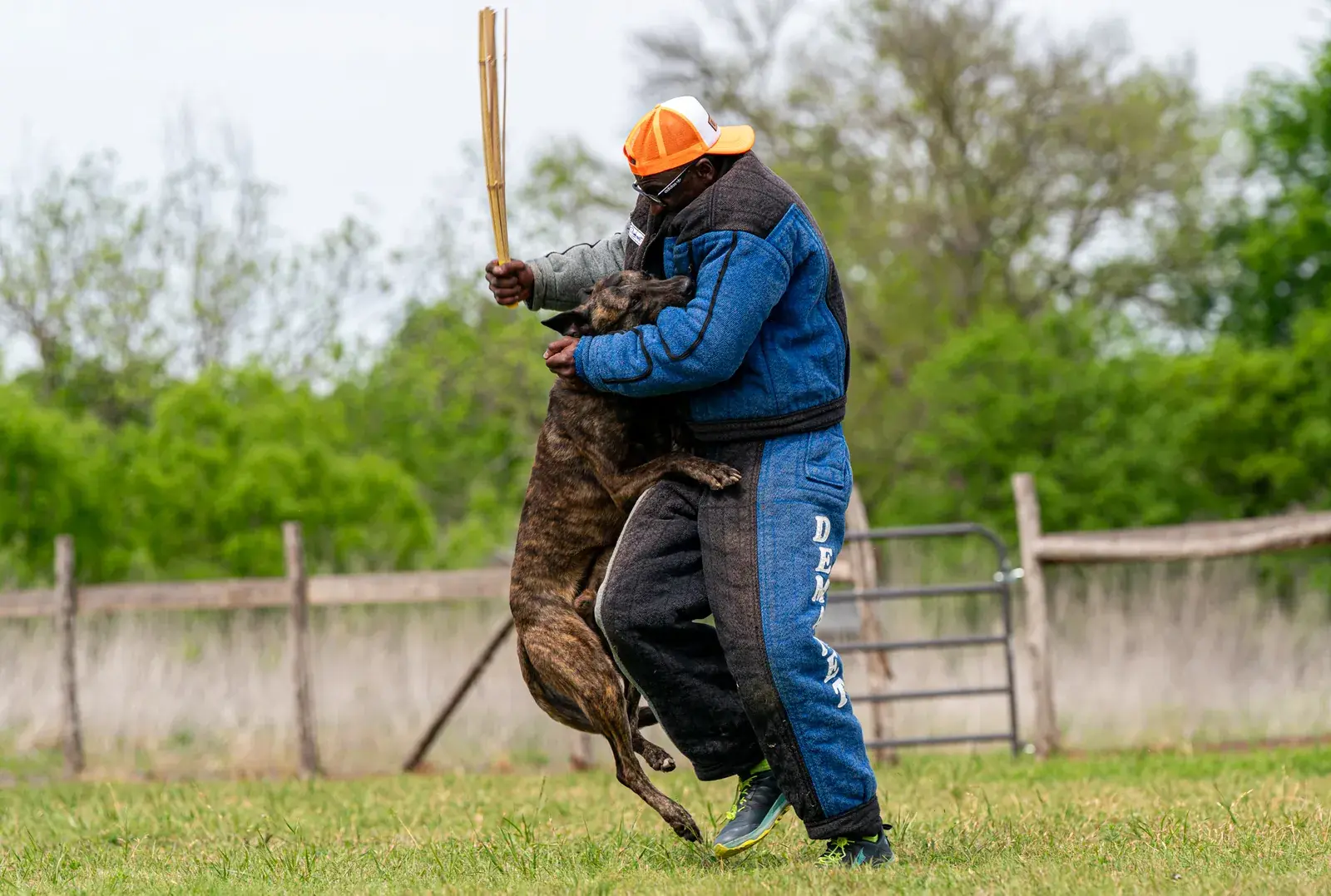
Whether the dog came for you or came for the suit is the one thing a suit is worst placed to settle, being a large obvious object handed to the dog in the first place. So we gave it a page of its own: what a dog does when the equipment comes off, and the muzzle work that proves it.
Everything a seller shows you happens during the work. What determines whether a dog can live in a family home happens after it. We call that recovery: what the dog does in the minutes once the pressure has stopped. It is the least photogenic part of any demonstration and it is the part we watch hardest.
Good recovery has a shape you can learn to see. The dog outs and comes off still switched on — that part is fine and expected. Then the breathing changes. The eyes come off the decoy and go to the handler. It takes a known command, properly, rather than after three repetitions at increasing volume. It can take food. It can be handled — collar, harness, a hand down the ribs — without stiffening. Give it a little longer and it lies down, and stops tracking the decoy around the field. Somewhere in that sequence the dog stops being a working dog and goes back to being a dog, and you can watch it happen.
Bad recovery has a shape too. The dog comes off and stays at the top. It will not take a command it knows perfectly well. It cannot take food. It leans into the lead and scans. Sometimes it redirects — onto the leash, onto the handler’s leg, onto whatever is nearest — which gets excused as enthusiasm and is not. And sometimes it looks calm and is not: the body has come down, the head has not, and the dog is quietly still working the problem. That last one is the version that fools buyers, because from ten feet away it photographs as a calm dog lying down.
Here is why we weigh this more heavily than the bite. In a house, almost nothing that raises a protection dog turns out to be a real event. It is a doorbell. A delivery. A neighbour’s kid coming over the fence after a ball. A friend arriving late and knocking harder than usual. The dog gets up, its arousal goes up, and the situation resolves into nothing at all — and that happens over and over for the life of the dog. The minutes that decide whether a dog is safe in a family home are not the ones during. They are the ones after, while a dog that was ready is standing in a room your children are also standing in. A dog with clean recovery is boring in those minutes. A dog without it is a management problem for as long as you own it, no matter how it looked on a field.
Use that list on us. It is written to be used on any seller, and a seller who is reluctant to let you watch the boring end of a session has told you something more useful than the session did.
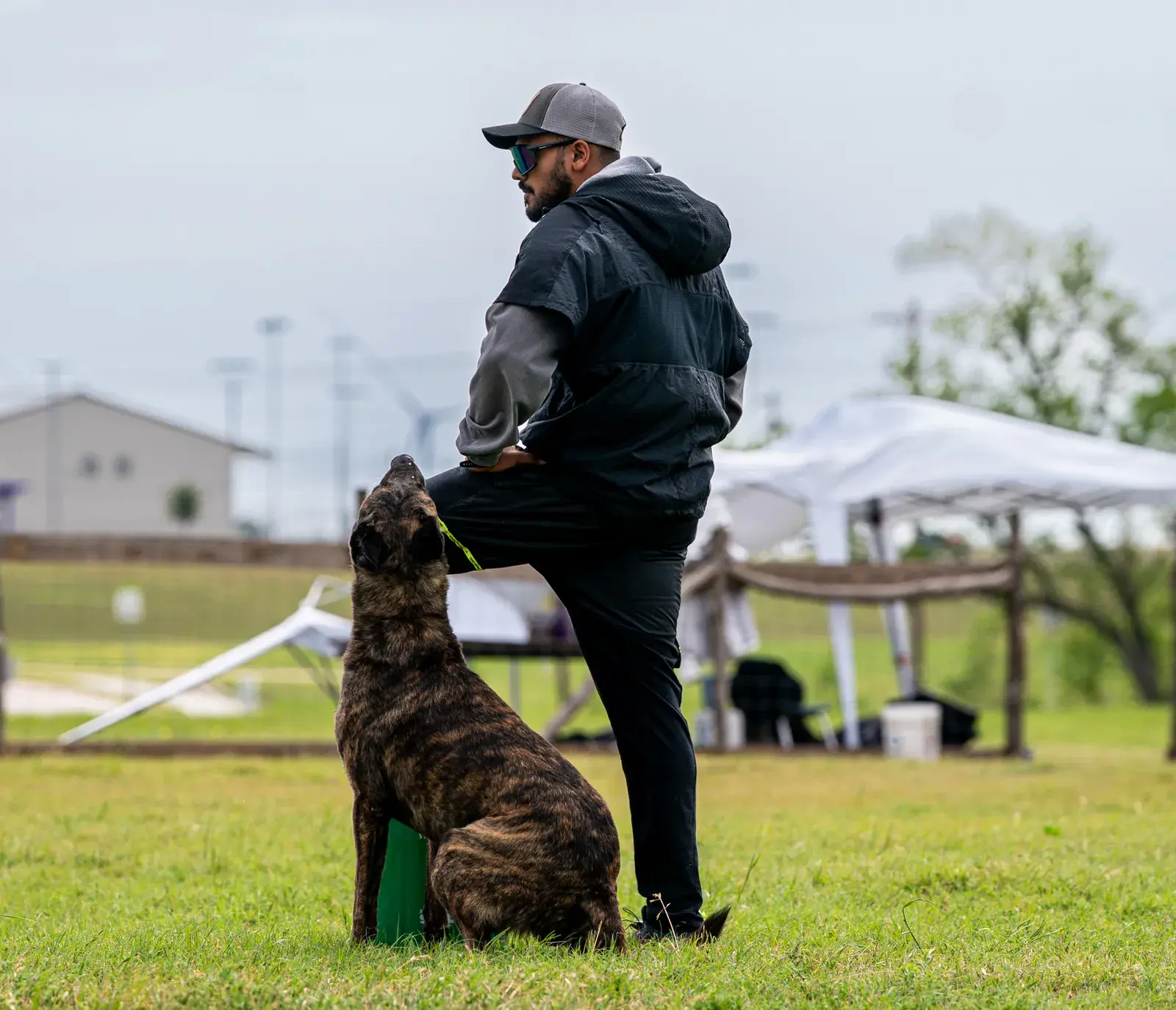
It guards by watching: this breed registers who and what it has seen before, which gives you warning rather than reaction. Coming down and letting go are two different processes, and this breed does them at different speeds. The physical part it usually does well — that is one of the real reasons it suits a household. The second part is where it differs from the other two breeds we place. Context sticks: the place, the person, the sequence of events, and how the last one ended. The dog files it.
Handled properly that is among the best things about the breed. It tends to register a repeated presence — the same vehicle on the street, the same person at the same corner — before the household does, because it already has something on file to compare against. You get warning instead of reaction, which is the entire argument for a dog over an alarm.
Handled carelessly, the same trait produces a dog that has made up its mind about a person or about a corner of your property, and a decision is far easier to make than to unmake. The everyday version is the visitor who got a reaction the first time and a stronger one the second, because nobody dealt with the first. The dog was not escalating out of nowhere. It was building on a file you let it open.
None of that is exotic or unmanageable. It just has to be somebody’s job. If the honest answer is that nobody in your house is going to do that job consistently, this is the wrong breed for you, and we would rather say so on a web page than on a delivery day.
It can be, in a household where all four of these are already true before the dog arrives. Read them as a set rather than a menu: the households where this breed does best are not the ones that satisfy one of the four.
The truck, the job site, the errands, the kids’ practice. This breed does its best work as a dog that is present for your ordinary week rather than one collected from a kennel for demonstrations. Exposure is also what keeps the memory trait useful instead of narrow — a dog that has seen a hundred unremarkable strangers files strangers as unremarkable.
Not a household that agreed to a dog, a person who wants to handle one. That adult sets the rules, does the daily obedience, and decides what happens at the front door. Everyone else can love the dog. Someone has to run it, and the dog will work out who that is inside the first weeks whether you assign it or not.
Not a locked-down house — a deliberate one. Visitors get introduced or the dog gets placed. Trades get crated. The same routine happens the second time that person comes, and the third. That is a few seconds of work per visitor, and it is most of what stops this breed’s memory from hardening into a grudge.
People arrive here after deciding a Malinois is more dog than their week can absorb. Sometimes that is right. This breed can give you working-line capability with a little more margin for the ordinary mistakes of a busy household — provided you understood that “a little more margin” is not the same as “less dog”.
The first of those four is the one you can actually watch: twenty unremarkable seconds of a Dutch Shepherd holding a down-stay at a downtown intersection while its handler takes a phone call — buses, crossing signals, strangers on the sidewalk, and nobody paying the dog any attention at all.
Every one of these is a household that would have been fine with a different dog, or with no dog. The failures below are not the breed being difficult. They are the breed doing exactly what it was bred to do in a place that had no use for it.
A fence, an empty house, and no job. The alertness that makes the breed useful stops having anywhere to point and turns into suspicion of everything that passes. What you get is not a guard dog, it is a dog that has taught itself that barking works, in a home where nobody is present to tell it otherwise. If you want something to leave outside unsupervised, buy lighting and cameras.
It is family-friendly the way a working dog is family-friendly: the work is still in there, and it is still your responsibility. The phrase describes what the dog is safe around, not how little it needs. Every household that has struggled with one of these read that sentence the other way.
Constant, unmanaged traffic is the specific environment this breed handles worst — a short-term rental, a business run out of the house, a rotating cast of strangers nobody introduces. Its instinct is to keep score, and you are asking it to keep score on a crowd. A German Shepherd absorbs that environment far better, and we would tell you so.
It is a real reason people choose this breed and a terrible one. Scarcity is not a temperament. If the appeal is that fewer people at the park will know what it is, you are buying a coat, and there is a whole market waiting to sell you exactly that at a premium.
If two of those describe your house, say so on the first call. We would far rather have that conversation before a dog is involved than have it as the question everybody puts off for months while it gets worse.
The comparison people search for is Dutch Shepherd versus Malinois, and the honest answer is that it is frequently the wrong question. In the working population the two have been bred to each other for decades. The difference between two individual dogs standing in front of you will routinely be larger than the difference between the breed averages you have been reading about. Anyone who hands you a clean, confident list of differences is describing a stereotype, not a dog.
Tendencies are still real, and here is ours — felt rather than researched. Between repetitions, the Malinois is more likely to be doing something. The Dutch Shepherd is more likely to be watching. That is a difference in ambient intensity rather than in ceiling, and ambient intensity is precisely what you live with: it is the difference between a dog lying in the kitchen while you cook and a dog that needs a job before you can cook. It is why we point some families here. It is not a reason to expect less dog.
If the choice is still open after that, stop comparing breeds and compare households. Where each of the three actually wins is settled by who is handling the dog, how full the week is, and how much traffic the front door takes — which is the version of this comparison that changes anybody’s mind.
You want the deepest talent pool and the highest ceiling, and you genuinely enjoy training rather than tolerating it. More people breed Malinois seriously for this work than any other breed, so at the top end there is simply more to choose from. The cost is that the drive does not switch off because you had a long day.
This is your first serious protection dog, or your household is busy and imperfect. It forgives handler error, it does not file people the way this breed does, and it is content to be off duty. For a large share of the families who call us asking about Dutch Shepherds, this is the better answer, and saying so costs us money.
You want working-line capability, you will do the work, you want the dog with you rather than kennelled, and you would rather live with a dog that watches than a dog that paces. That is a narrower brief than the other two, and when it fits, it fits better than either.
The one comparison worth making yourself is not between breeds at all. Put two individual dogs side by side, ask both handlers the same questions, and watch both dogs after the work rather than during it. That will tell you more than any breed page, including this one.
An evaluation is not a demonstration. A demonstration is designed to show you what a dog can do; an evaluation is designed to find out what it cannot. We are looking for the edge of the dog, and the fastest way to find it is to stop cooperating with the exercise.
Most dogs that do not make it fail on one of the following. None of them are exotic, and several of them are things a buyer standing at the fence would have read as a strength.
The most common reason we walk away, and the hardest to see from outside the suit. The dog is convincing on its own field with its own decoy running the pattern it knows. Change one variable — the surface, the light, the person, the order of events — and what looked like confidence turns out to have been momentum.
Some dogs come down beautifully, and then you notice the handler has been quietly working the whole time to bring them there. If the handler is the off-switch, the family is buying the handler, and the handler does not come with the dog. We want to see the dog do it.
A dog that puts its mouth on the lead, the leg, or whatever is closest when it is frustrated or thwarted. It gets described as intensity. In a house with children it is not a training problem to be solved after delivery, it is a reason the dog does not go to a house with children.
A dog that argues with the person who is supposed to be able to end the situation. Hardness toward a decoy is a working trait. Hardness pointed back down the leash is a different animal, and the family that finds out about it is the wrong party to be finding out.
A dog whose entire record happened in one location with one person is not an evaluated dog, it is a rehearsed one. That is not necessarily the dog’s fault and it does not always mean the dog is bad. It means nobody knows yet, and nobody should be selling it as though they do.
Enormous on the field, and in a house a week later still pacing, still unable to switch off, still unsettled by a normal evening. Protection is the smallest fraction of what this dog will actually do for you. The rest of it is living in your home, and a dog that cannot do the rest of it is not a family protection dog regardless of what it can do in the suit.
None of this is dramatic. Turning down a dog is usually a quiet decision about something small, made by two people who are also fathers and who apply a simple test at the end of every evaluation: would this dog go into our own homes? A seller who cannot tell you what would make them pass on a dog is not evaluating dogs. They are moving them.
Tell us about your household and what you actually need the dog to do, and we will be straight with you about whether a Dutch Shepherd is the answer — including if the answer is one of the other two breeds, or a puppy you raise yourself, or no dog at all. Some of these calls end that way, and that is a normal outcome here rather than a failed one.