How Are Protection Dogs Trained?
In our view, training a protection dog is mostly control, not the bite. Here are the stages a serious program moves through, what the sport and police rulebooks say about several of them, and what to ask the person who trained the dog you are looking at.
How Protection Dogs Are Actually Trained
Protection dogs are trained in overlapping stages: a dog is selected for nerve and drive, taught as a puppy to love gripping a tug, given obedience that holds while it is excited, developed on equipment by a decoy who adds pressure as it matures, proofed in places that are not the training field, and taught to release and stop on one command. The last stage is teaching the family to handle it.
In our view, from the suit, the bite is the part people over-weight. Obedience, proofing, the out and call-off, handler training and the gradual way pressure is added are all about control or about making the work travel, and they are what separate a dog that bites hard from one that bites hard, lets go the first time it is told, ignores a man it was not sent at, and does all of it in a dark parking garage for a handler it met last month.
Protection Dog Training Stages, In The Order They Start
“In the order they start” is deliberate. Obedience never finishes, grip work carries on for the life of the dog, and proofing begins in a small way the first week a puppy is taken somewhere new. What changes is which stage the time goes into. Each one is also a filter: a dog can stall at any of them, even after selection, and a program that never turns a dog away at any stage should be able to say why.
1 — Selection
Choosing a dog, or a litter, whose nerve, drive and recovery make the rest possible. Training shapes what is there far more than it adds what is missing.
2 — Foundation Play
Rags, tugs and pillows with a puppy. The goal is a dog that loves to grip, grips with its whole mouth, and believes it wins.
3 — Obedience
The steering. Built calm first, then rebuilt with the dog excited, because obedience that disappears when the dog is aroused is not control.
4 — Grip Development
Turning a playful bite into a full, firm, calm one that holds under the decoy pushing, pulling and threatening.
5 — Pressure, Gradually
Moving a mature dog from a game it is winning toward a confrontation it is comfortable staying in. Prey first, defence later.
6 — Real-World Proofing
Taking every behaviour off the familiar field: new ground, buildings, vehicles, noise, darkness, different decoys, clothing instead of equipment.
7 — The Out And The Call-Off
Release on one command, stop on the way in, guard without biting. The control that makes the rest safe to live with.
8 — Handler Training
Transferring all of it to the person who will actually live with the dog, in the place the dog will actually live.
Genetics And Selection: Training Starts Before The Dog Does
Start with the uncomfortable part. In our experience, nerve is largely set by genetics and early experience, and training mostly builds confidence on top of what is already there. Bad handling can wreck good nerve, and a dog that startles and stays startled, or that meets pressure by trying to leave, will spend its whole career one bad moment away from a fear bite. That is why the first stage is a decision rather than a lesson.
The RCMP, which breeds its own police dogs, selects its studs “based upon performance, health and genetics,” and most of those studs are working police dogs themselves. Its list of what a candidate must show reads like a trainer’s wish list: an even temperament with “consistent positive behaviours in a wide range of environments,” a “keen hunting instinct,” and a dog that can “respond to positive reinforcement.” The list describes a sound, keen, trainable dog.
What selection actually looks at. Whether the dog recovers quickly from a sudden noise or a dropped object, and goes back to investigate it. Whether it walks onto a slick floor, a grate or a wobbling surface after a moment’s thought. Whether it wants to chase, catch and keep a moving object, and keeps wanting it after the object stops being new. Whether it is social and neutral with strangers rather than either clinging or suspicious. And, in an adult, whether it can take pressure from a person and keep its head. Those are the raw materials. Breed shifts the odds — our breed comparison covers how — but the individual dog decides.
Our own version of this is on film. In our introduction video, the line is that “for selection we look for extreme levels of confidence, and we rigorously test the dogs to see how they hold up,” and that a dog lives in one of our homes before it is around anyone else’s family. For the puppy route, the Build Your Own Pup program starts with us evaluating the puppy’s temperament, nerve and drive ourselves before it comes home to you. How often puppies from any source fail to make it, and why early tests predict less than people hope, is set out with the research in our guide to raising a protection dog puppy.
Puppy Foundation: The Grip Starts As A Game
Bite work with a young dog does not involve a decoy acting like a threat. It involves a rag on a string, a flirt pole, a soft tug, and later a bite pillow — a small padded target with handles that a puppy can get its whole mouth around. The trainer makes the object move like something worth catching, lets the puppy catch it, and then lets the puppy win.
Winning is the whole lesson. A puppy that is allowed to carry the rag off in triumph learns that gripping works and that the contest ends in its favour. That belief is what the adult dog will draw on when a man is pushing back against it. A puppy that keeps losing the tug, or is overpowered by someone playing too rough, can learn the opposite, and in our experience that lesson is slow to undo.
The mouth is shaped early. A puppy can be encouraged to bite deep rather than nip with its front teeth, simply by where and how the tug is presented — low, still for an instant at the moment of the bite, wide enough to fill the mouth. Equally, a puppy can be taught to chew and regrip by a trainer who jerks the tug around constantly. In our experience, grip habits set in this stage often carry into the adult dog, good or bad.
And the dog learns to give it back. The first outs are taught here, in play, long before they matter: the tug goes dead and boring, the puppy lets go, and the game restarts immediately with a second tug or the same one. The puppy learns that releasing is how the game continues, not how it ends. That is the seed of the most important behaviour in the whole program, planted when the stakes are a rag. The adult version of that release, a dog that releases a suited decoy and sits watching him, is in Turbo’s send and bite-out film.
Alongside the play runs everything the puppy guide covers: socialisation, household manners, crate, car, vet. The RCMP’s own imprinting program pairs “Socialization” — “promoting a neutral behaviour and being comfortable with other animals, people, places and activities” — with familiarization, informal obedience, tracking, and “Prey and defence drives,” all before formal training begins. A protection prospect is raised as a confident, neutral dog first. The protection comes later and sits on top of that.
Obedience Is The Steering, Not A Separate Course
People picture obedience as the boring part before the protection starts. In a protection dog it is the part that makes the protection safe to own, and it is taught twice. First calm: heel, sit, down, stay, recall, place, built with food or a toy and a marker word that tells the dog the exact instant it got it right. Then again with the dog excited, near equipment, near a decoy, with its drive switched on. The second version is the one that matters, and it takes far longer.
The reason is simple. A dog in drive is a different animal from the one that sat nicely in the kitchen. If the down only works when nothing interesting is happening, the down does not exist at the moment you need it. Good programs use the dog’s drive as the reward for the obedience — a perfect heel earns a bite, a clean down earns the chance to go — so that control and engagement stop competing and start paying for each other.
On harsh corrections, one study is worth knowing. A study of 33 Belgian military dog teams, filmed doing obedience and protection exercises, found that “low-performance dogs received more aversive stimuli than high-performance dogs”, with leash pulling and hanging dogs by their collars the most common aversives. That is a correlation, and it can run both ways — a dog that is performing badly attracts more corrections — but the authors still recommended “more positive training methods” and more frequent training. The police world writes the floor into its rules: the USPCA certification disqualifies a team for “extreme or abusive correction or treatment of a dog” or “loss of temper.”
The language does not matter. Plenty of working dogs are trained in Dutch or German. That is habit and history, not a security feature. PSA’s rule book says flatly that “Commands may be given in any language.” What does matter is that the word is always the same word: PSA penalises a handler who changes the command mid-exercise, because to the dog a different sound is a different instruction.
Grip Development: Full, Firm And Calm
Once the foundation is in, the grip is developed on a decoy’s equipment: a soft puppy sleeve, then a harder sleeve, then a suit. The FCI’s regulations for IGP (the sport once called Schutzhund, which has its own explainer) name the target in three words and repeat them exercise after exercise: a “full, firm and calm grip”. The same document asks that the dog “remain unimpressed and show a full, energetic and, above all, consistent grip.” It is a fair target for any protection program, whether or not its dogs ever see a trial.
Full means the back of the mouth, the molars, not the front teeth. Firm means the dog is pushing into the bite rather than hanging off it. Calm means it is not chewing, shaking its head about or letting go to re-bite. Each of those is information about what the dog is feeling. A dog that is sure of itself grips deep and goes quiet in the mouth. A dog in conflict — half wanting to engage, half wanting to leave — tends to grip shallow, chew and regrip, because it is never fully committed to any one bite.
That is why grip development is not only about the jaw. A decoy builds it by making the deep, committed bite the one that pays: a full grip gets the fight the dog wants and, at the end, the sleeve as its prize, while a shallow or chewing grip makes the game go flat. Then the decoy starts adding counter-pressure — pulling, lifting, driving the dog backwards across the field — and the dog learns that the answer to pressure is to push harder, not to let go. A dog whose grip holds when the man is fighting it has been through this stage. A dog whose grip is only full when the decoy is running away from it has not finished it.
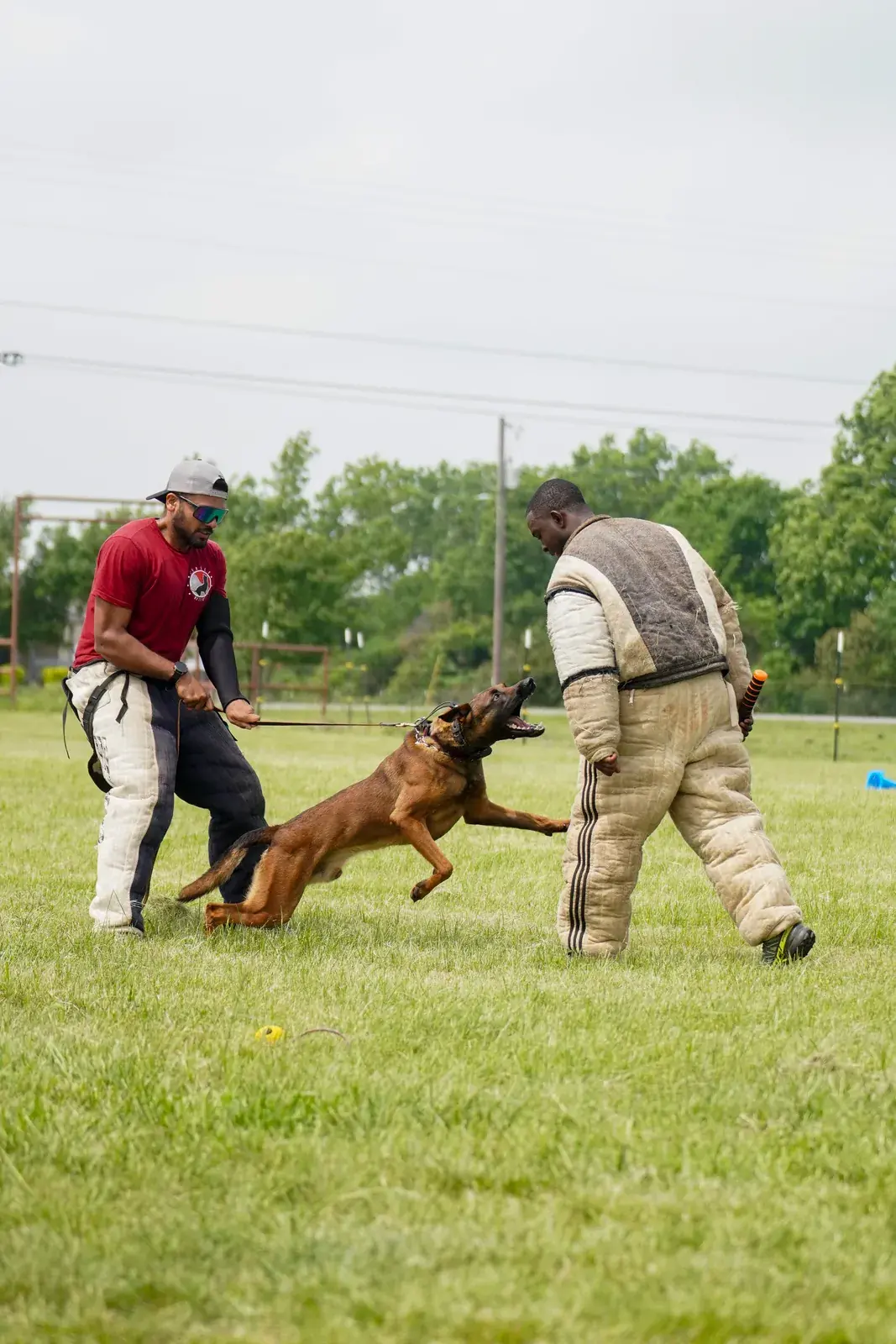
Equipment builds the grip and then has to be taken away; how that is done, and what it exposes, has a guide of its own.
The Decoy Is The Trainer The Dog Learns Most From
The handler holds the leash. The decoy decides what the dog experiences. How fast he moves, when he lets the dog have the bite, how hard he pushes back, when he goes still, when he turns a confrontation into a win for the dog — every one of those choices is a lesson, and a decoy makes dozens of them in a thirty-second session. A green dog with a skilled decoy improves fast. A good dog with a careless one can be soured on the work, or taught to bite the equipment and nothing else.
The clearest description of a training decoy’s toolkit is a list of things he is forbidden to do in a trial. On trial day, IGP’s helper guidelines bar “excessive offering the sleeve before the grip, verbal agitation, or hitting the soft stick against his pants”, a “limply held sleeve position,” and “independent termination when weakness is noticed in the dog.” Those bans come from specific exercises (the attempted escape and the defence during the guarding phase), and the FCI does not say why it imposes them. As we read them as trainers, though, they describe the help a young dog gets: offering the sleeve so it lands a clean bite (the trial only bars doing so excessively), using noise to wind it up, holding the sleeve soft so the dog wins easily, ending the session the moment the dog wobbles so its last memory is a success. In our reading, the trial removes that help to see the dog without it.
That cuts both ways for a buyer. The same techniques that build a young dog can make a finished one look better than it is in a demonstration, which is why reading a protection dog demo means watching the decoy as closely as the dog.
Both of us decoy, which is why we read dogs the way we do. Between us we have worked in the suit in sport, training, police K9 and family-protection settings, and we are listed as decoys on PSA trial schedules — the trials and dates are on our about page, linked to PSA’s own listing. What the suit teaches is things video cannot show: whether a dog is fighting the man or the equipment, whether its grip loosens the instant the pressure rises, and whether it can switch from fighting to guarding without simmering.
Prey Versus Defence, And Why The Order Matters
What prey and defence mean is laid out on the bite-without-a-suit guide. For training, the point is the order. In our experience, and in many sport programs, young dogs are built mostly in prey, because that is where confidence and a full grip come from; some programs introduce defence earlier. Real pressure from the decoy — a threatening posture, the man coming forward instead of running away — is added gradually, and only to a dog mature enough and sound enough to carry it.
Get the order wrong and the result is predictable. Put serious defensive pressure on an adolescent that does not yet have the confidence for it, and it either learns to avoid the work or learns to bite out of fear. Fear-driven biting looks impressive on a training field and is exactly the wrong thing to have in a family dog, because a dog biting from fear decides for itself when it is threatened.
Pressure is presented, not inflicted. The FCI’s stick threat is a useful illustration of how that works: the dog is “threatened by the helper with a threat of a blow without being touched or hit.” The test is whether the dog holds its grip and its nerve when a person looks and acts like a threat, not whether it can absorb punishment. PSA writes the welfare floor into the rules too: a team is dismissed if the dog is judged to be “avoiding the grip out of fear” and refuses to engage at all, “above all” so as not to cause the dog psychological trauma.
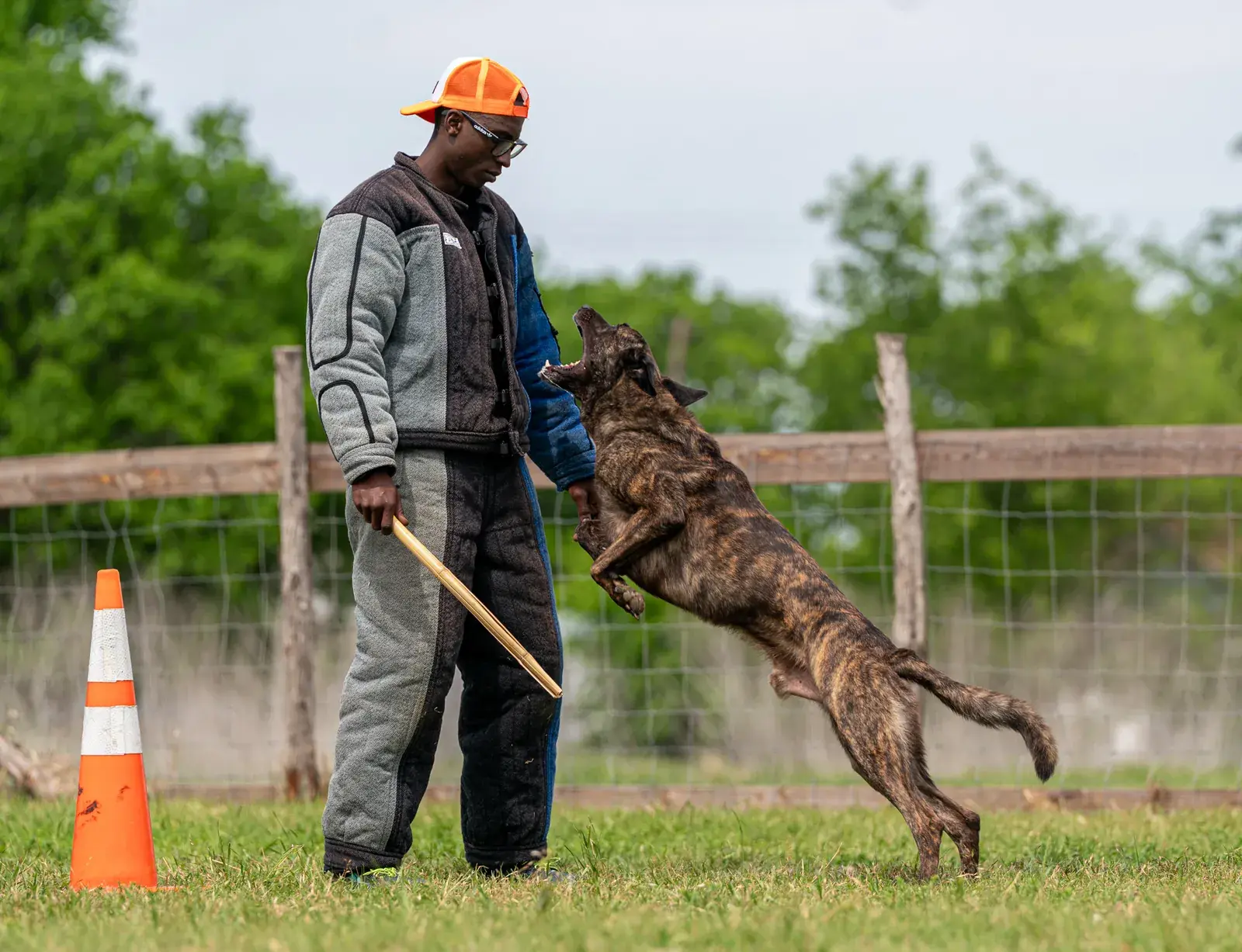
The end point of this stage is a dog that stays in a confrontation because it is comfortable in one, and that comfort is what carries over once there is no sleeve to aim at.
Real-World Proofing: Making The Training Travel
Dogs are brilliant at learning a place. Train every session on the same field, with the same decoy, in daylight, and the dog learns that protection is something that happens on that grass, against that man, at that time of day. Proofing is the slow work of breaking that link — one variable at a time, so the dog is never asked to cope with everything new at once.
The variables are the ones real life throws at you. Different ground: tile, gravel, stairs, a slick shop floor. Different spaces: a hallway, a garage, a doorway the decoy steps out of. Vehicles, inside and out. Noise, crowds, darkness, rain. Different decoys, with different builds and habits, wearing clothes rather than an obvious sleeve. And the reverse test, which matters as much: the dog walking calmly past the hundreds of people who are not a threat. The RCMP calls the early form of this “Familiarization,” defined as “promoting a confident behaviour when exposed to a variety of surfaces, obstacles, buildings, etc”.
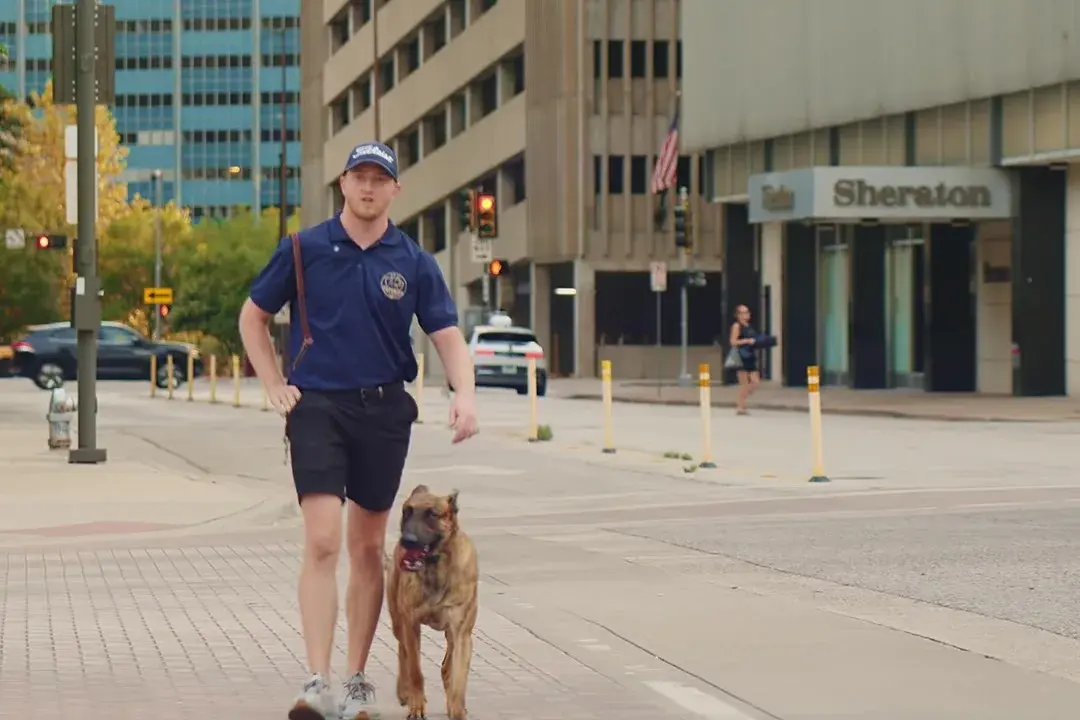
Police certification shows what proofed work is expected to look like. The USPCA’s Patrol Dog I test, which is for law enforcement handlers and their dogs, requires that any sleeve or suit be “covered or concealed by a garment, which shall cover the upper torso of the decoy”, and includes an apprehension under gunfire, with the decoy firing blanks as he runs. The obedience and the apprehension both happen off leash.
For a family dog the most important proofing is often the least dramatic: a down-stay that holds on a busy sidewalk, a heel through traffic, a dog that ignores a jogger. Our street control film shows a Dutch Shepherd holding a down at a live downtown Dallas intersection while its handler takes a phone call. It is also part of what we publish about our fully trained dogs: temperament testing that takes place “out in public around strangers and children,” not only in protection training. The full list is on the fully trained program page.
The Out, The Call-Off And The Guard
The veterinary definition is a good place to start. The American Animal Hospital Association’s working-dog guidelines describe the protection dogs used in criminal apprehension this way: “These dogs are not ‘attack’ dogs but are trained to bite and hold (and release) an individual as a method of restraint.” The words in brackets are the hard part, and they are what separates a protection dog from a dangerous one.
All three rulebooks quoted on this page treat an out that has to be forced as a serious failure, though the thresholds differ. In IGP, a dog that ignores the first release command can be given a second and a third, with the score dropping at each, and no out after the second extra command is a disqualification. PSA allows three commands, five seconds apart, counts any correction or step toward the dog as another command, and dismisses a dog from protection if it needs “a 4th command or physical means”. The USPCA police test says a team “may not certify if the physical removal of the K-9 was necessary” in its three scheduled apprehension exercises, while a removal in the handler-protection phase is a 10-point deduction instead.
How an out is built. It starts with the dead-tug game from stage two and grows up from there. The decoy stops all movement, so the bite stops being rewarding; the dog releases; and the release is paid — with another bite, a toy, a chance to guard. The IGP helper rules describe the decoy’s half of this exactly: when the exercise ends he must “reduce the stimulation by definitively not moving the sleeve,” and must stand still during and after the release. Only once the out is reliable in that easy form is it asked for in harder ones: with the decoy still moving, after a long hard fight, from a distance, in a new place. An out that only works after a gentle bite is not finished.
The call-off is harder still. Here the dog is sent at a decoy and recalled before it arrives. PSA’s rule book gives the total call-off distance as 50 to 80 yards (a later passage says 50 to 80 feet) and requires the recall at or beyond a halfway “point-of-no-return cone”, with more points the closer the dog gets before the handler calls it, and the rule that the dog “may not place teeth on the decoy.” The USPCA police test has its own recall exercise, plus a “false start” in which the decoy runs and the dog must stay put on one command. The practical meaning for a family is the one that matters: if you send the dog and then realise the person is not a threat, the dog has to turn around in mid-air.
The guard. After an out, the dog does not wander off. It stays close, watching the person, without biting unless that person moves to attack or run. In IGP the dog must guard “with attention, confidence, and high dominance” while the helper stands still. Guarding without biting is what lets a handler step back, think, and decide — which is the point of having a trained dog rather than an angry one. The out that makes the guard possible is also the behaviour most prone to slipping without practice, which is why the first-90-days guide lists an out turning into an argument among the reasons to call.
Handler Training: The Last Stage Is You
A dog trained to a high standard by a professional is trained to that professional: his voice, his timing, his body language, the way he holds the leash. Move it to a new owner and some of that work has to be rebuilt around a different person. It is also the stage most easily skipped, because it cannot be done by shipping the dog.
The rulebooks show how much the handler matters. PSA deducts points for “handler help” — turning into the dog to help it sit, touching it once a scenario begins — and for changing the wording of a command midway. Both are easy habits for a new owner to fall into. Neither is a moral failing; both cost precision, and a protection dog runs on precision.
This is the one stage of our own process we describe here, because it is published on the fully trained program page: the handover is done in person, at the family’s home, by us. The session rebuilds this page’s stages around new handlers — who gives which command, what the dog may and may not do, how the out and the off-switch work — until the dog answers someone other than its trainer. With Build Your Own Pup the handler training runs the whole way through, because your family raises the dog under our guidance from the start, through obedience and then age-appropriate protection development. Where the handover sits in buying a finished protection dog is covered on its own page.
The USPCA, for one, treats certification as perishable: a Patrol Dog I certificate is “good through December 31st of the following year,” and the association encourages annual recertification.
How Long Does It Take To Train A Protection Dog?
No honest answer fits in one number, because the clock starts at selection and the stages overlap. Sport bodies and police forces publish minimum ages and program lengths, and we collected them, with their sources, in the timeline section of our puppy guide. None of those published figures treats a puppy as a finished dog.
For our own fully trained dogs, the figures we publish are these: time in training with us runs from four to sixteen weeks, depending on what a family needs the dog to do, and we ideally place dogs between eighteen months and four years old — old enough that the dog is who it is going to be. Those weeks are the end of a much longer process, not the whole of it. What a finished dog can and cannot do, and why the “level 1, 2, 3” language you will see elsewhere is not a standard, is on our training levels page.
Five Questions About How A Dog Was Trained
These test the process rather than the dog, which makes them hard to answer with adjectives. Ask them of anyone, including us.
- Who decoys your dogs, and how many different people has this one worked against? A dog that has only ever met one decoy has learned one man’s habits. The answer tells you whether proofing happened.
- What was the grip built on, and what does it look like now? Anyone who has done the foundation can describe it. A full, quiet grip is visible on video; a chewing, front-of-the-mouth grip is too.
- How was the out taught, and what happens on a second command? You want a method, not a reassurance. If the honest answer involves a lot of pulling the dog off, you have learned something.
- Where has this dog worked that is not your own property? Proofing is the stage most easily claimed and least easily shown. Specific places are an answer; “everywhere” is not.
- What does the handover consist of, and who teaches my family? The last stage of training happens in your house. If nobody is coming to do it, it is not happening.
If you are still deciding whether a trained dog makes sense for your household at all, start with that question before this one.
Every Rulebook Quoted On This Page
Five rulebooks and guidelines, plus one study abstract, each opened at the rule or sentence quoted above. The training craft between the quotations, and anything marked “in our view” or “in our reading,” is our own account from working in the suit rather than something these documents say.
- FCI — International Utility Dog Regulations (IGP), 2025 — Grip criteria, the stick threat, the helper guidelines and the out scoring table, from Phase C (Protection).
- PSA K9 — Official Rule Book (2025–2026) — The three-command out, the five-second rule, the call-off scenario, command continuity and the fear-dismissal rule.
- USPCA — General Rules and Definitions Governing Certification, Patrol Dog I — A police certification: covered sleeves, the recall and false start, gunfire, physical removal, abusive correction, expiry.
- AAHA — 2021 Working, Assistance, and Therapy Dog Guidelines — The veterinary definition of what a bite-trained police dog is for.
- Royal Canadian Mounted Police — Our police service dogs — How studs are chosen, what the imprinting programme covers, and the traits a candidate dog must show.
- Haverbeke et al., “Training methods of military dog handlers and their effects on the team’s performances,” Applied Animal Behaviour Science 113 (2008) — Abstract, via the FAO AGRIS record. 33 Belgian military teams, filmed in obedience and protection work.
Checked against these editions on 8 October 2026. PSA and the FCI reissue their rules, and an out or call-off rule is the kind of detail that changes between editions; if a newer one says otherwise, we want to hear it.
When We Publish Something Worth Reading
No sequence, no drip, nothing automated. One email when we have written something a buyer would actually use — which is a handful of times a year, not a handful of times a month. Leave and we stop.
Ask Us About Any Stage
We are based in Dallas–Fort Worth and deliver in person across Texas and nationwide. If you are weighing a dog, ours or anyone else’s, bring the seller’s answers to the out and proofing questions above and we will tell you which stage they leave unexplained.