
Sport Titles vs Real Protection
Somebody has shown you a scorebook, or a line in an email that says IGP 3, and you do not know what it buys you. Here is what each of these titles certifies, read out of the governing body’s own rulebook, and what happens to it on the way to your front door.
Does An IGP Title Mean The Dog Will Protect You?
No. A sport title certifies that a dog passed a scored routine on a marked field against a helper working to a rulebook. It proves nerve, trainability and control under pressure. It does not certify behaviour in your home.
That is the honest answer and it disappoints people, so it is worth saying what it does not mean. It does not mean the title is decoration. A title is the only claim in this entire market that was decided by somebody with no financial interest in the answer, and further down this page we are going to argue that it makes a titled dog the safer purchase more often than not. But the thing being certified is a performance, on a field, inside a rulebook — and the gap between that and a Tuesday evening at your own door is real, measurable, and almost never explained to buyers.
The gap is also not the same width for every acronym. An IGP protection routine is sleeve work and the rules disqualify a dog for gripping anywhere else. A French Ring Brevet contains food refusal, muzzle work and gunfire. A PSA upper level is written specifically so the dog cannot have drilled the sequence. Those are three very different pieces of evidence, and they get flattened into the single word “titled” by sellers and buyers alike. So take the acronym apart first.
We write this from a particular seat. Both owners of this company are listed decoys at PSA-sanctioned trials — the decoy is the person in the suit taking the bite — which means the dogs described on this page have been felt rather than watched. The 3 trials we are listed on, and the organisation’s own listing for them, are on our about page, so you can check the credential behind this page rather than take it on faith.
What Each Title Actually Certifies
Everything quoted below comes out of the governing body’s own published document, and each card links to the document it quotes. Where a body keeps its regulations behind a members’ area, the card says so instead of guessing. This is deliberately dry. The whole problem with title claims in this market is that nobody reads the rulebook, and the rulebooks are more interesting than the marketing.
IGP
The FCI international utility dog trial — the sport many American buyers still call Schutzhund, renamed IPO and then IGP.
Awarded under the Fédération Cynologique Internationale and administered through its national member organisations.
Three levels, and the rulebook says the dog “must achieve at least a satisfactory result in 3 phases (A tracking work, B obedience teamwork, C protection)” — 100 points per phase, 300 in total, with 286 and up scored Excellent. The levels “must be completed in order (levels 1 – 2 – 3)” and each requires at least a satisfactory rating, 70%, in every phase of the level below. A companion dog test with a traffic part, the BH/VT, is a prerequisite, and a dog cannot enter IGP 1 before 18 months old.
What it tells a buyer. Two rules matter more to you than the score. First, protection is sleeve work: “the dog is allowed only to grip the provided protection sleeve. Biting other unprotected body parts of the helper leads to immediate disqualification (DQ).” Second, the sport will not let anyone specialise into the bite — “Protection Only Trials (Only Phase C) are not permitted.” So an IGP 3 is a statement about a dog that also tracked and also worked obedience, on a sleeve, on a marked field with six blinds on it. That is a lot of dog. It is not a demonstration that the dog reads a person who is not wearing equipment.
FCI — International Utility Dog Regulations (FCI-IGP), effective 1 January 2025
PSA
Protection Sports Association — an American scenario sport, and the body whose trials we are listed on.
Awarded by PSA itself, which describes its mission as “an outlet for civilian competition in canine obedience and controlled protection” and dates its own founding to 2001.
There is a mandatory entry certificate, the PDC, before any competitive level. It runs in a sleeve division and a suit division, and a dog must hold the suit-division PDC before moving on. PSA 1, 2 and 3 each require the dog to pass obedience and protection in two separate showings — two legs — before the title is awarded. Unusually, decoys in bite suits are on the field during the obedience routine rather than only during protection.
What it tells a buyer. PSA is built specifically to defeat rehearsal. Its own description of the upper levels is the useful sentence: because “the scenarios can change from trial to trial in the upper levels, handlers must be able to train components of exercises, and pattern training is a virtual impossibility.” If a dog you are considering holds a PSA 2 or 3, somebody has demonstrated it can be handed a routine it has not drilled. That is the closest thing in any of these sports to the problem a family actually has.
KNPV
Koninklijke Nederlandse Politiehond Vereniging — the Dutch police-dog association.
Awarded by KNPV, in the Netherlands, on the certificate rather than on a title suffix.
We are going to be straight about the limit here rather than fill it in: KNPV publishes its examination regulations to its members, and the pages that once carried them publicly no longer resolve. So this card describes what we can put a link on and nothing else. What KNPV does expose to the public is the record — a certificate lookup that searches on certificate number, handler and the dog’s microchip number.
What it tells a buyer. Precisely because the record is public and keyed to a microchip, a KNPV claim is one of the easiest in this market to verify and one of the easiest to fake in conversation. Do not accept a photograph of a certificate. Ask for the chip number and the certificate number, then look it up yourself. A seller who cannot produce a chip number for a dog they say is KNPV-certified is telling you something without meaning to.
Mondioring
An international sport assembled from several national programs, run under the FCI.
Awarded under the Fédération Cynologique Internationale, through national organisations.
Three disciplines in a fixed order — “1 - Obedience exercises 2 - Jumping exercises 3 - Biting exercises” — worked in front of decoys in bite suits. Level I is 200 points, Level II 300, Level III 400. Moving up is deliberately slow: a dog qualifies out of Level I “by obtaining, twice, at least 160 points out of 200,” and out of Level II “by obtaining, twice, at least 240 points out of 300.” Level I can run with one decoy; Level II uses two; Level III uses two or three.
What it tells a buyer. Read the stated purpose, because it is unusually blunt about what the sport claims to measure: “to highlight the aptitudes of the dog, the quality of its training, the control of its handler, and especially, the genetic inheritance of the dog.” Mondioring is also where the decoy is most tightly regulated, which is the reason a Mondioring result is hard to flatter. More on that below, because it is the whole argument of this page.
French Ring
A French sport, run in North America by NARA, the North American Ring Association.
Awarded through NARA in North America, whose rules require every handler to be “a member in good standing with NARA, CRA, SCC, GTRM or their equivalent.”
A Brevet worth 100 points, then Ring 1 at 200, Ring 2 at 300 and Ring 3 at 400. A title is not one good day: “A dog must obtain 80% of the points in the level two times under two different judges for that level to have been obtained.” There is a demotion rule as well — two consecutive results under 60% within twelve months put the dog back down a level for a year.
What it tells a buyer. Look past the high levels and read the Brevet, because for a family buyer it is the most informative 100 points in any of these sports. It is heel on leash, food refusal, heel wearing a muzzle, an absence with the handler gone, a face attack, a defence of handler with two gunshots fired, and general allure. The dog needs 80 of the 100, plus at least 80% on each protection exercise, and “a dog who is scared of the gunfire during the Brevet will be immediately disqualified.” Food refusal, muzzle work and gunfire are three of the things you actually care about in a house.
AKC
American Kennel Club — a registry and a sports body, and not a protection credential of any kind.
Awarded by the AKC across its own event program.
The AKC runs conformation, agility, obedience, rally, and performance sports — field trials, hunting tests, herding, earthdog, scent work and coursing. Its Canine Good Citizen program is described as “a 10-skill test that teaches good manners to dogs and responsible dog ownership to their owners.”
What it tells a buyer. There is no AKC protection title, no AKC bite-work title, and nothing on the AKC event calendar that evaluates a dog against a decoy. If a seller reaches for AKC paperwork while making a protection claim, they are citing a body that does not test the thing being claimed — usually registration, which certifies parentage and nothing else. A CGC is a real and worthwhile credential. It is a manners test, and it is evidence about the part of the dog you will live with rather than the part you are being sold.
None of those is a personal protection certification, because no such thing exists. There is no body anywhere that tests a dog against the situation a family is actually worried about, which is why the vendor tiers on the level 1, 2 and 3 page exist at all: they are filling a hole in the world with a number.
Five Things A Title Genuinely Proves
Take these seriously. Each one is a thing that is difficult to establish any other way, and each one is a thing a demonstration on the seller’s own field is structurally incapable of showing you.
Nerve Under Real Pressure
A decoy at a trial is not on the dog’s team and is not trying to make it look good. The dog was driven, threatened, faced and worked by a stranger whose job that day was to find the bottom of it, and it kept working well enough to score. Nerve is the one quality on this page that training does not manufacture, and this is the only setting in which most buyers will ever see it tested by somebody with nothing to gain.
A Head That Clears
Trials are long, loud and scored across a whole routine. A dog that goes up and cannot come down loses points everywhere after the first bite — in the guarding, in the obedience that follows, in the next exercise. A high total score is therefore quiet evidence of recovery, which is the property you will care about most in year four and the one nobody demonstrates on purpose.
Work In An Unfamiliar Place
The trial is somewhere the dog does not live, in front of people it does not know, with other dogs on the grounds and a judge standing in the middle of the picture. That is the opposite of a seller’s home field, and it is the single environmental variable a demonstration on the seller’s own property can never remove.
A Trained Out, Under A Judge
IGP, Mondioring and French Ring all score the release, and score it while the exercise is still live rather than after everyone has gone quiet. A titled dog has released on command in front of somebody who was writing down whether it took one command or three. That is a specific, checkable claim about the off-switch, which is the expensive half of a protection dog.
A Trainer Who Can Fail In Public
Somebody entered this dog on a published date, in front of a judge, against a written standard, knowing the result would be recorded either way. That is a statement about the person who trained it as much as the animal. A vendor who has never entered a dog anywhere has never once had their work marked by someone who could say no.
And Five Things It Cannot Prove
How the dog behaves in a house. Not one of these sports has a kitchen in it. No trial scores a dog for lying under a table while people eat, for ignoring a dropped pan, for tolerating a toddler who walks into it, or for being boring for eleven hours a day. Those are the behaviours that decide whether a household keeps the dog or quietly stops taking it anywhere, and they are entirely outside the scope of every rulebook linked on this page.
How it reads children. A trial field is adults, at scale, moving in predictable ways. Children are small, fast, loud, erratic and low to the ground, and dogs generalise people badly. A dog can hold a perfect long down at 30 metres under a judge and still find a group of nine-year-olds running and shrieking arousing in a way that costs you an afternoon of management every single time it happens.
What happens at the door. Doorways compress everything — a stranger, a threshold, a handler with their hands full, no warning and no marked field. Nothing in any of these sports rehearses it. The dog’s behaviour when a delivery driver arrives is a training and management outcome you will build after the dog gets to you, and it is not on any scoresheet.
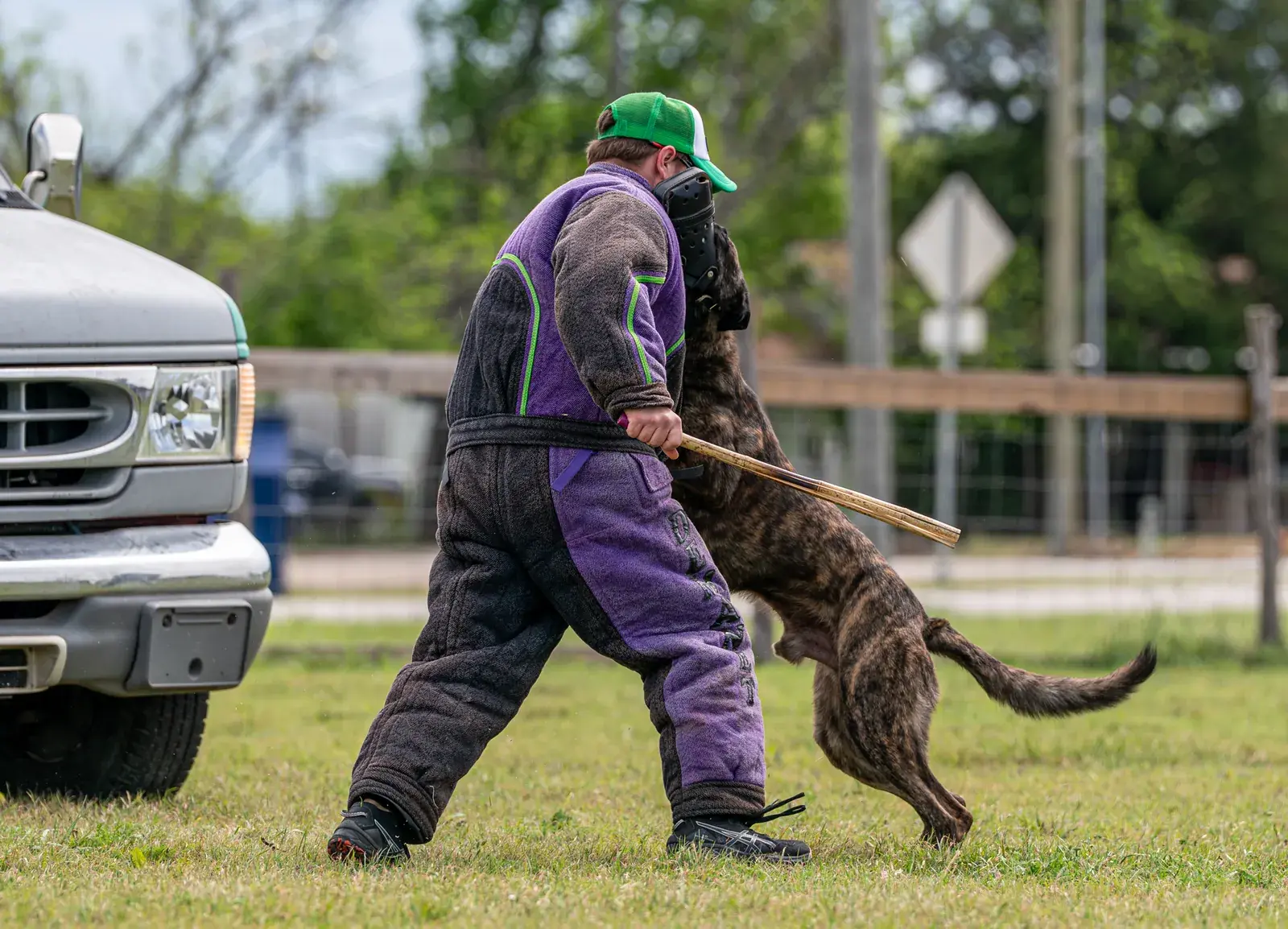
Behaviour with no equipment anywhere. IGP protection is sleeve work by rule. Ring, Mondioring and PSA are suit sports. Every one of those dogs has engaged, hundreds of times, a person visibly wearing something built to be bitten. A title says nothing at all about what the dog does when the picture it was paid on for three years is simply absent — and that question is big enough that we gave it a whole guide about reading a demo, because it is the single most important thing to test in person.
What the dog does without a pattern. Rulebooks are patterns by definition. The field markings are published, the exercise order is published, the distances are published. Smart dogs learn the sequence along with the exercise, and the sports know it — which is exactly why PSA says “the scenarios can change from trial to trial in the upper levels,” and why French Ring draws its running order at the trial itself: the NARA rules state that “There is a drawing of order for the exercises in each of Ring 1, Ring 2, and Ring 3.” Even so, a title is earned inside a structure, and nothing that happens to your family will arrive in order.
The Dog Has Only Ever Met A Man In A Suit
This deserves care, because it is where buyers overcorrect hardest. Equipment is not a flaw in these sports. There is no way to build a dog that bites full and hard without somebody being protected while it learns, and every serious program on earth runs on a sleeve or a suit for that reason. The question is never whether equipment was used. The question is whether the equipment became the point.
The rulebooks make the shape of the risk unusually easy to see. IGP is explicit that in protection “the dog is allowed only to grip the provided protection sleeve,” and that biting anywhere else on the helper is an immediate disqualification. Read that as a buyer rather than as a competitor: the sport is not merely permitting sleeve dependence, it is requiring the dog to be correct about the sleeve. A dog can hold an IGP 3 having never once made a decision about where to bite a person.
The suit sports narrow the gap without closing it. A full bite suit is a person-shaped target rather than an arm-shaped one, so a Ring, Mondioring or PSA dog has engaged legs, torso, shoulders and back, from angles a sleeve never presents. PSA additionally runs a hidden sleeve under clothing at PDC and PSA 1 level. French Ring puts a muzzle on the dog in obedience, which is a different kind of useful — it tells you the animal can work while wearing something it dislikes. All of that is real progress toward the problem. None of it is the problem.
What a good trainer does about it is unglamorous and mostly consists of removing one variable at a time. New decoys the dog has never worked. Clothing it has not seen. Hidden equipment under normal clothes. Ground it does not know — gravel, concrete, a stairwell, a parking lot at dusk. The handler moved out of the picture and made quiet. Sessions that end in the middle of the fight instead of at the dog’s strongest moment. The point of every one of those changes is the same: to find out whether the dog is working the man or completing a picture. That work is what separates a sport dog from a placeable one, and it is the substance behind the tiers people argue about on the training levels page and the reason a finished dog costs what it costs.
So the correct reading of a title is neither “this dog will protect me” nor “this is only a game.” It is narrower and more useful than both: this dog has proven nerve, trainability and an out, on equipment, under a stranger, away from home. Whether it has been bridged out of the equipment is a separate question with a separate answer, and the person selling it to you should be able to describe exactly how they did it. For a look at the out itself, there is a video of Turbo, a Malinois sent at a suited decoy who bites, releases and sits watching him.
Why A Titled Dog Is Often The Safer Buy Anyway
Everything above is a list of limits, so here is the part that matters more than the limits. A vendor demonstration and a sanctioned trial differ in one structural way that no amount of honesty on the seller’s part can fix: at a trial, the man in the suit is the constant and the dog is the variable. At a demo it is the other way around.
The rulebooks work hard at this and it is worth seeing how hard. Mondioring lays down three golden rules for the decoy, and the first is simply “The Decoy will be absolutely impartial.” The third is the interesting one — he must “behave as if he were not wearing a protective bite suit, and therefore, use promptness, deception, threats, and dodging.” The judge, meanwhile, “must take care that all exercises proceed in the same manner for all dogs.” IGP goes at the same problem exercise by exercise: the helper “must drive all dogs in the same direction,” and “the helper is to move at the same pace for every dog.”
Read those as a buyer and the point lands. Every one of those clauses exists to remove the decoy’s ability to make one dog look better than another. That is the exact ability a decoy at a sales demonstration retains completely — and we can tell you from the inside of the suit that the levers are many, subtle, and entirely invisible from where you will be standing. Feeding the bite. Taking the pace off at the last instant. Ending the exercise while the dog is still winning. None of it requires anybody to say a false word to you.
The sports then make the result hard to overstate afterwards. French Ring will not award a level until the dog has taken 80% of the points “two times under two different judges.” PSA requires two legs. Mondioring requires two qualifying scores before a dog moves up. Two judges, on two days, is a deliberate defence against a single flattering afternoon — which is precisely what a demo is. And the results are published by the organisation rather than by the seller, so the claim survives the sales conversation and can be checked after it.
That is the argument, and it is not a small one. A title is the only piece of evidence in this transaction produced by somebody who did not get paid when you said yes. It does not tell you the dog suits your house. It does tell you that a specific person with no stake in the sale watched this animal under pressure and wrote down what happened. Weigh it accordingly: not as a guarantee, and not as decoration, but as the one line in the file that a seller could not have written.
A Title Is A Threshold, Not A Score
Here is a gap in almost every conversation we hear reported back to us. A buyer is told a dog is IGP 3, writes it down, and never asks the obvious follow-up: with what score? The acronym is a pass mark. The number behind it is the actual information, and it is printed in the scorebook the seller is holding.
The FCI publishes the bands. An IGP trial is 300 points, 100 for each of tracking, obedience and protection. A total of 286 to 300 is rated Excellent. 270 to 285 is Very Good. 240 to 269 is Good. And 210 to 239 is Satisfactory — which is a pass, which earns the title, and which is what a great many dogs described to buyers as “IGP 3” actually scored. Nothing dishonest has been said. A 212 and a 291 are both IGP 3 dogs. They are not remotely the same dog.
The same applies within the protection phase alone, which is the phase you care about. Out of 100, the FCI scale runs 100 to 96.0 Excellent, 95.5 to 90.0 Very Good, 89.5 to 80.0 Good, 79.5 to 70.0 Satisfactory, and 69.5 down to zero Insufficient. A dog that scraped 71 in protection and carried the trial on a strong tracking score is a titled dog with a protection result you would want to know about before you flew anywhere.
Now compare the sports, because their pass marks are set in very different places. IGP will award a level at 70% of the points. French Ring will not: a dog must take 80% of the level “two times under two different judges,” and its Ring 1 qualification table puts Excellent at 160 to 200 out of 200, with anything under 100 not qualifying at all. Mondioring moves a dog out of Level I on 160 out of 200, twice, and out of Level II on 240 out of 300, twice. So a Ring 1 and an IGP 1 are not equivalently demanding pieces of paper, and treating “titled” as one category flattens a real difference in how much the dog had to do.
Ask for the scores. Ask for them per phase, not as a total. Ask how many attempts preceded the passing one — the FCI rules say plainly that “every trial level can be repeated as frequently much as desired,” so a passing score is not necessarily a first attempt and nobody is obliged to mention the earlier ones. None of that is an accusation, and any seller who competes will have the numbers in front of them — it is written in the same book they used to tell you the dog was titled in the first place.
An Untitled Dog Is Not Disqualified
Plenty of excellent dogs were never entered in anything. Trialling costs weekends, entry fees, travel and a club within driving distance, and a dog trained for a household is being trained for a set of behaviours no trial scores. Treating “no title” as a defect would rule out a large share of the best family placements in the country, including dogs we would put in our own homes. What you should refuse to accept is the absence of any external evidence at all. A title is one form of outside-in proof. It is not the only form, and these carry real weight.
- A named decoy who is not on the seller’s payroll and will speak to you about the dog. The decoy has felt things about that animal nobody watching from the side has.
- Unedited video of a full session, including the repetitions a marketing edit removes. Length and continuity are the two things a cut cannot fake.
- A working history that can be phoned: a club the dog trained at, a trainer who had it before, a vet who has seen it for years.
- A dog that will work for you, badly, on the first day. Handler transfer is hard to stage and enormously informative, and almost no buyer asks for it.
- Health documentation with dates and a clinic name on it — hips, elbows, eyes — because a protection dog is first an athlete and second a credential.
- A seller who volunteers a limitation before you find it. That is the rarest evidence in this business and worth more than most paperwork.
Notice what those have in common. Every one of them is checkable by you, after the conversation ends, without the seller’s cooperation. That is the standard — not the acronym.
Seven Questions, And How To Check The Answers
Ask these in this order, on the first call, before you spend anything on airfare. None of them is hostile and an honest seller will answer all seven in about four minutes. The information is as much in how quickly the answers arrive as in what they contain.
- Which body? IGP, PSA, KNPV, Mondioring and Ring are different sports with different rules and different equipment. “Titled” on its own is not an answer, and neither is a level number without the acronym in front of it.
- Which level, and did it come with the prerequisites? IGP levels run 1 – 2 – 3 in order behind a BH/VT. A claimed IGP 3 with no IGP 1 and no BH/VT behind it is a claim with a hole in it.
- Which year? A title is a photograph of one weekend. A dog titled four years ago and kennelled since is not the dog that scored, and a five-year-old scorebook is a record of who the dog used to be.
- Which club, which venue, which town? Every one of these sports runs trials hosted by named clubs at named places. That detail is either immediately available or it is not, and how fast it arrives is itself information.
- Which judge? Judges are certified by the organisation and published by it. A seller who trained the dog, ran the dog and cannot name who scored it is describing something other than a trial.
- Was it a leg or a title? PSA needs two legs. French Ring needs 80% twice under two different judges. Mondioring needs two qualifying scores. One good day at one trial is a result, not a title, and the two get spoken about interchangeably by people who are hoping you will not ask.
- Can I see the scorebook, and can I check the record myself? KNPV publishes a lookup keyed to the microchip. PSA publishes its trial results. Ask for the chip number and go and read the entry rather than the photograph of it.
Then go and stand on the field anyway. A verified title and a demo you know how to read answer different questions, and you want both before you decide. If you have not yet settled the prior question — whether a trained dog is the right answer to your problem at all — read whether you should actually buy one first. It talks a lot of people out of it, on purpose.
A Title Is Not A Breed Recommendation
Worth saying, because buyers routinely infer one from the other. These sports do not select for breed and mostly do not care. The FCI Mondioring rules put it in one line — “Any breed of dog is admitted” — with the only requirement being a pedigree from an FCI-recognised canine society, a recognised sociability test and a dog at least twelve months old. The titles also travel: NARA accepts that “all dogs who have obtained a Brevet in Ring, Campagne, Mondioring or a certificate in IGP can be presented in Ring I.” A title is a statement about an individual animal on a given weekend, not a statement about its breed.
That matters because the breed decision is the one people actually regret, and it gets made accidentally when a buyer chases an acronym. A Belgian Malinois, a Dutch Shepherd and a German Shepherd can hold identical titles and be completely different animals to live with — different tempo, different recovery after arousal, a different amount of dog in the room on an ordinary Sunday afternoon when nothing is happening. The scoresheet does not distinguish between them. Your living room will.
So read the title as evidence about the dog and read the breed as evidence about your next decade. They are separate questions and only one of them gets a number.
Both quotes above are from the rulebooks themselves — the FCI Mondioring regulations and the NARA French Ring rules.
Every Rule Quoted On This Page
Each of these was read directly, not summarised from somewhere else. If you are weighing a specific dog, the rulebook for its sport is worth twenty minutes of your evening — it is the only document in this transaction that was not written to sell you anything.
- FCI — International Utility Dog Regulations (FCI-IGP), effective 1 January 2025
- Protection Sports Association — About PSA
- KNPV — public certificate lookup
- FCI — International Rules of FCI-Mondioring Competitions
- NARA — French Ring Official Rules, September 2023
- AKC — Sports & Events
- AKC — Canine Good Citizen
- PSA — trial listings naming our decoys
Last checked 8 September 2026. Rules change — the FCI IGP regulations quoted here took effect on 1 January 2025 — so if you find one of these has moved, tell us and we will correct it.
When We Publish Something Worth Reading
No sequence, no drip, nothing automated. One email when we have written something a buyer would actually use — which is a handful of times a year, not a handful of times a month. Leave and we stop.
Send Us The Title And We Will Read It
If somebody has quoted you a title on a dog, send it over — the body, the level, the year, the club — and we will tell you what it does and does not establish, including when the honest answer is that it is a stronger credential than anything we could show you ourselves. More on what these dogs cost and what the market charges is on our pricing page, and the shorter answers live in the FAQ.