
Guard Dog vs Protection Dog vs Watchdog
Three words, three different animals, and the industry uses them interchangeably because the difference is inconvenient to explain and expensive to deliver. The line that matters is not size, breed, or whether the dog bites. It is who makes the decision.
The Difference Between A Guard Dog And A Protection Dog
A watchdog alerts you and stops there. A guard dog works territory on its own, without a handler directing it. A personal protection dog works with a handler, engages only on that handler’s decision, and switches off on command.
One sentence separates all three: how much the dog is asked to decide. A watchdog decides whether to speak. A guard dog decides whether to act, alone, on its own read of a person, with nobody there to overrule it. A personal protection dog decides almost nothing — it notices, tells you, waits, acts when you say so, and stops when you say stop.
None of the three is a breed. You can build a watchdog out of almost any dog, and both of the other two out of one litter of Belgian Malinois. What separates them is the job and the decision structure — which is exactly why a seller can attach any of the three words to the same animal and never say anything technically false.
Watchdog
Notices something and tells you. That is the whole job, and none of it is trained protection. Size is irrelevant — a twelve-pound terrier that reacts to the wrong footstep on the drive at eleven at night is doing the job better than most large dogs, because small dogs are more reactive and less inclined to talk themselves out of it. Most dogs are already watchdogs and nobody trained them.
Guard Dog
Works ground rather than a person, usually with nobody directing the work. A yard, a lot, a fence line, a flock. The dog is bonded to the place, decides for itself what belongs there, and acts while no human is present to overrule it. The oldest version of the job, and in a household the riskiest of the three.
Personal Protection Dog
Works with a handler and is trained on people rather than territory. Default state is neutral — nothing at all in a lobby, on a patio, at a school pickup line. It engages on your decision and stops when you say stop. The control is not a refinement of the category. It is the category.
A Watchdog Alerts, And That Buys More Than You Think
The watchdog is the category buyers skip and the one most of them should be buying. Be precise about what it is: a dog with normal territorial behaviour, in a household that responds when it speaks. No programme, no decoy, no equipment. The dog is not doing security work. It is doing what dogs have done beside humans for thousands of years, which is notice things earlier than we do and make noise about them.
That addresses the common threat model rather than the dramatic one. Most residential property crime is opportunistic and needs two conditions: nobody home, nobody looking. A dog attacks both. In the UNC Charlotte study of 422 incarcerated burglars, offenders choosing a target said they considered “signs of increased security – including alarm signs, alarms, dogs inside, and outdoor cameras”. The same study reports roughly 83 per cent would try to determine whether an alarm was present, and 60 per cent would seek another target if one was. Read those alarm numbers knowing the research was funded by the Alarm Industry Research and Educational Foundation. The finding that matters here is the cheap one: a dog inside is on the list of things checked before somebody picks your door.
- Time. Nearly every good outcome in a home intrusion follows from knowing sooner, and a dog hears the gate before it is fully open.
- Attention. Noise turns a quiet approach into a loud one, and opportunistic property crime depends on nobody looking.
- Uncertainty. From outside a door a dog is an unknown quantity — unknown size, unknown temperament, unknown whether anyone is home with it.
- A reason for you to look. Half the value of an alert is that it puts a person at a window, which ends most approaches.
- None of the liability. No bite work to maintain, no decoy schedule, no kennel that refuses the dog, no insurance conversation about what it was trained for.
What it does not do is equally short. It stops nobody, it cannot tell your contractor from an intruder, and a dog barking all day at an empty house is a noise complaint rather than a security layer. It is still, for a large share of the people who contact us, the honest answer — which is the argument of our guide on whether you should buy a protection dog at all.
A Guard Dog Works Property, Usually With Nobody Watching
This is the original meaning of the word and it describes a real, working model: the lot dog, the flock guardian, the dog left on a fenced site overnight. The animal is bonded to the ground or the stock rather than to a person, and the design assumes no handler is present. USDA’s review of working animals describes guard animals as “usually bonded to the particular resource intended to be protected” and used “primarily as a repellent”, and notes they “can sometimes be a risk to nontarget animals if not properly trained”. Bonded to the resource, not to a handler. Everything difficult about the category follows from that.
Nobody Is There To Say No
The defining feature of the category is also its defining problem. A dog working a property alone is reading strangers with no human in the loop — the meter reader, a contractor who arrived early, a neighbour’s kid over the fence after a ball, a driver who walks around to the side gate. Every one of them is lawfully there, and to a dog none looks different from the person you were worried about.
The Behaviour Rehearses Itself
A dog that drives people off a property gets a result every time, because they were leaving anyway. That teaches nothing about discrimination; it teaches that the behaviour works. Left uncorrected it generalises — the fence line, then the pavement, then arrivals at the front door. By the time anyone calls it a problem the dog has practised it hundreds of times.
Your Gate Is Not A Perimeter
The commercial version works because it is engineered: fixed fence line, one gate, signage, and nobody inside who is not supposed to be. A family home has a gate a child can open, a bin collection, a party, and a side yard the dog can leave. The model was not designed for a household and does not degrade gracefully in one.
There Is Nothing To Switch Off
Guarding is not a trained behaviour the way protection work is. It is temperament plus a bond to territory, developed by leaving the dog on the ground it will work. So there is nothing to maintain — which sounds like an advantage until you want it to stop and find there is no out, no recall off a person, and no obedience under pressure. None of it was ever installed.
There is a second thing buyers rarely discover until later: in some places a guard dog is a separately regulated category with duties attached. California runs such a scheme, in a chapter of its Health and Safety Code that “may be cited as ‘The Dog Act of 1969.’” Its definition of a guard dog is deliberately broad — “any dog trained to guard, protect, patrol, or defend any premises, area, or yard, or any dog trained as a sentry or to protect, defend, or guard any person or property, or any dog such as a schutzhund or any similar classification” — and the statute treats “guard dog” and “attack dog” as one term. A separate section defines a sentry dog as “a dog trained to work without supervision in a fenced facility and to deter or detain unauthorized persons found within the facility.”
The obligations are concrete. A dog covered by that chapter must be visited by a handler at least once every twelve hours while on duty, to check its condition, surroundings, food and water. A business open to the public may not keep a sentry or attack dog unless a handler is with it, and must post a warning sign at every entrance.
Two lessons for a buyer anywhere. The categories are legally real in some jurisdictions, and the duties land on the owner rather than the seller. And — the trap — that statute’s guard dog definition sweeps in a dog trained to “protect, defend, or guard any person”, which is a personal protection dog. Read your own state or city definition, not the label. The word on your invoice is not the word that governs you.
Our position on the category is not neutral. A dog left to make its own decisions about people is not what we place, and our FAQ says it in fewer words: if what you want is something to leave alone in a yard, buy a fence and cameras. The breed pages argue it from the other end — an alert, territorial dog with no job and an empty house to guard does not become a security asset. It teaches itself that barking works.
A Personal Protection Dog Works With You
“Personal protection dog” is the industry’s primary commercial term, and it names the only one of the three that is genuinely a training product. The dog is trained on people rather than ground, it goes where you go, and the decisions are yours. The federal working-dog world defines the same idea from the other direction: USDA Wildlife Services directives define a trained dog as one “proficient in the skills necessary to perform specific functions in a manner that is responsive to its handler’s commands”. Responsive to its handler’s commands. That clause is the difference between the two categories, written into a document about tracking hounds.
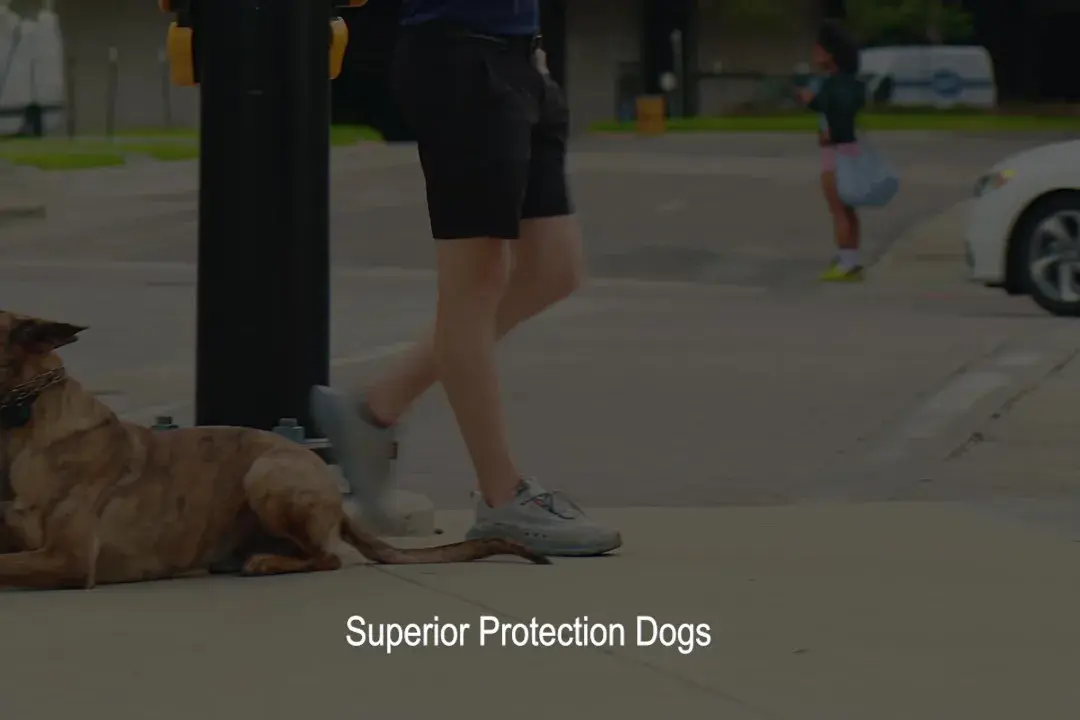
In practice it is a list of observable behaviours, not adjectives. Both of us are listed decoys at PSA-sanctioned trials — the decoy is the person in the suit who takes the bite — so these are read from the receiving end, where commitment and control are both visible in the same two seconds. The first behaviour on the list is on film: a down-stay on a city street.
Neutral Is The Default
Most of what you are buying is the hours the dog spends doing nothing. A finished dog holds a down on a busy pavement while people pass close enough to touch it, and does not track them, posture, or come up when a stranger reaches past it for a door handle. Nobody films that.
The Alert Is Information, Not Permission
A personal protection dog still notices — that part is shared with the watchdog and comes for free. What is trained is what happens next. It tells you, then waits. It does not escalate on its own read of a stranger, because that read is not what you bought.
The Out Is The Expensive Part
Anyone can find a dog that will bite. The months and most of the money go into the release on command, and the return to you while the decoy is still moving and still in front of it. A dog that engages and will not out has not been half-trained. It has been trained into a liability.
It Recalls Off A Person
The most informative thing you can ask to see: send the dog, then call it back before contact. A dog that turns off a committed run because you said so is under control at the moment control is hardest to hold. One that cannot is deciding for itself — the guard dog category, whatever the listing said.
It Defers To You In The Moment
Step in front of the dog, take the situation, tell it no. A finished dog takes the no — head off the target, weight back, eyes to you. That is what makes it safe in a house with children and visitors, and it is trained rather than innate.
It Works Where It Has Never Been
A dog that performs on its home field, with its own decoy, in familiar kit, has proved only that. Real work happens in a car park at night, with an unfamiliar person in street clothes. Ask for the unfamiliar decoy before any money moves.
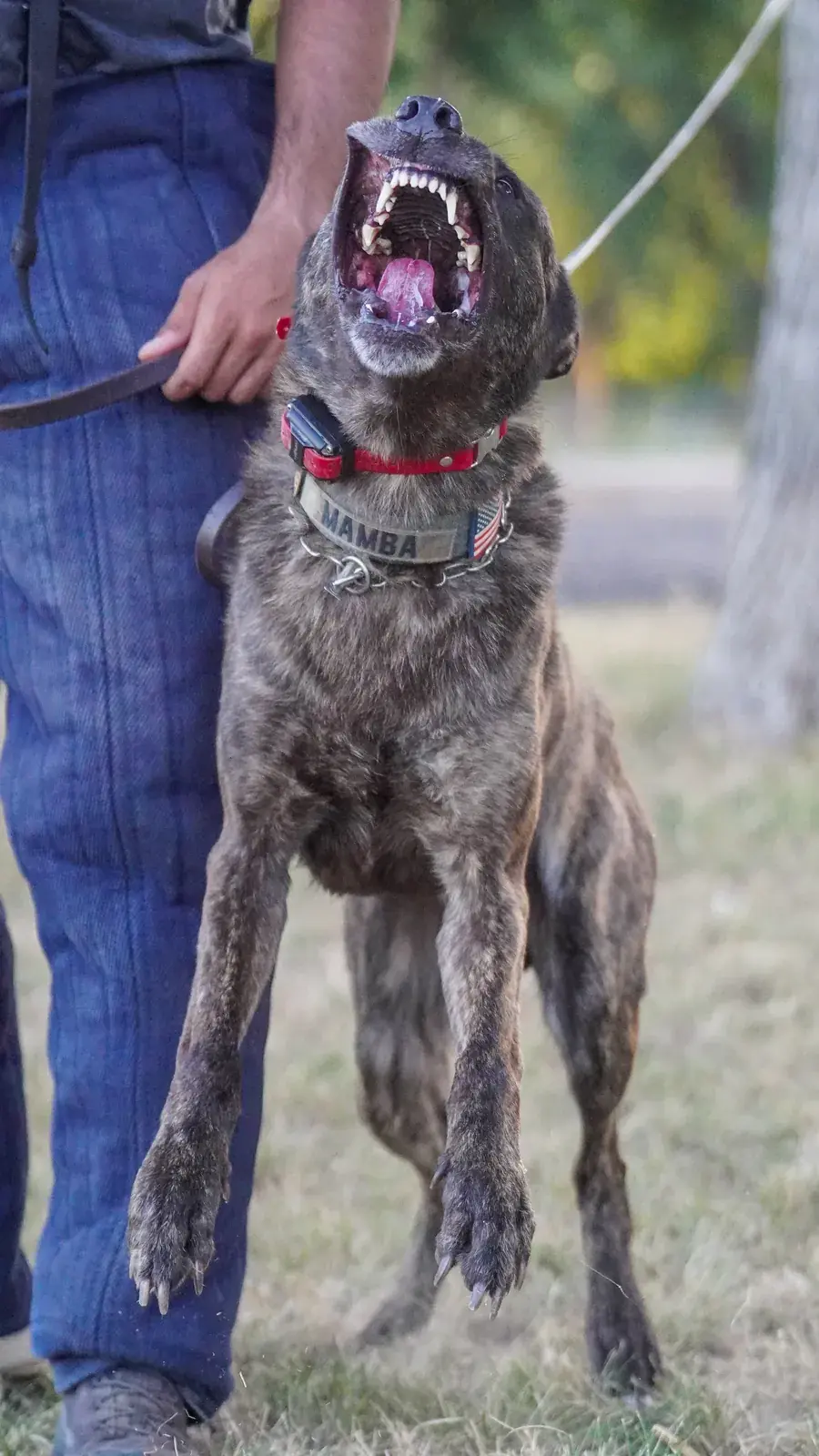
Only one item on that list is about biting, and it is about stopping. That allocation is the honest description of where the work goes. What each stage produces is on our training levels page, and what a finished dog arrives already carrying is on the fully trained page — written out because the tier language every vendor uses is standardised by nobody.
The category has a cost people underestimate and a limit they overestimate. The cost is maintenance: control is a trained behaviour, trained behaviour decays, and the dog needs obedience folded into ordinary life plus periodic decoy work or it stops being what you bought. The limit is coverage: the dog is where you are, and when the house is empty it is crated. If the hours that worry you are the hours nobody is home, that is a guard dog problem, and in a family home the honest answer to one is hardware.
One more distinction that hides inside the word “trained”: a dog can be excellent on a bite suit and useless in street clothes. That is a different failure, and whether the dog bites without a suit covers the equipment fixation behind it and the muzzle work that settles it.
Why Sellers Blur The Three Words
Nobody governs this vocabulary. No body defines a guard dog, no certification separates it from a personal protection dog, and there is no penalty for using either word about an animal that is neither. The terms drift toward whichever one the buyer typed into a search box, and one listing can carry all three without stating a falsehood.
The result is a market where the same three words sit on products at wildly different prices with wildly different amounts of work behind them. Our pricing page collects the published tier ladders and press-reported figures with a link on every number, and the spread is enormous. Reading two listings, you cannot tell whether the gap is months of control work or better photography. That is what a category with no shared vocabulary produces, and it is why the questions you ask before money moves do more work than comparing descriptions ever will.
Six questions sort the categories in one phone call. None is aggressive. Each is hard to answer vaguely.
- Is this dog expected to work when I am not there? Yes in any form means you are being sold a guard dog, whatever it is called. A personal protection dog works with a handler and is crated when the house is empty.
- Show me the dog release on command, with the decoy still active. The category test, and it takes ninety seconds. No out and no recall off a person means a dog that guards, priced like one that protects.
- What does this dog do when nothing is happening? Listen for neutrality described in specifics. If every answer is about drive, hardness and grip, nobody trained the ninety-nine per cent of the dog’s life that is not a bite.
- What is this dog’s default with a stranger who is lawfully on the property? A protection answer sounds like “it alerts and waits for me.” A guard answer sounds like “nobody gets past it” — a dog deciding for itself.
- How does this dog transfer to me, and what does that look like on the day? Handler-directed work is handed over deliberately, in your home, with your family. A dog bonded to territory does not transfer. It relocates.
- Would you place this dog in a house where a child can open the gate? A seller who has thought about the categories answers immediately, and sometimes says no. One who has not hears it as a question about temperament.
Run the list on us too. The demonstration settles it, and how to read a protection dog demo explains what to watch while the dog is working, including which impressive-looking things mean nothing.
Which One Your Household Actually Needs
We sell one of these three categories, so weigh what follows accordingly. It is still what we say on the phone, because a placement into the wrong category is worse for us than no placement.
- A watchdog and better hardware, for most households. Solid doors, long screws in the strike plates, motion lighting, a monitored alarm, and a well-bred family dog that speaks up. That covers the scenario most buyers are actually describing when they start looking, at a fraction of the cost.
- A guard dog, for a fenced commercial site with a defined perimeter, signage, no household inside it, and somebody responsible for the dog’s welfare on a schedule. That is a business arrangement with duties attached, not a household purchase.
- A personal protection dog, when your exposure is specific, ongoing, and attached to you rather than to a building — you are publicly visible, you work hours that leave you alone, response times where you live are long, or a known situation has not resolved.
- Nothing at all, quite often. If the honest answer to “what am I protecting against” is unease rather than a situation, a dog is the most expensive available way to avoid answering it.
If you land between those, the useful next step is not shopping. It is writing down the specific situations that worry you and checking which of them a dog is even present for. The list is usually shorter than expected, and the hours people are actually afraid of are hours the dog would be crated.
The Category Changes Your Insurance Position
Which category you own is not only a training question. It changes what your policy covers, because some carriers exclude guarding and protection work by name — as an activity, not a breed — and an unsupervised dog deciding for itself about visitors is the fact pattern those exclusions are written for. That is a subject with its own documents and its own call to make before you buy, set out with the policy wording and the sources in our guide to protection dogs and homeowners insurance. Read it before you choose a category, not after. We are not insurance advisers and nothing here is advice.
Attack Dog, Sentry Dog, K9 And Estate Dog
Five more terms you will meet while shopping, and what each is really doing in the sentence.
Attack Dog
A legal and advertising term rather than a working one. California law does not separate it from guarding: § 121881 defines “guard dog” or “attack dog” as one thing. Trainers do not use it about their own dogs — it names the least interesting capability the animal has. On a sales page it does emotional work, not descriptive work.
Sentry Dog
A genuinely defined category, and the cleanest statement of the guard model in American law: “a dog trained to work without supervision in a fenced facility and to deter or detain unauthorized persons found within the facility.” Note which words carry it — without supervision, and found within the facility.
K9 Or K-9
A homophone for canine, nothing more. In agency use it means a dog on an official roster with a handler, a certification cycle and a records trail. On a private seller’s site it is a styling choice, worth as much as their ability to name the agency, the unit and the years.
Estate Dog
A commercial coinage with no fixed meaning, usually attached to the top of a price list. It can describe a personal protection dog placed on a large property with staff and gates, or a guard dog with better photography. Ask for the release and the recall, and let the dog answer.
Family Protection Dog
A personal protection dog selected and socialised for a household with children and visitors rather than for a single adult. The extra word claims temperament, tolerance, and proofing against ordinary domestic chaos. It says nothing about the bite work, and a seller using it should describe the household testing behind it.
One test survives all of this vocabulary, and it takes ninety seconds: send the dog, call it off, watch what happens. Which of the three breeds we work with is in front of you matters far less than which category the dog was built for — and our whole position on that sits on the protection dogs page and on our story.
Everything Cited On This Page
Each was read on the page it is cited to. Everything else is our reasoning, from inside a business that sells personal protection dogs.
- California Health and Safety Code § 121875 — The short title of the chapter the sections below sit in.
- California Health and Safety Code § 121881 — The statutory definition of “guard dog” and “attack dog”, which are one term in law.
- California Health and Safety Code § 121880 — The definition of “sentry dog”, built on the words “without supervision”.
- California Health and Safety Code § 121930 — The twelve-hour welfare visit required of a dog on duty.
- California Health and Safety Code § 121935 — Signage at every entrance, and the handler requirement in places open to the public.
- USDA APHIS — The Use of Dogs and Other Animals in Wildlife Damage Management — Chapter XV. Guard animals bonded to the resource, and a federal definition of a trained dog.
- UNC Charlotte — Through the eyes of a burglar — Joseph Kuhns, 422 incarcerated burglars. Funded by the alarm industry — read it knowing that.
Last checked 8 September 2026. The statutes are California’s, cited as an example of category-specific regulation rather than a statement about your state. If one has moved or changed, tell us and we will correct it.
When We Publish Something Worth Reading
No sequence, no drip, nothing automated. One email when we have written something a buyer would actually use — which is a handful of times a year, not a handful of times a month. Leave and we stop.
Tell Us The Situation, Not The Category
Describe the hours that worry you, who is home, who would handle the dog, and what the property looks like. The category falls out of those answers, and sometimes the answer is a better door and a dog that barks. We would rather say that on a first call than sell you the wrong one of the three.