
The First 90 Days With A Protection Dog
Almost everything written about these dogs stops at the sale. This is the part after it: what the dog is doing in its head for three days, the rule it will test in month one, and the ten minutes a day that keep it a finished dog.
What To Expect In The First Weeks With A Protection Dog
Expect three days of decompression, two weeks of building a routine, and about a month before the dog tests your rules. Most of the first 90 days is deliberately boring: crate, schedule, short walks, ten minutes of obedience a day.
The dullness is the point. The work is structural — a routine the dog can predict and household rules that mean the same thing on a Tuesday as on a Saturday. What is new to a finished adult is not travel or strangers; it has done both professionally. It is you, your house, and whether your rules are real.
Six Things To Settle Before The Dog Arrives
Each is easier in the fortnight before delivery than the week after. If you are still reading what a fully trained dog includes and have not bought yet, do them anyway.
The Crate, And Where It Goes
A heavy wire crate or airline kennel, sized so the dog can stand, turn and lie flat — not bigger. Put it in a low-traffic corner of a room the family uses, away from the front door, which is the busiest arousal trigger in any house. Moving the crate three times in a month removes the one fixed point the dog has.
Gear, And What Not To Buy Yet
A flat collar with ID, a six-foot leather leash, a long line, stainless bowls, and a bag of whatever the dog currently eats. Do not buy training collars, harnesses or head halters in advance — the dog arrives conditioned to specific equipment, and guessing wrong just confuses it. Ask what it is on and buy that. Skip the flexi lead.
Rules Agreed In Advance
Say them out loud before the dog is in the house. Furniture, beds, who feeds, who walks, what happens at the doorbell, whether the dog is ever loose in the yard alone, and that nobody hands it food from the table. Rules invented on the spot in week two get enforced by whoever is standing there, which is another way of saying they do not exist.
Name The Handler Out Loud
One person trains, enforces and decides. Everyone else lives with the dog under the same rules. This is about who owns the commands and who settles an argument the dog starts. Households that answer with “all of us” discover in month two that the answer was nobody.
A Vet, Booked Before Delivery
Ask whether the practice is comfortable handling a working dog, what their muzzle policy is, and where their after-hours referral actually is — you want that address in your phone before the night you need it. Book a baseline exam early, and ask then what they want you watching for in your dog.
The Insurance Call, First
Ring your homeowner’s carrier before the dog arrives. Some ask about breed, some ask whether the dog has bite training, and some decline to write the policy at all. Finding that out with the dog already in your kitchen is the worst version of that conversation.
The insurance call has its own guide, because the answers differ by carrier, by state and by what you tell them: protection dogs and homeowner’s insurance.
Decompression, And What Is Happening In There
In about a day the dog has changed handlers, climate, water, floor surfaces, sounds, smells, feeding times and every human it deals with. It has no map of your house, no idea where food comes from, and no schedule. Its old life had a rhythm you could set a clock by.
From outside that looks like a dog at reduced capacity. It may not eat. It may sleep enormously. It may be aloof or clingy, and look less impressive than the dog you watched work. That is not a disappointment revealing itself. It is an animal building a model of a new world.
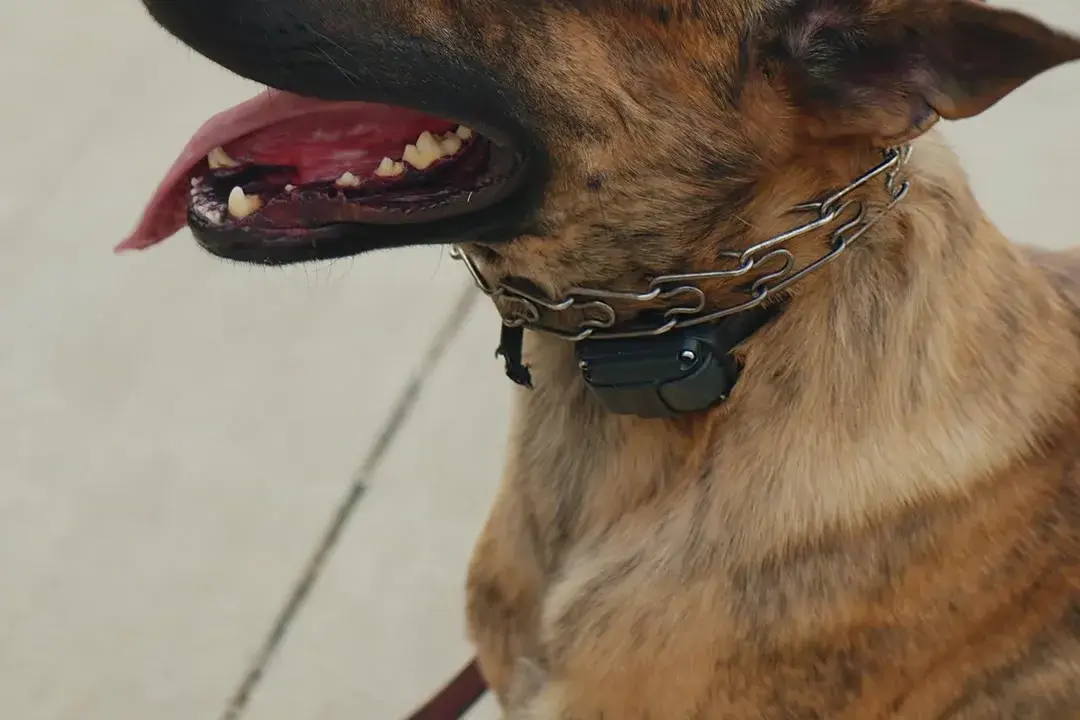
Your job for three days is to be boring and to be the source of everything. Food comes from your hand. Water sits in the same bowl in the same place. Outside happens on a leash, on your schedule, at quiet hours. The crate is the default. You are becoming predictable, which is the only thing a dog in this state wants from a stranger.
Hand-feed. It is the highest-return thing you will do all year. Give the day’s measured food a few pieces at a time, out of your hand. Fifteen minutes buys hundreds of repetitions of one idea: good things come through this person. That window closes after a fortnight.
The week-one mistakes are not random. They are the same ten, in the same order, for the same understandable reason: the owner is excited and wants to see what they bought.
- Inviting people over to meet it. Not the neighbour, not your brother, not the friend who is good with dogs.
- Testing it. Somebody puts on a jacket and comes at you in the driveway. You are staging a fight in a house where the dog does not yet know how you say stop.
- The dog park. Not week one, not month one, and for most of these dogs not ever.
- Changing the food. New home, new water and new kibble in one week produces diarrhoea, and then you cannot tell stress from diet from illness.
- Skipping the crate because it feels unkind. The crate is the one object in your house the dog already understands.
- Loose in the house unsupervised. On day two the dog is on a leash, in the crate, or in the room with you.
- Introducing the resident dog or the cat on day one. No version of that meeting improves by happening early.
- Letting the children sit on the floor and bond with it. Not yet, not unsupervised, not on day three.
- Drowning it in affection. To a dog trained in a working register, petting and high-pitched talk from a stranger is meaningless noise.
- Taking it to the hardware store to show it off. Your errand, the dog’s bad week.
If you have already done two or three of them, nothing is ruined. Go back to the boring version. Dogs forgive a bad week and never forgive an inconsistent year.
Building A Day The Dog Can Predict
Sleeping. Crated at night, in a room where the dog can hear people — not a garage or a far spare room. Expect noise for a few nights. What matters is timing: take the dog out on your schedule, before the protest, and never open the door in answer to one. A dog that learns barking opens crates has learned something you will spend months undoing.
Feeding. Twice a day, measured, on a fixed schedule, in the crate or from your hand — never free-fed from a bowl left down. Working dogs eat well settled and skip meals when they are not, so a scheduled bowl doubles as a daily health readout. Hold the toppers and table food back; you will need those to mean something later.
The crate schedule. Out to relieve itself, walk or work, feed, settle, crate. In week one the dog is never loose in the house alone. Freedom expands in increments — dragging a leash while you are in the room, then one room, then the house while you are home — and each step is granted because the last was dull for a week, not because you felt guilty.
First walks. Your own street, off-peak, on a six-foot leash. Not exercise, and not socialisation. You are collecting information: what this dog notices and ignores. Walk the same route for a week — familiar ground makes reactions legible.
Meeting the household, one person at a time. On leash, in a neutral space, and that person ignores the dog — no frontal approach, no eye contact, no reaching over the head. Stand side-on and let the dog come and go. Everyone crowding the hallway on arrival day makes your family the scrum the dog had to tolerate.
“The dog is being weird.” Nine times in ten that means something on the normal list below, and the routine resolves it. The exception worth a call the same day is a dog that goes stiff, still and hard around one specific person or in one specific place. That is not adjustment. That is information.
The Month The Dog Tests Your Rules
Obedience has to transfer from the trainer to you. The dog knows the exercises; it does not know that you know them. Same words, same language, same tone and cadence — a dog worked in Dutch or German is answering a sound, not a translation, and “sitz, please” is a different sound. Say it once. Do not repeat it, do not stack three commands into a sentence, and do not let one go unanswered. An unanswered command teaches the wrong thing.
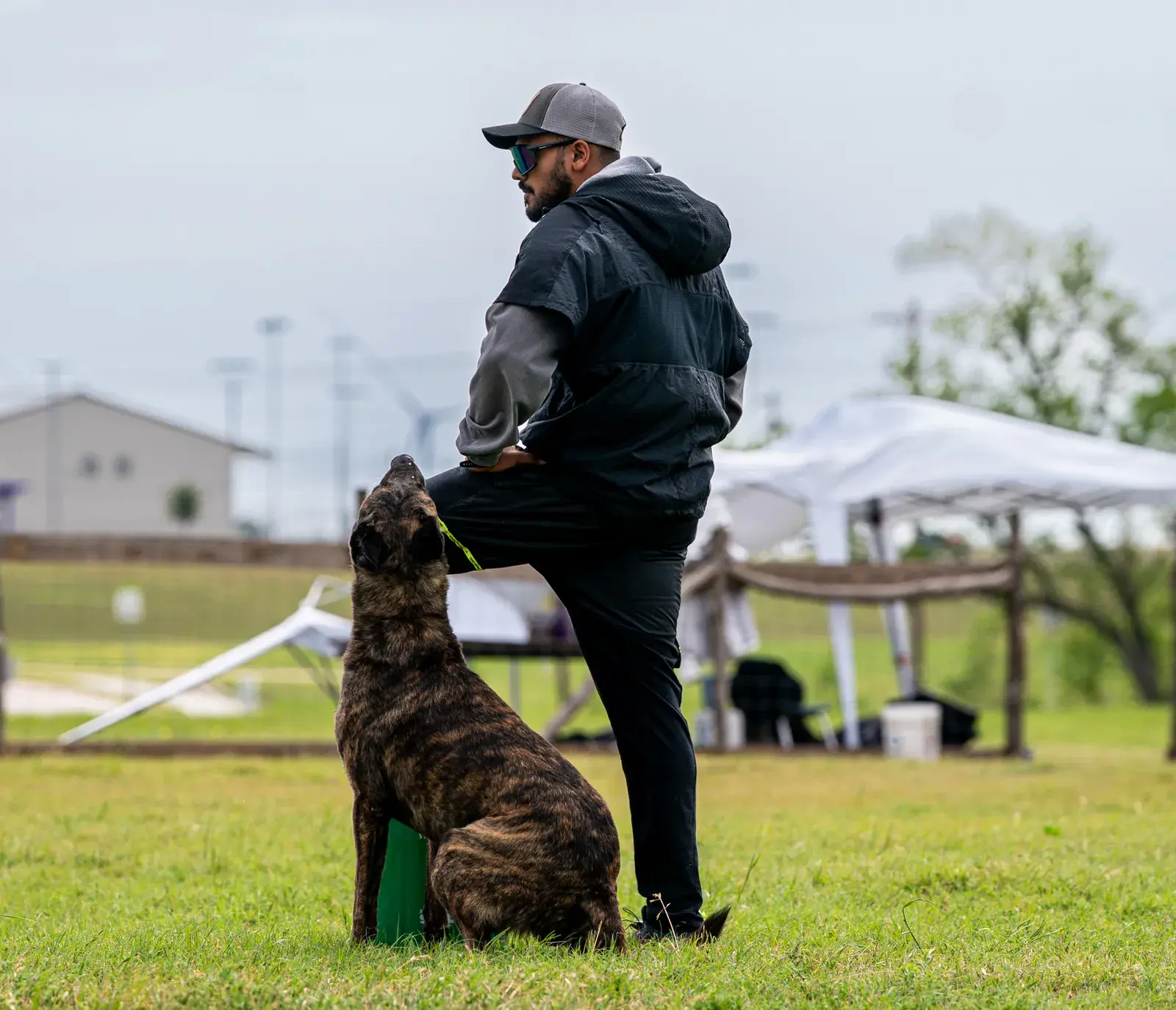
The relationship runs on food, movement and clarity. Affection is not on that list. The dog does not care that you love it; it cares that you are legible, that good things come through you, and that the rules do not move. Owners who lead with affection end up with a dog that adores them and does not listen.
Somewhere around week three to five the dog will test a rule. It will take the sofa, lift something off a counter, blow a recall, or shoulder through a doorway ahead of you. That is not the dog showing its true colours and it is not a training failure. It is an intelligent animal whose baseline has recovered, running a fair experiment: the rule existed at the trainer’s, does it exist here? Answer calmly, immediately and identically every time and the question closes. Let it slide the next day and you have taught that the rule is negotiable, which is harder to undo than the behaviour was.
Children, and the rules that protect both of them. The dog and the child are never alone together — not loosely supervised, not in the next room, in the room. Children do not hold the leash and do not enforce commands; a kid asking for a sit with an adult present is a good relationship-builder, but enforcement stays with the handler. Nobody enters the crate, reaches into it, or wakes the dog. Nothing gets taken off the dog — not food, not a chew, not a toy. No wrestling, no chase games, no arms round the neck, no leaning over a sleeping dog. When your children’s friends are over, the dog is crated or on a place command. Notice how little of that concerns protection work: what goes wrong with family dogs goes wrong in ordinary moments.
Other animals, slowly. Parallel walks outdoors first, both leashed, at distance, no face-to-face greeting. Then crate-and-rotate for a fortnight so they share a house without being loose in it together. Then short supervised sessions with both dogs occupied. Never feed them near each other. With cats, accept that some dogs are never safe with one.
Normal Life, And The First Decoy Session
By the back half of the 90 days the house should feel unremarkable. Now widen the world on purpose: a quiet parking lot, another neighbourhood, a social visit to the vet where nothing is done to it. Keep every outing short, boring and successful. The aim is a dog that finds new places uninteresting.
The first maintenance session with a decoy belongs in this window. This is where the protection side gets checked rather than assumed: a decoy in equipment running work the dog knows, confirming the grip is still full, the out still clean on the first command, and above all that the dog will do it for you rather than only for the person who trained it. When it happens depends on the dog; we set the date rather than pretend a universal week number exists. If that vocabulary is unfamiliar, our training levels page sets out what each stage contains, and how to read a protection dog demo covers what to watch while a decoy works your dog.
The honest timeline for settling is two answers, not one. A finished adult usually looks settled sooner than people expect — the house-manners version, the one that sleeps through the evening and stops caring about the ice maker, arrives inside the first few weeks. The dog you will live with for a decade, opinions and all, comes later and on its own schedule. Where that lands for your dog is not something anyone can tell you from a website.
Breed shifts the shape of this. Belgian Malinois come up to speed fast and need the off-switch worked hardest, Dutch Shepherds are often the steadier version of the same engine, and German Shepherds usually read as the most neutral of the three in a living room. A tendency, not a promise.
Ten Honest Minutes A Day, For The Life Of The Dog
Day 91 is not a finish line. It is the day maintenance becomes the only thing keeping the dog finished.
What the ten minutes actually are. Not a session on a mat with a clicker and a timer. Obedience folded into the day you were having anyway: a sit before the bowl goes down, a place command that holds while the family eats, a heel out of the front door instead of being towed through it. Scattered, every day. People who schedule half-hour sessions four times a week have stopped by March. People who ask for a sit before every meal never stop.
Protection work is a perishable skill. Everything the dog does on the field is a trained behaviour, and trained behaviours decay unrehearsed. The grip goes shallow. The out slows and starts needing a second word. The bark and hold turns into circling. Note the failure mode: not safe-to-dangerous, but precise-to-approximate, and approximate is a bad adjective for an animal with this much capability. Nobody notices the day it starts.
What “we do maintenance every so often” turns into. A session in month two. Another in month five. A gap over summer. Then a call to us a year later saying the dog has stopped listening and asking what went wrong with the training. Nothing went wrong with the training. Nobody did anything for most of a year and the dog reverted to being a dog. Put the sessions in a calendar with dates or they will not happen.
The recurring costs start now too. Food, and a working dog eats more of it. Routine veterinary care plus the occasional injury. Decoy sessions. Boarding, arranged before you need it, because not every kennel takes a dog with bite training. What the market charges is set out with sources on our pricing page, and the FAQ answers the line-item version.
What To Ride Out, And What To Call Us About
This is the section nobody publishes and the one a new owner needs at eleven at night. The first list alarms people and should not. The second is what people talk themselves out of calling about.
Normal. Give it the routine and a fortnight.
- Not eating for a day or two. Offer, wait ten minutes, take it up, offer again on schedule.
- Loose stool in the first week. New water, transport, a different routine.
- Sleeping a great deal. Days one to three should look boring and largely horizontal.
- Aloofness. A dog that does not want handling is gathering information, not rejecting you.
- Noise in the crate for a few nights. Take it out before the protest, never because of it.
- Startling at your particular house — the ice maker, the HVAC, one creaking stair.
- Shadowing whoever feeds it. That is the relationship forming in the currency it runs on.
- A command failing because you say it differently to the trainer. Most week-two obedience problems are pronunciation problems.
- Testing a rule in week three. Expect it. It means the dog has recovered enough to run experiments.
Call us the same day. Every one of these, every time.
- Any bite on any person at any level — a scrape, a bruise, a grab at a sleeve. Do not grade it yourself.
- A growl, a freeze, a hard stare or a lifted lip aimed at somebody in the household, above all a child. “He was just grumpy” is what people say twice before they call.
- Guarding — food, a chew, a bed, a doorway, a spot on the sofa, or a person, defended against someone who lives there.
- The dog inserting itself into ordinary family life: hugging, roughhousing, an argument, a raised voice.
- An out that has become an argument. The out is the safety system and it degrades first.
- The dog engaging without being sent. Once. That does not settle down on its own.
- Escapes, out of the yard or the crate. Once is a system failure worth fixing before it is twice.
- Anything structural changing: a new baby, a partner moving in, a house move, a second dog. Call before, not after.
- Any time you catch yourself not telling us something because you think it means you failed.
Medical emergencies are a different phone number and go first. Unproductive retching with a hard, swollen belly, a leg the dog will not weight, repeated vomiting, or blood in the stool is the emergency clinic immediately. Call us afterwards.
Does The 3-3-3 Rule Apply To A Protection Dog?
Partly. The 3-3-3 rule says a newly homed dog needs roughly three days to decompress, three weeks to learn the household’s routines, and three months to start feeling at home. It is a rescue and shelter heuristic, not a standard, and it was written about a dog whose history nobody knows — which is not the dog you are collecting.
Worth being precise about where it comes from, because it gets quoted as though it were a finding. Take Me Home Pet Rescue, a rescue organisation, publishes it as “three days for initial decompression,” “three weeks to learn the routines of your household” and “three months to start to feel relaxed and at home”. Sniffspot’s write-up of the same framework says it “was popularized by rescue communities” and is explicit that it is “a general framework, not a guaranteed schedule.” That is accurate: useful shorthand, widely shared, never a clock.
What carries over. The shape is right and so is the reasoning. Any dog whose every variable changed at once needs days before it is itself and months before it is settled. The first-three-days instruction — rest, routine, low stimulation, do not make it perform — is exactly what we tell owners.
Where it does not apply. The rule exists to manage an unknown. With a shelter dog the central question is what happened before, and the timeline says be patient while the truth surfaces. A finished protection dog has no such gap: handled daily by professionals, kennelled, transported, worked around strangers, and selected for the nerve to cope with change. That resilience is what makes days one to three shorter than the rule assumes. Plenty are eating normally by day two, and owners who read the rescue version sometimes worry the dog settled too fast. It did not.
And where it inverts. With a rescue, month three is when you find out what you got. With a finished working dog you already know, because you watched it work. The variable that moves across your 90 days is not the dog. It is you: your consistency, your timing, whether the rules hold on a bad Tuesday.
The last difference matters most, and no version of the rule mentions it because it has no reason to. A rescue dog does not arrive carrying a perishable trained skill. Yours does. There is no point at which the settling-in ends and the dog stays finished on its own — the argument this page, and the guide on whether to buy one at all, have been making from different directions.
Both 3-3-3 sources read on 8 September 2026: Take Me Home Pet Rescue — Decompression, The 3-3-3 Rule · Sniffspot — The 3-3-3 Rule for Rescue Dogs.
When We Publish Something Worth Reading
No sequence, no drip, nothing automated. One email when we have written something a buyer would actually use — which is a handful of times a year, not a handful of times a month. Leave and we stop.
Call Early Rather Than Late
Nothing on the call-us list gets cheaper by waiting. We would rather talk you through a growl in week three than a bite in month eight. If you have not bought yet and this page raised more questions than it answered, read our story and credentials, then ask them all on one call.