
Austin
Protection Dogs
The dog is the same one we would hand over anywhere: a fully trained Belgian Malinois, Dutch Shepherd or German Shepherd, driven down from North Texas and handed over in person. What is different here is not the dog. It is the ground it lands on.
The Densest Money In Texas
On The Hardest Ground
Of the four largest Texas metros, Austin has the highest concentration of the households a dog at this price is within reach of, and the smallest absolute number of them. The Census Bureau’s American Community Survey, 2024 five-year estimates, puts 189,518 households in the Austin–Round Rock–San Marcos metro above $200,000 of income — 19.2% of all households here, the highest share in the state — and 58,167 owner-occupied homes worth a million dollars or more, 10.1% of them, again the highest share in Texas. Dallas–Fort Worth has more than twice as many households above that income line in raw count. Austin has them packed into a much smaller footprint, and most of that footprint is hills.
That is the only statistic on this page, and it is here to say one thing: the Austin household this page is written for is usually on a west-side lot rather than a flat suburban plot, and that changes more about a placement than anything else in this city.
Before any of it — we are based in North Texas. No office in Austin, no kennel in Austin, no trainer here on retainer, and no published placement records for any city, so nothing below should be read as a claim about Austin clients. What we do is bring the dog down and hand it over in your house. The parts that are the same everywhere, like how the two programs differ and what this market actually charges, live on their own pages rather than being retyped here as padding.
Hill Country Lots Are
A Containment Problem
Austin’s expensive residential ground sits on and behind the Balcones Escarpment, which the Texas State Historical Association describes as a fault zone several miles wide, about 300 feet high by the time it reaches Austin, dividing the Edwards Plateau from the coastal plains and forcing up the water that surfaces at Barton Springs. East of that line the city is flat. West of it — Westlake, Rollingwood, Lost Creek, Barton Creek, Bee Cave, Lakeway, Steiner Ranch, Spicewood, Dripping Springs — keeping a dog where you put it is a different physical problem.
The Fence Sits On Rock
On blackland prairie you trench a fence line. Out here the shovel finds limestone a few inches down, so fences follow the surface instead of cutting into it. They ride over ledges and leave gaps underneath that look like nothing from standing height and look like a door from a dog’s. Walk your fence at the dog’s eye level before delivery, not after.
The Lot Is Not Flat
A recall downhill is not the recall you practised on grass. A dog moving down a slope carries speed it cannot shed on command; a dog moving up one loses your voice into the rock. Handlers who built the obedience on a level yard are surprised the same words land differently on a steep lot, and they blame the dog rather than the grade.
You Lose Sight At Thirty Yards
Ashe juniper is the dominant canopy west of I-35 — evergreen, low-branched, dense. On an ordinary oak-and-cedar lot you can lose a dark dog at thirty yards in the middle of the afternoon. Charming feature of the property; real operational problem for an animal whose whole value is that it does what you say while you can see it.
Something Walks Through Every Night
Hill Country deer do not treat a residential lot as anybody’s property, and west of town a deer trail across the yard is ordinary. That trail is a live proofing test running at dusk and again at dawn, every day, for the life of the dog. A dog that breaks for deer has told you what it will do for a cyclist.
The Preserve Past The Back Fence
Western Travis County holds the Balcones Canyonlands Preserve: more than 33,000 acres across more than 140 tracts, created in 1996 for eight endangered species, including six karst invertebrates living in the caves under the limestone. Plenty of west Austin lots back onto it. If yours does, a loose dog is a wildlife problem, not a neighbour problem.
None of that argues against a dog out here. It argues for settling containment before delivery rather than in week three. If your place is genuinely acreage rather than a large lot, how much ground one dog can and cannot cover is worked through in our guide to protection dogs on ranches and acreage.
Snakes, Rock And
The Cedar Months
Texas Parks and Wildlife counts 76 snake species in the state, or upward of 115 with subspecies, of which — in their words — “Only 15% of the total number are venomous”: rattlesnakes, copperheads, cottonmouths and coral snakes. The line that matters for a buyer here is the next one on the same page — TPWD states plainly that “The Central Texas region has the largest number of species.” You are not buying a dog into snake country in the abstract. You are buying into the part of the state with the most of them, onto lots built from exactly the ledges, dry-stacked walls and brush piles they use.
What That Changes In The Training
Almost nothing, and that is the point. We do not sell snake-proofing and we will not pretend a trained dog is safer around a copperhead than any other dog. What a finished dog gives you on this ground is the behaviour it already had: it looks at you before it investigates. A dog that checks in before putting its nose in a rock crevice is not snake-trained. It is obedient at distance, under distraction.
Rock Is Not Grass
Caliche and weathered limestone are abrasive, and stone in full sun holds the day’s heat long after the air starts to cool. A dog that has worked its life on a North Texas field is on a harder, sharper, slower-cooling surface here. Check pads after work on rock the way you would after hot asphalt, and pick the training surface deliberately.
The Cedar Months Are Yours, Not The Dog’s
Ashe juniper starts producing pollen in mid-December, peaks in mid-January and tapers toward March. Cedar fever is a human complaint and we will not invent a canine version of it. It belongs here for one reason — scheduling. December to February is when Austin weather is best for working a dog outdoors, and it is also when a lot of Austin handlers least want to be outdoors. A routine that quietly dies every January is a routine that dies.
The pollen dates come from the Texas A&M Forest Service, which also notes cedar fever is worst in the Hill Country west of I-35 — the same trees that take your sightlines.
The Problem Is The Length
Of The Summer
Every Texas metro is hot and every company in this business writes the same sentence about it, so here is the version that is actually about Austin. In 2023 the city recorded 80 days at 100 degrees or above and a day that hit 110; the same University of Texas page notes that the ten hottest summers on record in Austin have all come since 1998, and that the National Weather Service does not issue a heat advisory here until 103 degrees or a heat index of 108.
That last number is the one to ignore. A schedule keyed to advisories is keyed to a threshold written for a city full of people, not for an animal doing physical work in a fur coat. A 97-degree afternoon triggers no warning and is still not a session.
It is worth being precise about how this differs from the other two big metros, because the honest answer is not that Austin is hotter. Houston’s constraint is humidity: a dog sheds heat by panting, panting works less well in saturated air, and a Houston dog can be in trouble at a temperature that reads mild on a screen. Dallas–Fort Worth gets brutal afternoons and then, most years, gets a break. Austin’s constraint is duration — a summer that starts in May and is often still running in October — compounded by the ground, because limestone and caliche take the day’s heat in and give it back after sunset. So the after-dark training window handlers use elsewhere opens later here, and the surface under the dog matters as much as the number on the thermometer.
Inside a placement that is unglamorous and specific. First light from May onward. Water that has not stood in the sun. Shade that is still shade at five, which on a west-facing hillside lot is a smaller area than it looks at noon. And a handler willing to cancel, which is the part that actually fails.
A Dog That Lives On Patios
Is Held To A Higher Standard
This is what makes an Austin placement genuinely different from a Dallas one, and it is the part most people reading this page have not thought about yet. Austin is a city where dogs go everywhere: to the office, under the table on a Barton Springs Road patio, around the lake on a Saturday morning alongside a few thousand other people and their dogs. Families move here partly for that, and it is the strongest reason to be careful about which dog you buy.
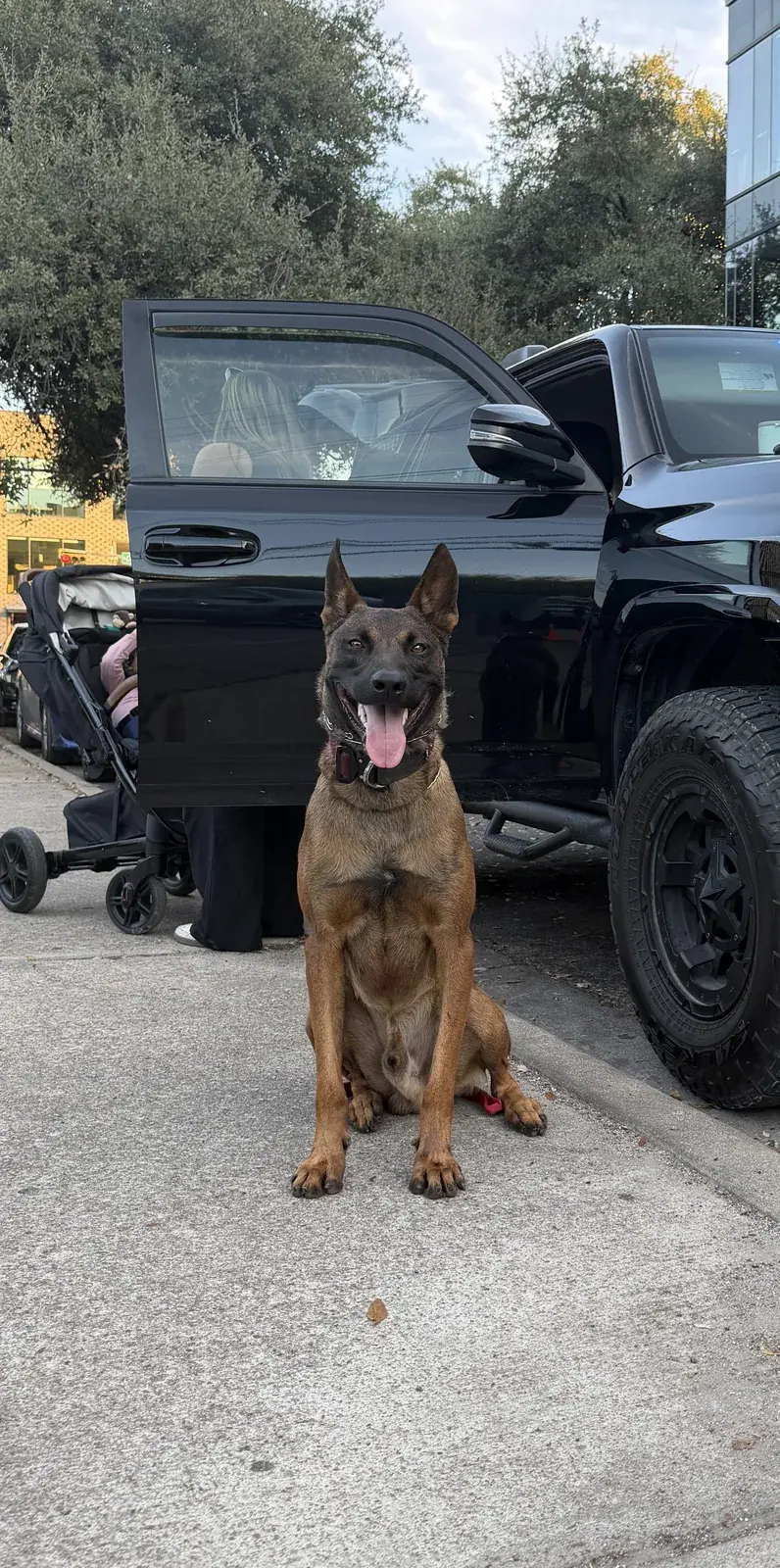
A protection dog living behind a gate is tested a handful of times a year. A protection dog living an Austin life is tested continuously, under the worst possible conditions for a neutrality exam: strangers who reach for a dog without asking, because here that is normal; children at exactly table height; loose dogs in off-leash areas whose owners sincerely believe every dog in this city is friendly; skateboards, scooters, bikes, a patio of people who have been drinking since two. None of it is an emergency. All of it is an examination, and it runs every day.
The honest version, then, is that Austin’s dog culture raises the bar rather than lowering it. If the plan is patios and trails, the capability to shop for is not a harder bite. It is a dog that can be ignored — one that lies under a table for two hours doing nothing, lets a stranger pass within a foot of it without a reaction, and has an off-switch you would trust in a crowd. That is the expensive half of a finished dog and the half hardest to fake. Twenty unedited seconds of a dog holding a down-stay on a city street shows it better than a paragraph can, and what each stage of that control is called — and does not include — is set out on our training levels page. Before anyone shows you a dog, read how to watch a protection dog demo; in a market like this one, neutrality is the question a demo quietly skips.
The legal frame is simple. Austin City Code requires dogs to be on a leash in public areas unless the spot is a designated off-leash area, where the city asks that dogs stay “within sight and sound control of their humans/handlers at all times.” Our own position goes further than the ordinance: we would not put a dog with protection training off-leash in a public off-leash area, ever, however good its recall. Not because the dog would fail — because the other dogs there are an uncontrolled variable, and you are the one who would be explaining it afterwards.
Choosing A Breed For
An Austin Household
We work with three breeds. What follows is only the Austin slice of that decision: constant public life, a long summer, and hill ground.
Belgian Malinois — Usually The Wrong Answer Here
If this dog’s life is patios, trails and an office, we will normally steer you off the Malinois, against our own interest in selling the most impressive animal in the yard. Not because the breed cannot be neutral — a good one is — but because the individual that is genuinely content to be ignored for two hours under a restaurant table sits at the low-to-moderate-drive end of it. If that is the dog you want, you did not need the breed to get it.
Dutch Shepherd — The Quiet Middle
Brindle and less immediately recognisable, which in a city this full of dog people cuts both ways: fewer strangers lunge at a dog they cannot label, and more stop to ask what it is. The breed tends to land near where many Austin households actually live — enough drive to be a serious working dog, enough off-switch to be boring in public. Variation between individuals is wider than the label suggests.
German Shepherd — The Likeliest Fit For This Profile
For the profile this page keeps describing — a hill lot, a family, a dog that will be seen constantly — the German Shepherd is usually the answer, and we would rather say so than dress up whichever dog we happen to have. It reads as serious to a stranger without reading as exotic, which matters where being noticed is unavoidable. Coat against a long summer is a real trade-off, but one variable among several.
Three sketches, not a decision. The variables that actually settle it are in our comparison of the Malinois, Dutch Shepherd and German Shepherd, and each has a page of its own — the Belgian Malinois, the Dutch Shepherd and the German Shepherd — under the main breeds page.
What Delivery From
North Texas Actually Is
We bring the dog ourselves. Austin is a same-day drive down I-35 from where we are, and we make it rather than shipping an animal or meeting halfway. That is not a courtesy: the handover only means something if it happens on your ground — your gate, your stairs, that gap under the fence panels, your kitchen at the hour the family is actually in it.
What we do not have here is worth saying just as plainly. No Austin office, no Austin kennel, no local trainer working for us, no roster of Austin clients to point you at. We have never published placement records for any city and we are not going to start by implying some for this one. If a company’s location page says it has quietly placed dozens of dogs in your suburb and cannot name one, treat it like any unfalsifiable claim — the red flags worth checking before you send anyone money are written down.
Two things to settle before delivery, both because of the distance. Where the dog boards: not every kennel accepts a dog with bite training, and the week before a trip is a bad time to find out. And who does maintenance decoy work: protection work is perishable, we are not around the corner, and a plan that depends on us driving down every month is not a plan.
The rest is the same for Austin as for anywhere. Whether you want a dog that arrives finished or a puppy you raise with us alongside is a question about your household, not your postcode. Who we are, and why we evaluate dogs from inside the suit, is on the about page; the ordinary questions about cost, upkeep and terminology are in the FAQ.
Two Austin Rules
Worth Reading Once
Austin Animal Services states that tethering a dog inside the city limits is prohibited by ordinance unless the owner is physically present with the dog. That catches people out on large lots, and it applies to every dog in the city rather than to ours in particular.
The second is not a category our dogs are in, and it would be dishonest to dress it up as a feature. Under the same city rules, a dog that has been declared dangerous must be registered with the City of Austin for a $50 annual fee, kept leashed in a person’s immediate control or in a secure enclosure, covered by $100,000 of liability insurance, and made to wear the city-issued tag. It is here because it is a plain price list for what one incident costs, and reading it beforehand is more useful than reading it afterwards. Coverage is the larger question, and what homeowners and pet insurers say about protection dogs has a page of its own. None of this is legal or insurance advice; it is the set of questions to put to someone qualified to give it.
Everything Cited On
This Page
Each was read on the page it is cited to. Where a claim is ours rather than theirs — the handling arguments, the breed judgements, the position on off-leash areas — it is argued rather than sourced, and you should weigh it knowing we sell these dogs.
- Texas Parks and Wildlife — Snake FAQ — Species counts and the line about Central Texas.
- Texas State Historical Association — Balcones Escarpment — The fault zone and its height at Austin.
- Texas A&M AgriLife Today — Cedar fever season begins in Texas — Ashe juniper pollen timing and canopy dominance west of I-35.
- UT Austin, Bridging Barriers — Scorched: Climate Change Turns Up the Heat on Austin — The 2023 summer figures and the advisory threshold.
- Travis County — Balcones Canyonlands Preserve — Acreage, tract count, and what it protects.
- City of Austin Animal Services — Animal Protection — Tethering and dangerous-dog requirements.
- Austin Parks and Recreation — Dog Parks: Off-Leash Areas — The leash requirement and the sight-and-sound rule.
- US Census Bureau — American Community Survey 2024, 5-year estimates (B19001, B25075) — Income and home value for the Austin–Round Rock–San Marcos metro.
Last checked 8 September 2026. If one has moved or changed, tell us and we will correct it.
Tell Us What Your Austin Week Looks Like
The lot, the fence, the slope, who is home and when — and honestly, how much of this dog’s life happens in public. Some of these calls end with us saying the right answer is a well-bred family dog and a better gate, which is a normal outcome here rather than a failed one. The longer version of that argument is our guide on whether to buy one at all.