
Flying With A Protection Dog What Airlines Allow In 2026
A move, military orders, a second home. Sooner or later a large working dog and an airport end up in the same plan, and the rules come from airlines, federal agencies and an airline industry body, each writing for its own purposes. This is what each of them said on 8 October 2026, and what it means for a dog like ours.
Can You Fly With A Large Dog?
Not in the cabin as a pet: every one of the five U.S. airlines we read requires the pet’s carrier to fit under the seat in front of you, and a 60–80 pound shepherd does not. In the hold, the options have narrowed sharply. On 8 October 2026, American, Delta and United checked pets only for military and State Department travellers on orders, Southwest carried no pets in cargo at all, American’s cargo arm would still ship one as freight, and Alaska with Hawaiian was the one carrier that would check a large dog onto an ordinary passenger’s own flight.
A protection dog is not a service dog, and the federal rule that lets service dogs ride in the cabin does not stretch to cover one. Beyond that, the decisions that matter are the crate size, the temperature at every airport on the route, and not sedating the dog.
Where we stand, before the detail. We deliver dogs in person and do not ship them — our reasons are in the delivery answer on our FAQ. So this page is about the flights that come after a purchase. If you are still deciding whether to buy from a seller in another state, the transport and paperwork of that decision, including the federal holding-temperature rule, are in our guide to buying a protection dog out of state, and we do not repeat them here.
Can A Large Dog Fly In The Cabin?
As a pet, no, and the reason is a box rather than a weight limit. Delta says the kennel must fit fully under the seat in front of you and recommends a soft-sided kennel of at most 18" x 11" x 11". United caps a soft-sided carrier at 11 x 18 x 11 inches and a hard-sided one at 9 x 17.5 x 12, and adds, almost cheerfully, that there are no weight or breed limitations for pets — none are needed when the carrier has to go under a seat. American recommends the same 18 x 11 x 11 soft-sided size and, on its three-cabin A321T, puts a number on it: pet and carrier together must not exceed 20 pounds. Southwest welcomes small cats and dogs, and Alaska takes pets that fit in an under-seat carrier.
For scale, the American Kennel Club gives a male Belgian Malinois as 24–26 inches tall and 60–80 pounds. The under-seat box is eleven inches high.
Buying the dog its own seat does not change this. None of the five policies we read offers a seat to a dog that does not fit under one. United asks a passenger bringing two pets to buy two seats, with the second next to the first so the passenger can care for both pets. Its page does not offer a seat to a dog that does not fit in a carrier under the seat.
Is A Protection Dog A Service Dog On A Plane?
No, and the definition is short enough to settle it. Under the Department of Transportation’s Air Carrier Access Act rules, a service animal is a dog “individually trained to do work or perform tasks for the benefit of a qualified individual with a disability”. The same definition excludes emotional support, comfort and companionship animals, and service animals in training. A dog trained to bite on command for a household’s security is doing work, but not work for a disability, and that is the whole test.
The airline rule does not mention protection at all. The Americans with Disabilities Act rule for shops, hotels and other public accommodations does, and it is worth reading because it draws the line in so many words: its list of tasks includes “providing non-violent protection”, and the same definition says the crime deterrent effects of an animal’s presence do not count as work or tasks. Different statute, different agency, same conclusion: the deterrent is not the task.
The behaviour standard points the same way. The DOT rule describes a trained service animal as one that does not bark or growl repeatedly at other persons, bite, or jump on people, and lets an airline refuse an animal that poses a direct threat to the health or safety of others, judged on the individual dog rather than its breed. Airlines may also require a DOT form attesting to the animal’s health, behaviour and training. A protection dog does not meet the definition, so the form could not truthfully be completed for one.
One detail is worth knowing even for genuine service-dog handlers. A service dog rides on the lap or in the passenger’s foot space; if a large one cannot fit without encroaching on someone else, the airline must first offer another seat in the same class and, failing that, carriage in the cargo hold free of charge or a later flight. Size is a constraint even inside the exception.
Which Airlines Fly Large Dogs In Cargo Now?
Read on 8 October 2026, from each carrier’s own pages. Treat it as the state of play on that day, and confirm it with the airline the week you book.
American
Checked pets are accepted only for active-duty U.S. military and State Department Foreign Service personnel on official orders, and the checked kennel is capped at 100 pounds with the dog inside. Everyone else whose dog is too big for the cabin is sent to American Airlines Cargo’s PetEmbark service, which ships the dog as freight. Its 85°F and 45°F limits apply in holding areas, at the terminal, on the way to the aircraft and on a plane waiting to depart, and pets outside the cabin cannot travel to, through or from Phoenix, Tucson, Las Vegas or Palm Springs between 1 May and 30 September.
Delta
In-cabin pets only, unless you are active U.S. military or a Foreign Service Officer on permanent-change-of-station orders. Delta Cargo says that, until further notice, it ships pets only for those travellers. Its weather rule is the strictest number any of the five publishes: no pet travel if it is above 80°F or below 20°F while the animal is on the ground anywhere on the trip, with a vet’s acclimation certificate needed between 20°F and 45°F.
United
United ended its PetSafe cargo programme for the public. Pets fly in the cabin or, for certain active-duty military and State Department employees, in cargo. United says it has no weight or breed limitations for pets — the carrier does the limiting, because it must fit under the seat in front of you.
Southwest
Small, vaccinated cats and dogs in an under-seat carrier on domestic flights, and nothing else. Southwest states plainly that no pets are carried in the cargo compartment, so for a large dog there is no Southwest option at all.
Alaska And Hawaiian
The only one of the five that, on the day we read them, would check a large dog onto an ordinary passenger’s own flight. The dog and kennel together may weigh up to 150 pounds, you must be on the same flights, and the airline will not transfer the dog to another carrier. If you are not flying with the dog, Alaska points you to its Pet Connect cargo service instead. Its breed exclusions and its rule that animals be harmless still apply.
Checked versus cargo is not a formality. A checked pet flies on your booking and comes back to you at baggage claim. Cargo is a separate shipment, and where you hand it over depends on the carrier. Delta’s cargo pets go to its cargo facility, and must reach it 4 to 6 hours before a domestic departure and are not guaranteed the same flight as their owner. American Airlines Cargo says it takes household pets from passenger ticket counters, baggage service offices and dedicated Global Priority Shipping Centers, not only at a cargo terminal. Its PetEmbark service, the cargo route open to civilians on the day we read it, sorts dogs by size: under 100 pounds combined and in a kennel no larger than 36 x 26 x 28 inches, the dog flies as Priority Parcel Service; heavier, larger or international, it flies as ExpediteFS.
Neither route promises to take a bite-trained dog. Alaska’s baggage-compartment rules say animals must be harmless, inoffensive and not destructive to themselves or the carrier, and the same page excludes a list of breeds and their mixes from the hold, among them the Boxer, every Mastiff breed and the Staffordshire Bull Terrier. American Airlines Cargo publishes its own policy and restrictions page. Check the dog’s breed and any mix against each carrier’s list, then ask each carrier in writing whether it will accept a bite-trained dog before you buy a kennel.
Connections are where a protection dog meets strangers. Alaska will not hand a pet to another airline; you claim the dog and recheck it, and should allow at least four hours to do it. American Airlines Cargo requires a comfort stop for every dog whose first leg runs seven hours or more with a connection, whose same-day connection runs seven hours or more, whose itinerary exceeds 24 hours, or that cannot connect the same day. At a comfort stop a local kennel provides a well-being check and a chance to relieve itself, which means someone opens the crate. Read that as a trainer would. Somebody you have never met will reach into a box holding your bite-trained dog, after hours of noise, in a strange building. A dog whose neutrality with strangers is real will tolerate that. A dog that is merely managed will not, and nobody at the kennel knows the difference until the door is open. If you are unsure which you have, what a protection dog does without a suit in front of it is the question to answer first.
Private and shared-charter flights for pets do exist. We have not reviewed any operator’s terms, so we will not describe them.
Pet Cargo Heat Embargoes, Read From Texas
Every carrier that still flies dogs in the hold publishes a temperature rule, and the rules differ. American will not carry a checked pet if the current or forecast temperature is above 85°F at any location on the itinerary, or below 45°F without a vet’s acclimation letter, and not at all below 20°F. Its cargo arm uses the same 45–85°F band and wants the vet to name the exact lowest temperature, between 20°F and 44°F, the dog is acclimated to. Delta draws its line at 80°F, measured while the animal is on the ground at any point in the trip. Alaska publishes no single number; it says it may decline a pet when temperatures at the origin, destination or connecting airports exceed certain limits.
Now put those numbers next to a Texas summer. At DFW Airport, the nearest long-record airport station for North Texas, the 1991–2020 normal daily maximum is 83.6°F in May, 91.5°F in June, 95.6°F in July, 95.8°F in August and 88.6°F in September, and the normal daily minimum in July is 75.8°F. On an ordinary day, then, Delta’s 80°F line is crossed from May through September and American’s 85°F line from June through September. In a typical July, even the overnight low sits only a few degrees under Delta’s limit.
Two things follow. First, the test is applied to the forecast hour, not the daily high. American Airlines Cargo’s own worked example checks the hourly forecast at the departure time and the arrival time for each station on the routing, which is why Alaska and the AVMA both tell you to choose early-morning or late-evening flights in summer. Second, the hottest airport on the route decides, and it need not be yours. American shuts Phoenix, Tucson, Las Vegas and Palm Springs to pets outside the cabin from 1 May to 30 September, whatever the forecast says. On American, a Texas summer move that connects through the desert is not a scheduling problem; it is a routing that does not exist.
What heat does to a working dog on the ground, in a vehicle and on a training field is the subject of our guide to protection dogs in Texas heat. The airline limits above are acceptance rules about ground temperature, not a statement that 84°F on a ramp is comfortable for a large dog in a plastic box.
IATA Crate Size For A 60–80 Pound Dog
Airlines size crates against the International Air Transport Association’s Live Animals Regulations, Container Requirement 1 — Delta names it outright. The mandatory part is a performance test: the dog must be able to stand, sit erect, lie in a natural position and turn around. IATA then offers a formula for the minimum inside dimensions, using four measurements of the dog standing naturally:
- A — nose tip to the base of the tail.
- B — ground to the elbow joint.
- C — width across the shoulders or the widest point, whichever is greater.
- D — floor to the top of the head or the ear tips, whichever is higher.
- Inside length = A + ½B. Inside width = C x 2. Inside height = D plus the depth of the bedding.
A worked example, with made-up numbers. Take an illustrative dog measuring 36 inches nose to tail root, 13 to the elbow, 10 across the shoulders and 29 to the ear tips — plausible for a large male shepherd, but invented for the arithmetic, not measured off any dog of ours. The formula wants an inside length of 42.5 inches, a width of 20 and, with two inches of bedding, a height of 31. Measure your own dog; ears count, and a shepherd’s ears are the tallest point on it.
Now compare that with the kennel series American Airlines Cargo publishes. These are outside dimensions and empty weights; the walls and door take some of that space away.
- 300 (Intermediate) — 33 x 22 x 23 in outside, 18 lb empty.
- 400 (Large) — 36 x 24 x 26 in outside, 24 lb empty.
- 500 (Extra Large) — 40 x 27 x 30 in outside, 32 lb empty.
- 700 (Giant) — 48 x 32 x 35 in outside, 51 lb empty.
Our invented dog does not fit a 500 on length or on height. It needs the 700. That one fact reshapes the trip, because crate height decides which aircraft can take the dog. American Airlines Cargo limits its Boeing 737s and its regional jets to the 400 series and a 28-inch kennel height, accepts the 500 and 700 only as ExpediteFS, and its kennel table lists the 777, 787 and A321T (code 32B, up to 46 inches) as the aircraft that take kennels taller than that. Before that table matters, though, American rules out most of its Airbus narrowbodies altogether: its kennel page says it cannot transport warm-blooded animals on any Airbus 319, 320, 321NX, 321S or 321H, and its policy page excludes the A319, A320, A321, A321E, H, S and X, 32Q and 32B, except between New York JFK and Los Angeles or San Francisco. The two pages disagree on the A321T: one lists it as taking tall kennels, the other excludes it outside those routes. Confirm the specific flight with American Airlines Cargo before you plan around it. Delta’s checked-pet table for military travellers tops out at the 500 series on its largest compatible aircraft, routes giant crates to cargo, and takes only a 200 series on its A321neo. Alaska’s published baggage-compartment sizes stop at 40" x 27" x 30". A dog that needs a 700 has very few seats in the sky.
Weight compounds it. A 75-pound dog in a 32-pound 500 is 107 pounds, over American’s 100-pound line for both checked pets and Priority Parcel Service. The same dog in a 51-pound 700 is 126 pounds, close to the 60 kg (132 lb) total at which IATA requires forklift spacers and under Alaska’s 150-pound cap.
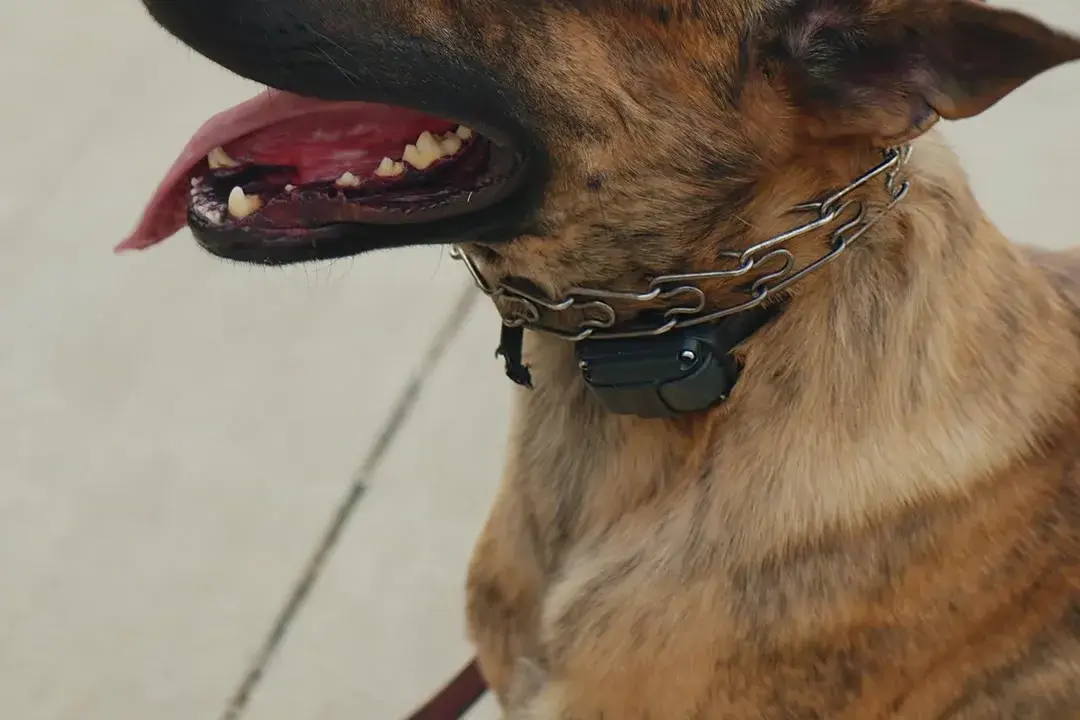
Then teach the dog the box. Delta’s cargo page says acclimating a pet to its travel crate is a process that can take weeks to months, and the AVMA calls defective crates and carriers the most common cause of animals escaping or being injured in air travel. A trained dog that settles in its wire crate at home has not met this one: a plastic or wooden shell, a bolted metal door, ventilation on every side, a water dish it must drink from without spilling. Feed it in there. Crate it in the car. Leave it in the garage with the radio on for an afternoon. The goal is the dog in the photograph above, in a box, on a day nothing makes sense.
Metal Door, Bolted Shell
American wants a door of welded or cast metal and a shell secured with bolts or screws. Alaska refuses a plastic door, a door held by a lock, and any carrier whose halves are held only by twist, slide or snap fasteners. A kennel that simply clips together fails both.
No Wire Crates
The folding wire crate a trained dog often lives in at home is out. IATA says containers made entirely of wire mesh must not be used for air transport. American Airlines Cargo and Alaska both repeat it, and Delta defers to IATA Container Requirement 1. Your dog needs to learn a second crate.
Plastic Has Limits
IATA’s container standard says some rigid plastic containers may not be suitable for large dogs, or dogs that are aggressive, and leaves acceptance to the airline. A bite-trained dog that is frustrated has the jaw to test a vent grille. Buy the heaviest-built kennel in the size you need.
Collars Off, Name On
IATA recommends removing collars, vests and harnesses before crating, and requires any GPS tracker to meet its dangerous-goods rules. Prong and e-collars come off. Identification moves to the microchip and to the crate itself, which the AVMA says should carry your name, address, phone and a destination contact.
The construction rules above come from American’s checked-pet kennel guidelines, Alaska’s baggage-compartment rules, IATA’s Container Requirement 1 and the AVMA’s travel guidance. They do not agree on collars. IATA’s container standard recommends removing collars, vests and harnesses before crating, while IATA’s pet page tells owners to put two pieces of identification on the collar, and the AVMA wants tags. The microchip plus a labelled crate is the way through; ask the airline what it wants on the dog.
Should You Sedate A Dog For A Flight?
No, and on most of these routes you could not if you wanted to. The AVMA tells owners to consult a vet before giving any tranquilizer or sedative, because they can increase the risk of heart or respiratory problems and generally are not allowed by airlines. American will not knowingly accept a dog that has been or appears to have been sedated. Delta does not permit sedation of household dogs and cats, including any medication that causes sedation. Alaska says it is not advised.
IATA explains the mechanism. Most common tranquillizers lower blood pressure, altitude lowers it too, and a cabin in flight is pressurised to roughly the equivalent of 8,000 feet; it calls that combination potentially fatal in old, chronically sick or stressed animals. Its pet page adds the detail a handler should care about most: a dog given acepromazine often loses its righting ability and sense of balance, and can end up in a posture that obstructs its own airway, in a crate nobody is watching. Where a vet prescribes medication for a genuine medical reason, IATA wants the drug, dose and time recorded on the health certificate.
Our view, as trainers rather than vets. A protection dog that needs a drug to tolerate a crate is telling you about the crate work, not the flight. Fix that on the ground, over weeks, and talk to your own vet about anything medical. If the dog still cannot settle, that is information too, and it may mean this dog should travel by road.
Flying A Dog Into The U.S.: The CDC Rules
Since 1 August 2024 the CDC has set the terms for every dog entering the United States, and what you need depends on where the dog was vaccinated and which countries it has been in during the previous six months. There are three situations worth knowing before you book anything.
Only rabies-free or low-risk countries in the last six months. The one required document is the CDC Dog Import Form receipt, which is free and filed online, one per dog. The dog must also appear healthy, be at least six months old, and carry a microchip a universal scanner can read. CDC lists only the high-risk countries; a country not on that list counts as low-risk.
Vaccinated in the U.S., and in a high-risk country in the last six months. This is the trap for a family taking its own dog abroad. On top of the import form you need a Certification of U.S.-issued Rabies Vaccination, completed by a USDA-accredited veterinarian and endorsed by USDA before the dog leaves the U.S. CDC is explicit that it is a specific CDC form, not the ordinary rabies certificate from your vet, and that the microchip must have been implanted before the rabies vaccine or the vaccine is invalid.
An older export certificate works only if it meets every condition. CDC still accepts, in place of that form, a USDA-endorsed export health certificate issued no later than 31 July 2025, but only if it was endorsed by USDA and can be viewed in USDA’s database, gives the dog’s age as at least six months, lists the microchip number, and carries current, unexpired U.S.-issued rabies vaccination details for a vaccine given after the microchip went in. An export certificate issued after 31 July 2025 is not accepted for re-entry. For a dog leaving now, expect to need the CDC form.
Without either document, the dog falls into the foreign-vaccinated rules. Those rules mean a reservation at a CDC-registered animal care facility and arrival at the airport tied to it. American Airlines Cargo, separately, has embargoed new bookings for dogs originating in a CDC high-risk country, or that have been in one within six months of travel, until further notice.
Mexico, which matters from Texas. Delta’s page says that from 3 August 2026 every dog entering Mexico needs a New World Screwworm inspection certificate from a USDA-accredited vet, issued no more than five days before arrival; United applies the same requirement to service dogs and in-cabin pets alike. Some destinations refuse dogs in the hold outright: Delta’s checked-pet list includes the United Kingdom, Australia and New Zealand, and other carriers keep their own lists. Delta also requires international cargo customers to use a shipper approved by the International Pet and Animal Transportation Association.
The Order To Do It In, And When To Drive Instead
Each step below can cancel everything after it, which is why the crate comes before the ticket.
- Measure the dog standing naturally — nose to tail root, ground to elbow, shoulder width, floor to ear tip — and run IATA’s formula before you buy a kennel.
- Check the largest kennel each aircraft on every leg will take. A routing that works on a widebody can fail on the regional jet that finishes it.
- Weigh dog and kennel together. At 100 pounds or more American’s cargo arm moves the dog from Priority Parcel Service to ExpediteFS; above 150, Alaska will not take it in the baggage compartment.
- Look up the hourly forecast for departure and arrival at every airport on the itinerary, against that carrier’s own limits, not the federal floor.
- Book a USDA-accredited vet for a health certificate inside the window the carrier sets — ten days before travel at American, Delta and Alaska — plus an acclimation statement if any airport may be cold.
- Plan food and water within four hours of handing the dog over, which American, Delta and Alaska all ask you to certify.
- Leave training collars, harnesses and trackers off the dog, and label the crate with name, contacts and feeding instructions.
- For any flight into the United States from abroad, complete the CDC Dog Import Form, and check whether a second CDC form had to be done before the dog left.
If the list keeps failing — a crate that will not fit the aircraft, a summer departure out of Texas, a connection through the desert, a dog that will not settle in the box — the answer is usually the road. It is slower and it is not glamorous, but it removes the hold, the temperature rules, the strangers at the comfort stop and the crate-height arithmetic in one decision. How a dog handles the first weeks in a new place, whichever way it arrived, is the subject of our guide to the first 90 days.
And if you are choosing a dog with travel already in the plan, say so early. Size and build differ between the three breeds we place, and the differences in temperament are set out in Malinois vs Dutch Shepherd vs German Shepherd.
Every Rule On This Page, And Where It Came From
Airline and agency pages were read on 8 October 2026; the IATA standard is the 52nd edition, January 2026. Airlines change these policies without notice, so read the originals before you book rather than relying on our summary.
- American Airlines — Traveling with pets — Checked pets only on military or State Department orders; 85°F and 45°F limits; under-seat carrier sizes.
- American Airlines Cargo — American PetEmbark — The cargo route for pets that do not qualify as carry-on or checked; warm-city embargo; high-risk rabies embargo.
- American Airlines Cargo — Kennel guidelines — Kennel series 100 to 700 with outside dimensions and weights; maximum kennel height by aircraft; no warm-blooded animals on the Airbus 319, 320, 321NX, 321S or 321H.
- American Airlines Cargo — Policies and restrictions — The 100-pound PPS line, the temperature method, comfort stops, the sedation policy, excluded Airbus types, and where household pets are accepted.
- Delta — Pet travel overview — The under-seat kennel rule; CDC and New World Screwworm notes.
- Delta — Shipping your pet — Cargo limited to military and Foreign Service PCS moves; 80°F and 20°F limits; no sedation; IPATA shipper abroad.
- Delta — Military pet travel — Checked-baggage crate rules and the largest kennel each aircraft type accepts.
- United — Traveling with pets — PetSafe ended; cabin only for the public; carrier dimensions.
- Southwest — Pet policy — Small cats and dogs in the cabin; no pets in the cargo compartment.
- Alaska Airlines and Hawaiian Airlines — Pet travel — Cabin, baggage compartment and Pet Connect options.
- Alaska Airlines and Hawaiian Airlines — Pets in the baggage compartment — 150-pound combined limit, kennel sizes to 40" x 27" x 30", door and construction rules.
- 14 CFR 382.3 — Definitions (Air Carrier Access Act rules) — The federal definition of a service animal on an aircraft.
- 14 CFR 382.73 — Determining whether an animal is a service animal — The two questions an airline may ask, and the behaviour that disqualifies an animal.
- 14 CFR 382.77 — Location and placement of service animals — Lap or foot space, and what happens to a service dog too large for either.
- 14 CFR 382.79 — When a carrier may refuse a service animal — Direct threat, significant disruption, and the individualized assessment.
- U.S. DOT — Service animals — Plain-language summary, including the DOT forms airlines may require.
- 28 CFR 36.104 — Definitions (ADA, public accommodations) — “Non-violent protection” as a task, and crime deterrence expressly excluded.
- IATA — Traveler’s Pet Corner — The container formula and IATA’s position on sedating animals in transit.
- IATA — Live Animals Regulations, Container Requirement 1 (52nd edition, January 2026) — Construction, ventilation, forklift spacers, cabin pressure, and removing collars before crating.
- AVMA — Traveling with your dog or cat — Tranquilizers, health and acclimation certificates, and crate failures.
- CDC — Bringing a dog into the U.S. — Requirements turn on where the dog was vaccinated and where it has been in six months.
- CDC — Entry from dog-rabies-free or low-risk countries — The CDC Dog Import Form, six-month age floor, and microchip.
- CDC — U.S.-vaccinated dogs returning from high-risk countries — The second CDC form that must be done before the dog leaves the U.S., and the four conditions on a pre-August 2025 export certificate.
- NOAA NCEI — 2023 Local Climatological Data, Dallas-Fort Worth (KDFW) — 1991–2020 normal daily maximum and minimum temperatures at DFW Airport.
- American Kennel Club — Belgian Malinois — Breed height and weight ranges.
Delta’s cargo rule is written to last only until further notice, and the others carry no promise of permanence either. If a carrier’s page reads differently on the day you book, send us the link and we will rework this guide around the new rule.
When We Publish Something Worth Reading
No sequence, no drip, nothing automated. One email when we have written something a buyer would actually use — which is a handful of times a year, not a handful of times a month. Leave and we stop.
Ask Before You Buy The Crate
If a move, a deployment or a second home is part of why you want a trained dog, tell us on the first call. It changes which dog makes sense, and we would rather talk through the logistics honestly than have you find the crate-height problem at a cargo counter. Our fully trained dogs are delivered in person.