How To Read A Protection Dog Demo
You are about to stand on somebody else’s field, watch a dog work for fifteen minutes, and then decide whether to spend more on it than you spent on your car. This is what to look at while you are standing there — written by two people whose job is to be the one it bites.
What A Demo Is Built To Show You
A demonstration is not a test. It is a presentation, and there is nothing dishonest about that by itself — you asked to see the dog, and this is how anyone would show you one. But a presentation optimises for the moment it is built around, and in this business that moment is the bite. The bite is loud, fast and cinematic. It is the reason you booked the flight. It is also close to the least informative thirty seconds of the entire visit.
Be clear about what a demo genuinely does establish. It shows that the dog will engage, that it has been taught a set of exercises, that the handler can run it, and that it has seen equipment before. Those are real things and they are worth confirming, because a surprising number of dogs sold as protection dogs cannot do them. Watching the dog work is not optional. Never buy one of these dogs off a video alone.
Now be equally clear about what a demonstration, left to its natural shape, will never show you. It will not show the dog somewhere it has never been. It will not show the dog worked by a person it has never met. It will not show what happens in the twenty minutes after the equipment goes back in the truck, which is the part of the day you will actually be living in for the rest of the dog’s life. And it will not show the repetitions that went badly, because nobody schedules those.
None of that requires anyone to lie to you, and that is the point worth carrying onto the field. Nearly everything that goes wrong for a buyer at a demo happens inside the truth. The dog really did bite. The decoy really did take a hit. The handler really did give one command. The question is never whether what you watched happened. It is what it was evidence of.
Is The Dog Working The Man, Or The Equipment?
If you take one idea from this page, take this one. Every protection dog is trained on equipment — a sleeve, a suit, a hidden sleeve — because there is no other way to teach a dog to bite full and hard without wrecking the dog or the person. The equipment is not the problem. Dependence on it is.
For some dogs the equipment stops being a training tool and quietly becomes the object of the exercise. The dog is not confronting a person; it is chasing a target it has been paid on hundreds of times, the way a retriever loves a bumper. That dog can look tremendous. It can be fast, loud, hard-hitting and thoroughly convincing on video. And on the day something happens involving a person who is not wearing a sleeve, the picture it was trained to complete is simply not there.
Watch the eyes before the bite, not during it. A dog reading a person orients to the whole person: it checks the face, tracks the body, adjusts as the man moves, and takes whatever presents when it arrives. A dog reading equipment locks onto the limb carrying the gear — its head follows the sleeve rather than the shoulders. At speed the difference is small, and it is still the most reliable single tell there is.
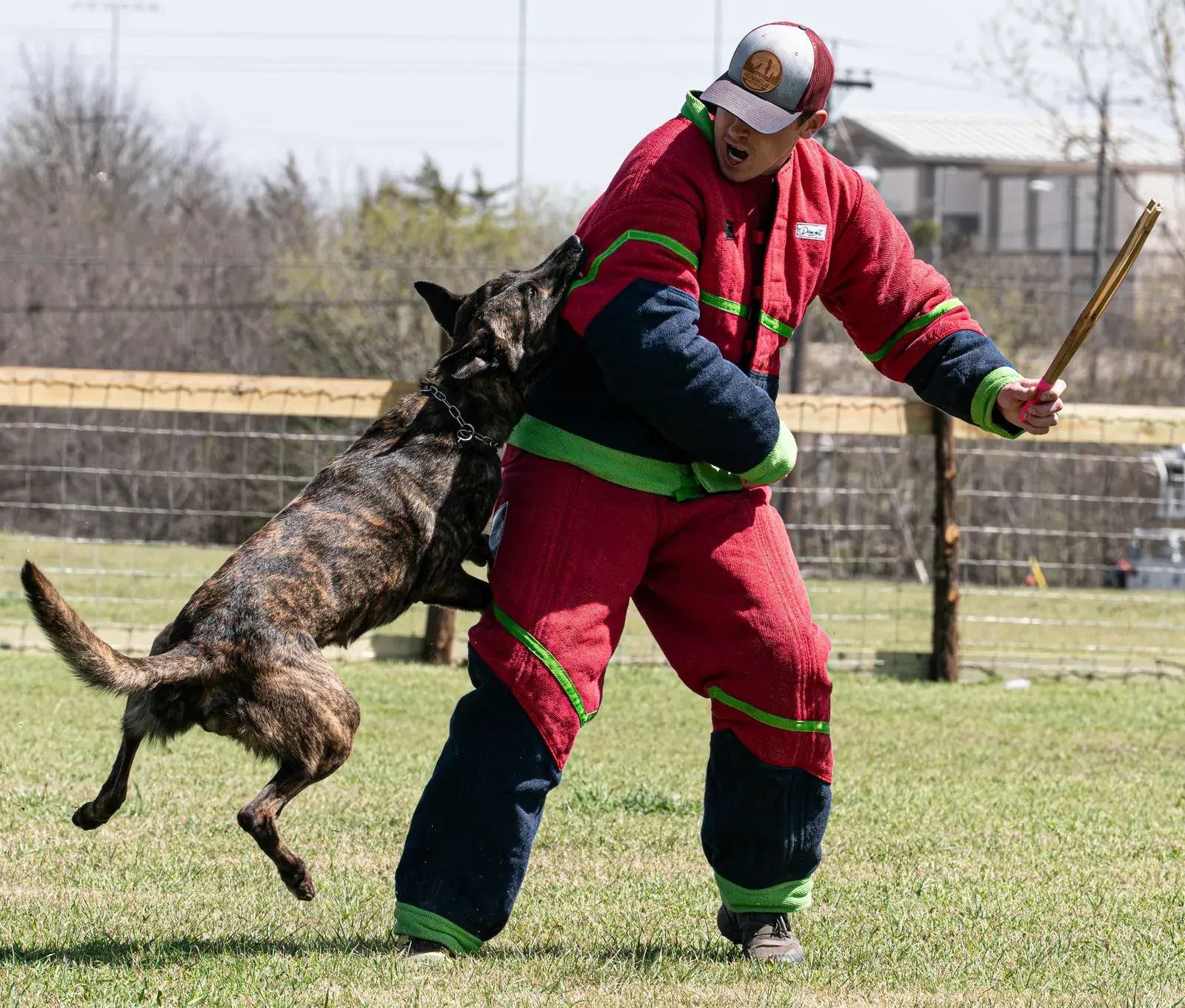
Ask for the three-second version. A decoy can settle this on request: present the equipment to one side while taking the body the other way. An equipment dog goes where the sleeve went. A dog working the man goes where the man went, and sorts out the bite when it gets there. It costs nothing to run and no honest trainer will mind being asked.
Change the picture and watch for confusion, not fear. Ask for a presentation the dog has not memorised — a hidden sleeve under a jacket, a different suit, a decoy dressed differently to the one the dog knows. What you are looking for is a dog that arrives, stalls, circles, and then looks back at the handler. That look back is the moment to remember. It is a dog asking where the game went.
Watch what happens when the equipment comes off. If the decoy slips the sleeve, does the dog carry it away and celebrate over it, or does it stay oriented on the person who was just inside it? Be fair here: carrying a slipped sleeve is taught, normal, and shows up in plenty of good young dogs. What you are reading is not whether the dog takes the prize, but which of the two it finds more interesting when both are standing in front of it.
Notice how much ritual the dog needs. Some dogs require a specific stack of cues to switch on: a certain approach, a certain sound, a certain arm movement, a certain distance. Any one of those on its own is meaningless. A dog that needs the whole sequence, in order, is a dog with a very narrow trigger — and nothing outside a training field is ever going to arrive in order.
Every Way A Decoy Can Make A Dog Look Better Than It Is
This is the part of the subject we can write and a sales page cannot. None of what follows is fraud. These are ordinary decoy skills, used constantly for good reasons — protecting a young dog’s confidence, keeping training clean, making sure nobody gets hurt. Pointed at a buyer instead of at a training plan, the same toolkit will flatter an average dog without a single false sentence being spoken. So here it is, itemised.
Feeding The Bite
Delivering the arm into the dog’s mouth at the exact moment it arrives, so a mediocre entry closes clean and full. A decoy who wants a dog to look good can give it the bite rather than make it take one, and almost any dog’s grip improves when the target cooperates.
Absorbing The Hit
Stepping into the dog and turning with its momentum makes a modest impact look violent. Taking pace off at the last instant means a dog that would have been bounced never has to deal with being bounced. Impact is the easiest thing on the field to stage, in either direction.
Managing Pressure
Pressure is the decoy’s to give: driving forward, standing tall over the dog, staring, freezing, working in close, stick presence. Every dog on earth looks confident when the pressure is taken away, and nothing about a demonstration obliges anyone to apply any.
Timing The Slip
Ending the bite at the dog’s strongest moment. If every exercise stops shortly after the entry, you never see the middle of the fight — and the middle is where grip, clarity and nerve actually live. A demo in which nothing lasts is telling you something.
Choosing The Ground
Dogs are more surface-sensitive than buyers expect. Grass and matting are forgiving. Slick concrete, gravel, metal, wet footing, a stairwell, or tall grass that hides where the feet are going are not. A demo on the home field is home-court advantage in the literal sense.
Controlling The Angle
Straight-line sends from a comfortable distance, presentation from the side the dog prefers, the handler standing where the dog expects, the same field at the same time of day. Each one is a rehearsal cue, and stacked together they are how a decent dog is made to look finished.
We would use most of that in a session with a green dog and not think about it twice. The reason to hand you the list is that the same six levers, applied to a dog you are about to buy, produce footage you cannot argue with and a dog you cannot rely on. The defence is not suspicion. It is specificity — asking for particular changes and watching what happens.
Five Things To Ask For, And Why A Good Seller Agrees
You are not trying to catch anybody out. You are removing rehearsal one variable at a time and watching two things: how the dog responds, and how the seller responds. A seller with a finished dog finds these requests routine, because a dog that only works in one picture is not much use to them either.
A Decoy The Dog Has Not Worked
Dogs learn individual people — footwork, timing, presentation, size, rhythm, even smell. A familiar decoy is a conversation the dog has already had. A new body is a new question, and this is the single most revealing change you can ask for. It also has a legitimate modified answer: an inexperienced decoy can be hurt and can hurt the dog, so “not you, but here is someone the dog has never worked” is a fair reply from an honest seller. “There is nobody else” is a different kind of reply.
Ground The Dog Does Not Know
A different surface and a different place. A parking lot, gravel, an indoor hallway, a stairwell, the ground next to your rental car. The point is not to rattle the dog — it is to find out whether its confidence travels, because yours is going to have to.
The Handler Back, And Quiet
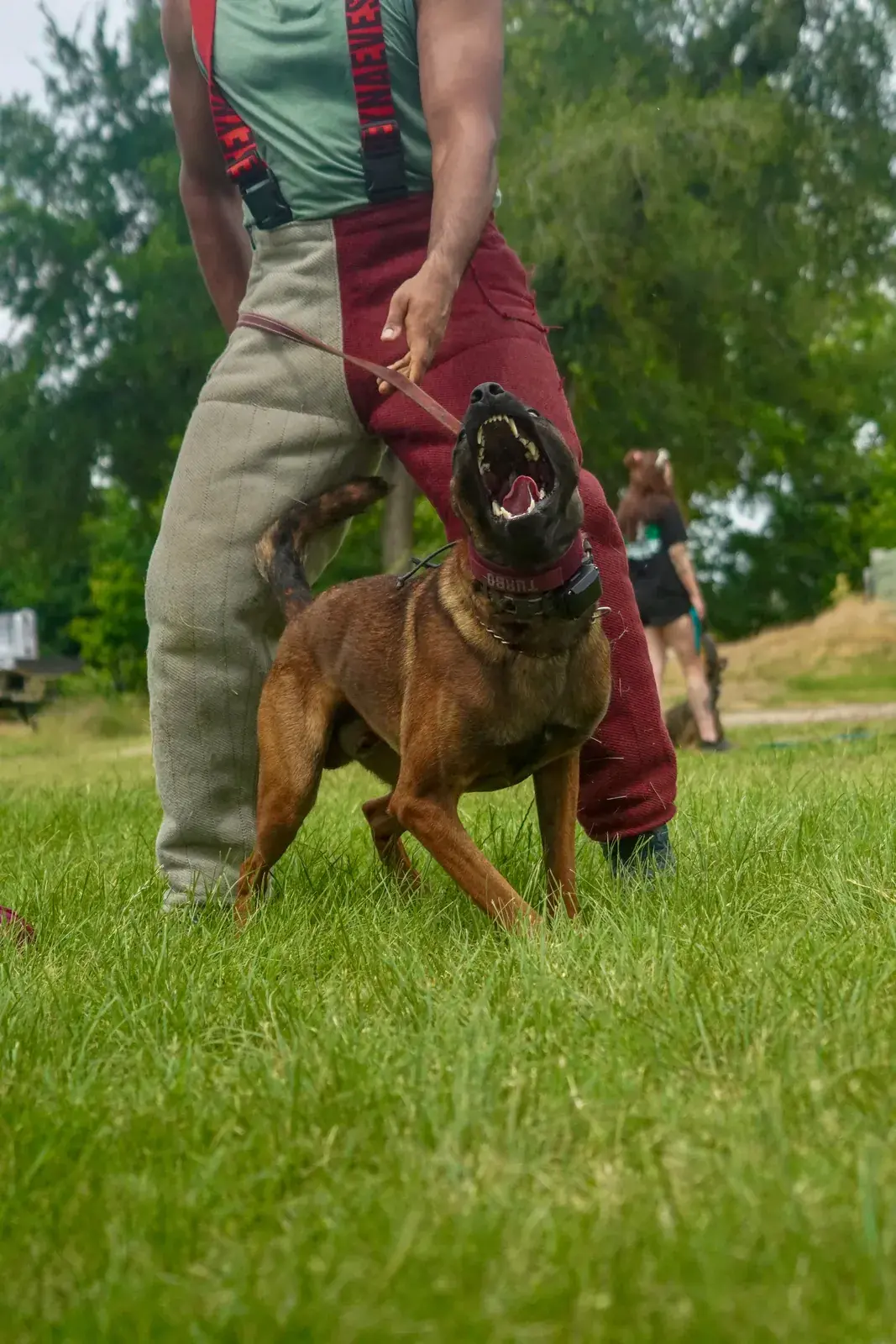
A great deal of what reads as the dog’s obedience is really the handler standing at its shoulder. Ask for the same exercises with the handler well back and saying nothing between commands. Watch whether the dog still hears its name at distance, and whether the picture holds when the person it is bonded to is no longer inside it.
An Out While The Fight Is Live
Outing off a decoy who has already gone still is the easy version, and it is the version most demos show. Ask for the out while the decoy is still working, and then for the dog to hold position rather than re-bite on its own initiative. A dog that outs cleanly and then quietly re-engages without being sent is not showing you drive. It is showing you who decides.
Ten Minutes Of Nothing
Ask them to put the equipment away and simply let the dog exist near you. Buyers give this request the least respect and it returns the most information — enough that the two sections below are about nothing else.
One more request, and make it before you book anything: ask for a single unedited take. Cuts hide. If everything you have been sent runs under fifteen seconds, ask for one continuous clip of a full session — including the repetitions a marketing edit would remove. What a seller does with that request tells you a great deal before you have spent a dollar on airfare.
The Thirty Seconds After The Bite
The bite tells you what a dog can do at the top of its arousal. Recovery tells you what its nervous system is like, and you are going to spend vastly more of your life with the second thing than the first.
Watch the dog after the out and count roughly in your head. A dog with a sound nervous system comes down: the mouth opens into a normal pant, the body loosens, it turns to its handler, it can take a sit and hold it, it can take food, it hears its name. It went up fast and it came back down fast. That is the property you are buying.
The other version stays up. It remains locked on the decoy long after the exercise ended. It screams, whines, paces or spins. It will not take food. Its name means nothing for a long while. Or it puts the leftover adrenaline somewhere else — the leash, the handler’s sleeve, whatever is nearest. None of that is extra drive. It is a dog that cannot get back to baseline, and it matters far more in a house than on a field, because in a house nothing is scheduled. Something will happen in your driveway one evening, and a dog that stays up will still be up while your family is trying to move around it.
There is a simple way to see it. Ask them to put the dog away, wait five minutes, and bring it back out. Does it come out neutral, or does it come out cranked and hunting for the fight it just had? A dog that can only return to work in the second state has told you what your evenings look like.
Watch handling in the same window. Can the handler take the collar, put the dog in a down, walk it past the decoy at a normal distance without a scene? Neutrality on the way past somebody it was biting moments earlier is one of the better signs in the whole visit, and it is the exact behaviour you will need on every walk you ever take.
The Dog With Nothing To Do
Almost all of a protection dog’s life is ordinary, and almost all of the disappointment buyers report comes from the ordinary parts rather than the work. So spend the last stretch of the visit watching the dog be a dog, with the equipment packed away and nobody performing.
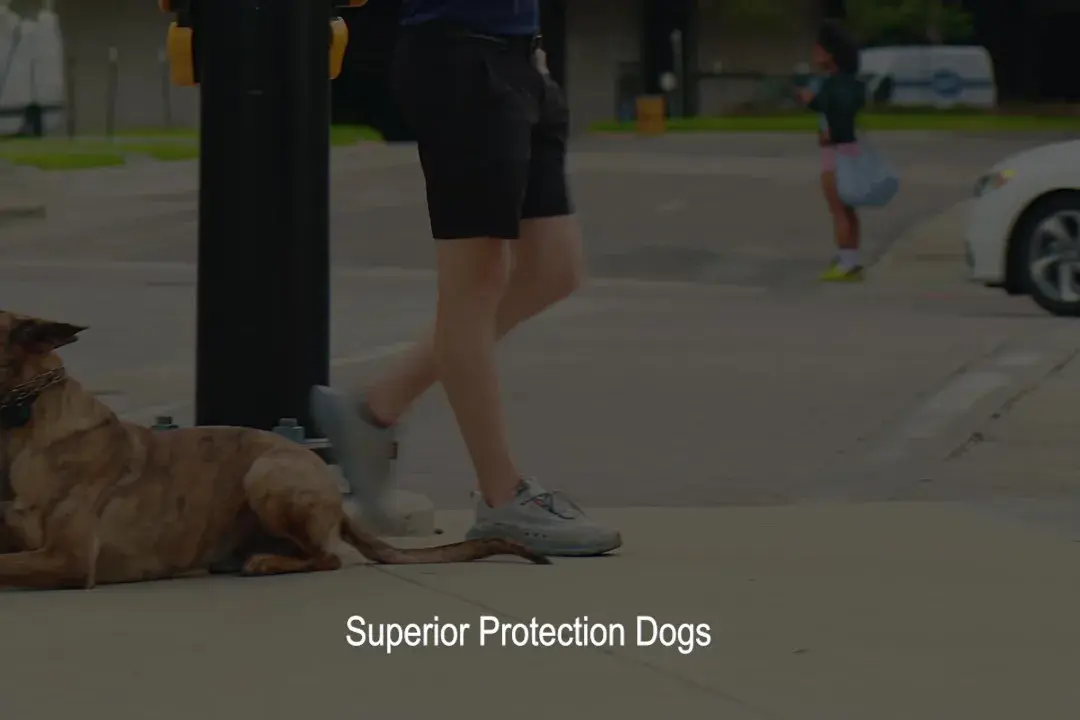
A stranger walking past at a normal distance, not engaging. The correct answer is nothing at all — no bark, no hard stare, no lunge to the end of the leash. A dog that alerts to everybody is not more protective, it is less discriminating, and it is the reason people quietly stop taking their dog anywhere.
Something dropped. A chair scraping, a metal bowl on concrete, a tailgate. Startle is fine, and a dog that never startles at all is unusual rather than superior. What you are grading is the recovery: look, orient, go back to what it was doing. A dog that leaves the area, or that comes up and stays up, or that has to be talked down, has a nerve issue — and nerve is the one thing on this page that training does not fix.
A child’s voice. High, sudden, unpredictable, paired with running. This is not primarily about bite risk; it is about arousal. Watch whether erratic fast movement and squealing lifts the dog. If it does, you are signing up to manage that inside your own home for the animal’s whole life, and if you have young children it is the most important thirty seconds of the trip.
Unfamiliar human shapes and unfamiliar floors. A hood up, an umbrella, someone carrying a large box, a person with a limp, a wheelchair. Dogs generalise people badly. The same goes for tile, wood, open stairs and metal grating. If you can get five minutes of plain walking somewhere with people in it and no work at all, take it. It looks like the least valuable part of the day and it is often the most.
What Is Not A Red Flag
Buyers who read a guide like this sometimes arrive determined to catch somebody out, and end up turning down good dogs for bad reasons. In fairness to the people doing this work properly, every one of the following is normal.
- Barking, and plenty of it. The bark and hold is a trained behaviour in most systems, and volume tells you close to nothing about the dog underneath it.
- A keen dog. Pulling toward the decoy, vocalising, spinning on the start line — that is what an animal that likes its job looks like, not a defect.
- Equipment. Sleeves and suits are how these dogs are built without anybody getting hurt. The presence of equipment is never the problem; dependence on it is.
- Prey drive. Prey is not fake and a dog without it is not more serious. The question is only whether prey is the sole thing present once real pressure arrives.
- A dog that needs a command to engage. That is the correct answer and you should insist on it. A dog that engages on its own judgement is a liability with a pedigree.
- An out that takes a beat. A beat is not a refusal. What matters is that it happens every time, without an escalating argument between dog and handler.
- One imperfect repetition. Every honest trainer will show you a session containing one, and a demonstration in which nothing at all goes slightly wrong should make you more curious, not less.
- A skilled decoy. Skill is not deception — it is what keeps the work safe. The only concern is skill used to keep something from you, which is why what you ask for matters more than how polished the catch looks.
The Short Version, For Your Pocket
Roughly in the order the visit will run. You will not get through all of it on every trip, and the last two questions are the ones most likely to change your mind.
- In the seconds before the bite, where do the dog’s eyes go — the man, or the equipment?
- Ask the decoy to present the sleeve one way while moving his body the other. Which one does the dog follow?
- Change the picture: a presentation the dog has not memorised, clothing it has not seen, a decoy it has never worked.
- Change the ground: a different surface, a different location, somewhere nothing has ever been rehearsed.
- Put the handler well back and quiet, then run the same obedience and the same send again.
- Ask for an out while the fight is still live, then for a hold instead of a self-sent re-bite.
- Time the recovery roughly. How long until the dog can sit, take food, and hear its name?
- Put the dog away, bring it out five minutes later, and watch which dog comes back out.
- Ten minutes of nothing: a stranger walking past, something dropped, a child’s voice, an unfamiliar floor.
- Ask for one unedited continuous clip of a full session, including the repetitions they would normally cut.
- Ask what kind of home they would refuse to sell this dog to. No answer means they are moving inventory.
- Ask yourself whether you would still want this dog if it never bit anything in its life.
What A Demo Can Never Tell You
Everything above is about the dog. None of it settles the prior question, which is whether a trained protection dog is the right answer to the problem you actually have. A dog can pass every check on this page and still be the wrong purchase for your household, your schedule, or your tolerance for managing an animal that needs a job. That question has its own guide, and we would rather you read it first.
If you are still working out which kind of dog you are even looking at, the three breeds we place read very differently under pressure and even more differently in a living room. And if you want to know why we are the ones writing this — both of us are listed decoys at PSA-sanctioned trials, which is a claim you can check rather than take on faith. It is set out, with the source, on our story.
Take this list to whoever you are buying from, including us. If a seller is uncomfortable with any of it, that is your answer, and it cost you nothing to find out.
When We Publish Something Worth Reading
No sequence, no drip, nothing automated. One email when we have written something a buyer would actually use — which is a handful of times a year, not a handful of times a month. Leave and we stop.