
A Protection Dog With Kids In The House
What the research on child dog bites actually shows, why training is not the safety system, and the rules that let a powerful dog and small children share a house without anybody relying on luck.
Can A Protection Dog Live Safely With Kids?
Yes, when that individual dog was selected for a family and the adults run the house. The protection training is not what makes it safe with children. The Philadelphia study of children under 7 found a typical scene: a young child, indoors, in a friendly interaction the child started, with a dog it knew, bitten in the face. The other studies below agree on home and face, but not on the dog being familiar. Older children are bitten differently. None of the studies below looked at protection-trained dogs, so we cannot say what bite training changes for child bites. What the studies show is that the bites happen in ordinary household moments, which training alone is not shown to prevent. That is why a protection dog with kids lives by the rules for any large dog.
Nobody can honestly promise you a dog that will never bite a child, and we do not. What can be done is to stack the odds: a dog chosen first for its temperament around children, a household that never puts it in the situations the research keeps pointing at, and children taught what they are old enough to learn.
Child Dog Bites: Who, Where, And Which Dog
Children carry the risk, and the youngest carry it in the face. The CDC’s national estimate for 2001 put 368,245 people in US emergency departments for nonfatal dog-bite injuries, with the injury rate highest for children aged 5 to 9. Among children under 4, 64.9% of injuries were to the head or neck. Those figures are more than two decades old. We use them because they are a national CDC breakdown by age, and the newer studies below show the same shape.
Two different kinds of bite, split by age. A team at the Children’s Hospital of Philadelphia interviewed the families of 203 children treated for dog bites. 72% knew the dog that bit them. Most bites to children under 7 happened indoors, with a familiar dog that was not moving, during a friendly interaction the child started — and 70% of those younger children were bitten in the face. Older children were mostly bitten by unfamiliar dogs, outdoors, while they were active and not interacting with the dog at all, and 72% of their bites were to the arms and legs.
In the youngest group, the typical bite came from a stationary, familiar dog indoors, during a friendly interaction the child started.
The national trauma data agrees. A study of 7,912 children in the US National Trauma Data Bank from 2007 to 2014 found that children aged 0 to 2 — about as numerous as the 6-to-12 group, in a far narrower band of ages — were frequently bitten at home, on the face and head. The authors’ conclusion is blunt: children that young “cannot yet be taught how to properly interact with a dog,” so the education has to go to their parents.
And so does Texas. A case series by researchers at the Texas A&M Health Science Center in Temple reviewed 102 children treated for dog bites between October 2011 and October 2016. The mean age was 5.84 years and 43.1% were preschoolers aged 2 to 5. The injuries involved the head and neck in 92.1% of cases, 57.8% happened at home, and 28.4% happened while the child was petting or playing with the dog. A parent was reported present in 43.6% of cases, so a parent being nearby did not prevent these bites. The paper does not say how close or how attentive the parent was.
Where the studies disagree. You will read that almost every child is bitten by a dog they know. The Philadelphia figure supports a strong version of that for young children. But a prospective study of 100 children across six emergency departments in Belgium found the dog was not familiar to the child in 77 of the 100 bites. What it shares with the American data is the part that matters for your house: 65 of the 100 were bitten at home, and those home bites involved children with a median age of 5 who were without adult supervision at the time. The honest summary is not “it is always the family dog.” It is that the youngest children are bitten at home, in the face, often with no adult supervising closely (Belgium), though in the Texas series a parent was present in 43.6%.
In One Clinic Study, Most Dogs That Bit A Child Had Not Bitten One Before
The study we would hand every buyer is a small one from the University of Pennsylvania’s veterinary behaviour clinic, covering 111 bitten children and 103 dogs. Where the dog’s history before the clinic visit was known, 66% had never bitten a child before, and 19% had never bitten anybody. 66% of their owners had taken them to obedience classes. The authors’ verdict was that common calming measures, neutering and training among them, “were not routinely effective deterrents.”
The same paper shows what the bites were about. Children under 6 were most often bitten in connection with resource guarding (44%) — food, toys and other things the dog valued — though that group was only 34 children. Older children were most often bitten over territory (23%), and for children who did not know the dog, territory guarding was the most common circumstance, at 53%: a child arriving in the dog’s house or yard.
Three caveats, because they matter. These were dogs referred to a behaviour clinic after biting a child, and 77% of them had anxiety-related abnormalities, so they are not a cross-section of family dogs. The authors say obedience training was not specifically measured, and that cohort studies would be needed to know whether it prevents bites. And the paper does not say what kind of obedience class that was; we assume it was ordinary pet obedience rather than the control a finished protection dog works under. Our own view is that a dog which sits on cue in a training hall has not thereby learned to tolerate a three-year-old reaching for its bowl. Selection and management are our answer to that; the study did not test them.
A survey of 804 owners at a university veterinary hospital found a general lack of knowledge about dog behaviour and safety practices for dog–child interactions. That gap is why the rules below are written as rules.
Is A Protection Dog More Dangerous Around Children?
A UK council’s safeguarding guidance for home-visiting professionals, the North East Lincolnshire guidance on dangerous dogs, tells them that dogs “kept and/or bred for the purpose of fighting, defending or threatening others” are likely to present more risks than genuine pets. It is UK guidance, written for a different legal system, and it is not about trained personal protection dogs in particular.
In our judgment, a badly made protection dog is the real risk. A dog that bites because it is frightened, that was made sharp by agitation rather than selected for clear nerve, that comes up fast and stays up, is in our view a worse dog to have in a kitchen than an ordinary pet.
What a well-made one adds. Obedience that holds when the dog is aroused. An out that works on the first word. A place command that keeps the dog on its bed while a toddler crosses the room. Engagement that starts on a handler’s cue rather than the dog’s opinion. And, through selection rather than training, a dog that recovers quickly when something startles it — which is the trait that decides how it reacts to a dropped plate or a shriek. We set out how the cue and the off-switch work in whether a protection dog will bite without a suit.
What it does not change. It is still a dog, and the bites in the studies above are ordinary dog bites: a resting dog crowded, a bowl approached, a face pushed into a face. We know of no study showing that protection training teaches a dog to enjoy a hug or removes resource guarding; screening for guarding before you buy is our own advice, not a research finding. And training does not shrink the dog. A large working dog that makes the same mistake as a small terrier does a different amount of damage, which is the whole reason the margin for error has to be smaller.
What “Great With Kids” Should Actually Mean
Our own position is published on the FAQ: temperament around children, guests and everyday household situations is the first filter, ahead of anything the dog can do on a field. We are fathers ourselves. That is a filter we apply before a dog is offered to a family. It is not a guarantee about any animal for the next ten years, and anybody who offers you that guarantee is selling the sentence rather than the dog.
What good looks like. A dog that notices a toy truck hit the floor, looks, and goes back to sleep. A dog that lets a child walk past it in a hallway without tracking her. A dog that, when it has had enough of a small person, gets up and leaves — and a family that treats that as the dog doing everything right. Neutral, tolerant, quick to settle, and living under rules that mean it is rarely asked to tolerate much.
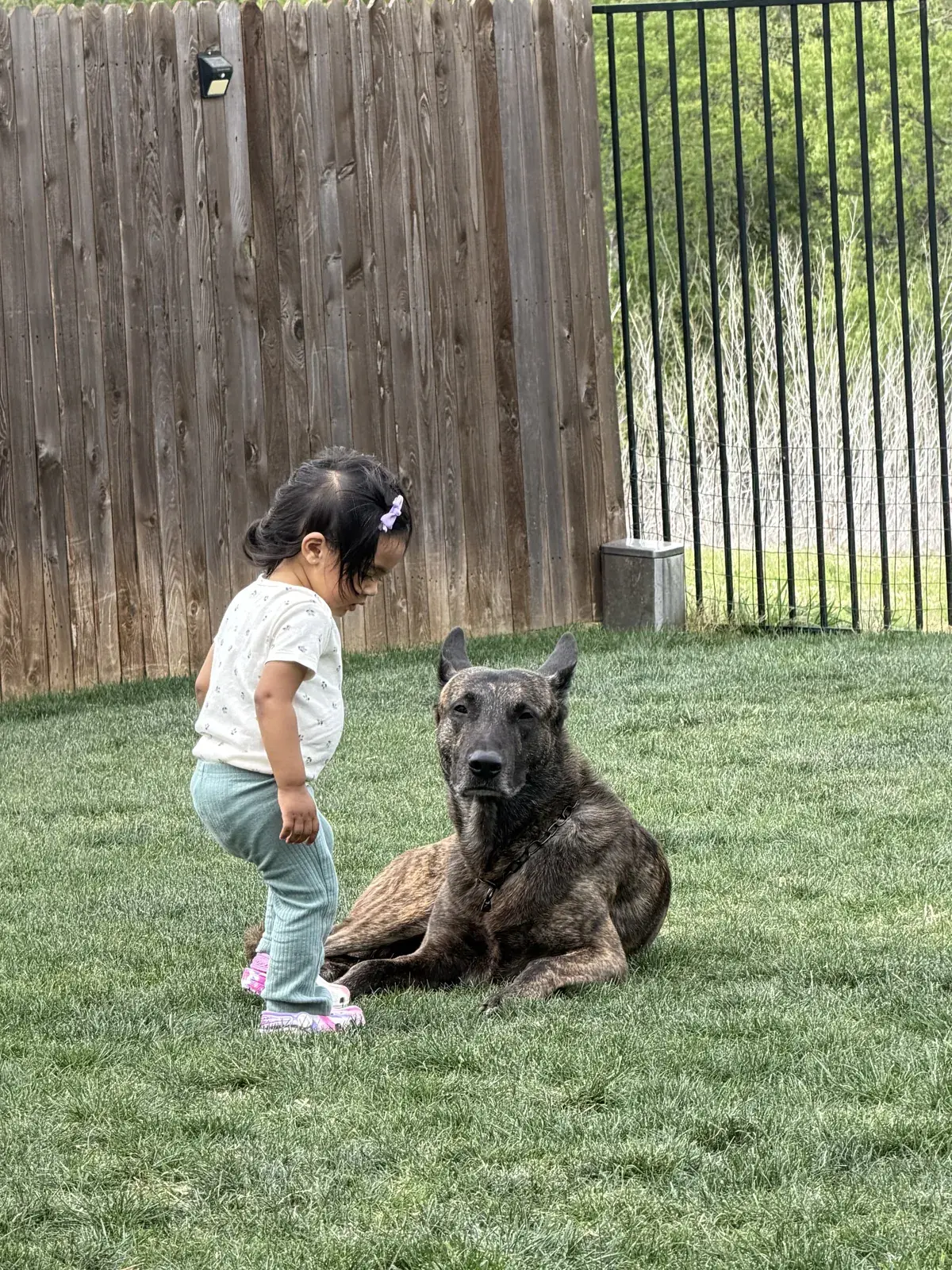
What it does not mean. A nanny. A playmate for unsupervised games in the yard. A dog that “lets the kids do anything to him.” That last one is the phrase to listen for, because a dog that stands still for ear-pulling is not necessarily enjoying it. Researchers at the University of Lincoln point out that when a dog freezes and does not move, parents and teachers may take it as a happy dog.
The consent test. When a child pets the dog with you there, have them stroke for a few seconds and then stop. If the dog leans in or nudges for more, it is enjoying it. If it stays still, turns its head away, licks its lips or moves off, the answer was no, and the child has just learned to hear it. Hugging is off the list entirely. The RSPCA’s family guidance says flatly that most dogs dislike it, and the Lincoln researchers note that young children hug dogs as a sign of friendship without realising it can frighten them.
Eight Rules For A Protection Dog In A House With Children
These sit on top of the general household rules for a new dog, which are covered in the first 90 days with a protection dog. Most of them trace straight back to a finding above.
Supervised Or Separated
Supervised means an adult whose eyes are on the dog and the child and who could reach them both before anything happened. Separated means a crate, a closed door or a gate. “In the same room while I cook” is neither of those.
The Dog Always Has An Exit
A crate or gated corner the children never enter, not to fetch a toy, not to say goodnight. When the dog gets up and walks away from a child, it has made the best decision available to it. A house that lets it leave keeps that decision cheap; a house that follows it into its corner teaches it the next step up.
Food And Chews Behind A Door
The dog eats in its crate. Bones, bully sticks and anything else it would care about losing happen only when it is crated or the children are out. Resource guarding is the circumstance most tied to bites on small children in the clinic data below, so the simplest fix is a house where the situation never arises.
No Fetch Run By Small Children
A game of fetch ends, every few seconds, with someone taking an object out of the dog’s mouth. With an adult throwing, that is training. With a four-year-old throwing, it is a resource contest repeated fifty times an afternoon. Same with hand-fed treats: the adult gives them, or the child tosses one to the floor when an adult says so.
Nobody Lies Down With The Dog
Families who would never let a child wake a sleeping dog still let a child curl up against one on the rug. To the dog it is the same event: something pressing on it while it rests, with no way out that does not involve moving the child.
Rough Play Happens Without The Dog
Wrestling, a sibling fight, a friend tackling your son in the yard, a pillow fight, a scream that is really a laugh. This is the rule that is specific to a protection dog. The dog should not engage without a cue, and selection and training are built around exactly that — but nobody needs to test it with your children. Crate first, then play.
Protection Cues Belong To Adults
Children do not learn the words that start or stop protection work, do not say them as a joke, and do not ask the dog to “get” anybody, not even a sibling in fun. Obedience a child can share under an adult’s eye. The other vocabulary stays with the handler.
Toys Live In Two Places
The dog’s toys and the children’s toys are kept apart, and the dog never gets a stuffed animal as a chew. A dog taught that plush things are its own will eventually take one off a toddler, and the toddler will try to take it back.
Two of those rules come from a survey of 402 caregivers of children up to six in Austria and Germany. The most common resource interaction they reported was the dog letting the child take objects out of its mouth, and the injuries that did happen around resources happened while children were feeding treats or taking things from the dog during fetch. Families mostly respected the rule about not disturbing a resting dog, yet children lying down against a resting dog was reported more often, though it amounts to the same thing. The same researchers found low compliance with the best-known rule of all, never leaving the child alone with the dog, and that parents’ attention dropped as their children got older — just as the children’s play with the dog was getting more complicated.
One more rule that is not on the list because it is about you: never punish a growl. A growl is the dog telling you, early and loudly, which situation it cannot tolerate. Punish it and you keep the situation and lose the warning.
What Children Can Learn, Age By Age
Children can be taught to read dogs, and the evidence for it is better than most people expect. It is also slower and patchier than most parents hope, which is why the teaching sits on top of the rules rather than replacing them.
How well small children read a dog. The University of Lincoln showed 3- to 5-year-olds and their parents short videos of dogs giving distress signals, then taught them what the signals meant. Before teaching, 3-year-olds correctly identified the loud signals — growling, snarling, snapping — 47% of the time, about half, and parents 83% of the time. The quiet signals at the bottom of the ladder, like yawning, blinking and licking the nose, were where everyone struggled: 3-year-olds got them right 16% of the time and 5-year-olds 20%, and even the parents only 28%. After a short lesson, the parents rose to 73% on those quiet signals. Children improved most on the loud signals and kept the gain for a year; on the quiet ones they barely moved.
The practical reading: the person in your house best placed to catch a dog’s early discomfort is an adult who has been taught what to look for. Learn the ladder yourself — yawn, nose lick, head turned away, body turned away, walking off, crouching with the tail tucked, stiffening and staring, growling, snapping — before you expect a child to.
Older children change their behaviour when taught. A randomised trial in Sydney schools with 346 children aged 7 and 8 gave the children at four of the eight schools a 30-minute lesson from a dog handler. Seven to ten days later a docile Labrador was tethered in the playground, with its owner nearby disguised as a tradesman, and a hidden camera watched. 79% of the untaught children patted it without hesitation; 9% of the taught children patted it, after careful assessment or surreptitiously. The trial used one friendly dog, measured behaviour only in the following week, did not measure bites, and was run by consultants to the programme’s developer, which also funded it. Within those limits, it is evidence that a short lesson changed what 7- and 8-year-olds did in the following week.
Under Three
Teach nothing and rely on nothing. A toddler is mobile, grabs, falls, and is at exactly the height of the dog’s face. Every rule at this age is an adult rule: gates, crate, and the dog out of the room when nobody is watching. This is the stage where separation does most of the work.
Three To Six
Old enough to learn a few concrete rules. In the Lincoln study, 3-year-olds identified loud signals like a growl or a snap correctly about half the time before any teaching, so an adult still reads the dog for them. Not old enough to be trusted to obey those rules when excited. “The dog’s bed is the dog’s room.” “When the dog walks away, the game is over.” “Ask a grown-up, not the dog.”
Seven To Twelve
Old enough to follow concrete rules like the Sydney lesson: approach slowly, ask first, leave a resting dog alone. We have not found a study showing that this age group reliably reads the quiet signals, so an adult still watches for them. Can join obedience sessions with an adult present, feed the dog its measured meal into the crate, and take part in the routine. The risk at this age moves outward: friends over, other people’s dogs, the yard and the street.
Teenagers
Can share daily care and obedience, and some can be taught to walk the dog once they are physically able to hold it and have been through the handling training. Protection work, and deciding when the dog is put away, stays with the adult handler.
When we deliver, we meet everyone who lives in the house, children included, and the handover happens in your own rooms. What the children learn that day is the beginning, not the job.
Playdates, Birthday Parties And The Kid Next Door
Your children live under your rules. Their friends do not know the rules, are not yours to correct in the way your own are, and arrive in the one setting the Pennsylvania clinic data flags for children who do not know the dog: the dog’s own house and yard. A protection dog makes that worse in one specific way, because noticing who comes through the door is part of what it was selected for.
Put the dog away before the doorbell, not after. Crated in a quiet room with the door shut, before the first car pulls up. Putting a dog away once it is already up at the door means handling an aroused dog through a crowd of excited children, which is the worst version of the job.
Birthday parties and pool parties are not training opportunities. A Texas backyard in July with twenty children, a pool, splashing and shrieking is a lot of noise and fast movement for any dog. The dog spends it crated indoors with the air conditioning and a chew, or at a boarding kennel that takes dogs with bite training. Nobody’s afternoon gets better because the dog was there.
Sleepovers. The risk is at two in the morning, when a child who does not live there walks past the dog’s room in the dark looking for the bathroom. Crate the dog and close the door for the night. Tell the visiting children where the dog is and that its door stays shut.
The gate. A child coming over the fence for a ball is in the dog’s territory with no adult anywhere. Locking gates, a dog that is not loose in the yard unattended, and a word with the neighbours’ children are cheaper than any of the alternatives. The legal side of a bite on someone else’s child is its own subject; Texas dog bite law covers how the state treats it.
A New Baby, And The Year The Baby Starts Moving
If the dog is already there and a baby is coming, prepare the dog before the baby arrives rather than after. The RSPCA’s advice is practical: bring out the cot and the pram early so the dog gets used to them, play recordings of baby sounds, and teach the dog a resting spot in the same room as you but away from where you will be busy with the baby. Tell us before the due date, not after the first hard week.
The danger window is not the newborn. It is the crawler and the toddler. The UK safeguarding guidance cited above tells professionals to repeat their risk assessment when the baby becomes mobile, and the Austrian-German survey saw fear-related dog behaviour toward children peak between six months and three years. The same survey found that dogs which had lived in the family longer than the child showed fewer friendly behaviours toward the child and more fear-related ones than dogs that grew up with children. If your dog predates your baby, assume it will need more help with the change, not less.
Gates do the work in this stage. Baby gates across the kitchen and the dog’s room, a crate the toddler cannot open, and a household habit that the dog is behind a barrier whenever the adult in charge looks away — to answer the door, to change a diaper, to take a call. That is not a sign the dog is untrustworthy. It is what the research on young children and dogs points to.
Starting with a puppy instead? A puppy growing up alongside small children has its own set of problems — mostly needle teeth and a toddler who runs when the puppy chases. We set that out in raising a protection dog puppy.
Choosing A Dog For A House With Young Children
Breed matters less than the individual animal in front of you. A badly bred dog of the “family” breed is a worse choice for small children than a well-bred dog of the breed with the bigger reputation, and the comparison of temperaments, front-door traffic and arousal is laid out in Malinois vs Dutch Shepherd vs German Shepherd. Whoever you buy from, these are the questions to ask out loud.
- How was this dog tested around children — which ages, moving how, and for how long? “He’s great with kids” is not a test.
- Can I see it with children running, shrieking and dropping things, and then see it ten minutes later?
- What does it do when its food bowl, a chew or its bed is approached? Show me rather than tell me.
- How fast does it come down after something startles it, and what does it do when it has had enough of a person?
- What does it do when a child moves into its space while it is resting?
- Has it ever lived in a house with children, or only in a kennel?
- What would make you refuse to place this dog with a family like mine?
The answers you want are demonstrations, not adjectives. What to watch for while a seller shows you a dog — including the thirty seconds of children’s noise that tell you the most — is in how to read a protection dog demo, and the questions we will ask you about your children are in what happens on the first call. What the purchase covers is on its own page.
Everything Cited On This Page
Twelve sources on child dog bites, child behaviour around dogs and family guidance, in the order the page leans on them. The ones from Belgium, Austria and Germany, the UK and Australia carry their country in the text. Every bite figure above is theirs; the eight house rules and the reasoning about protection dogs in a family are ours, drawn from those findings rather than tested by them.
- CDC, MMWR — Nonfatal Dog Bite-Related Injuries Treated in Hospital EDs, US, 2001 — National estimate (368,245), highest rate at ages 5–9, 64.9% head/neck under age 4.
- Reisner et al., Injury Prevention 2011 — dog bites to children at an urban trauma centre — Children’s Hospital of Philadelphia; 203 children, 72% knew the dog, 70% face bites under 7.
- Fein et al., Injury Prevention 2019 — pediatric dog bites, a population-based profile — National Trauma Data Bank, 7,912 children, 2007–2014; youngest bitten at home, face and head.
- Abraham & Czerwinski, J Pediatr Surg 2019 — Pediatric Dog Bite Injuries in Central Texas — Texas A&M Health Science Center, Temple; 102 children, parent present in 43.6%, 92.1% head-neck.
- Kahn, Bauche & Lamoureux, Eur J Pediatr 2003 — child victims of dog bites (Belgium) — Six Belgian emergency departments, 100 children; home bites to unsupervised five-year-olds.
- Reisner, Shofer & Nance, Injury Prevention 2007 — child-directed canine aggression — University of Pennsylvania behaviour clinic; resource and territory guarding, prior bite history, training.
- Reisner & Shofer, JAVMA 2008 — dog owners’ knowledge of dog aggression toward children — Survey of 804 owners; limited knowledge of the factors that raise bite risk to children.
- Arhant, Beetz & Troxler, Frontiers in Vet Science 2017 — children up to 6 and the family dog — Austria/Germany online survey, 402 caregivers; fetch, treats, resting dogs, supervision.
- Meints, Brelsford & De Keuster, Frontiers in Vet Science 2018 — teaching dog signals — University of Lincoln (UK); how 3- to 5-year-olds and parents read dog distress signals.
- Chapman et al., BMJ 2000 — randomised trial of a dog-bite education lesson (Australia) — Sydney schools, 346 children aged 7–8; 79% vs 9% patted a strange dog.
- RSPCA — Children & Dogs: How They Can Live Together (UK) — Supervision, hugging, and preparing a dog for a new baby.
- North East Lincolnshire Safeguarding Children Partnership — Dangerous Dogs and Safeguarding Children (UK) — UK safeguarding guidance; the line about dogs kept for defence, and reassessing when a baby becomes mobile.
Last checked 8 October 2026. Bite research gets revised and journal pages move; if a study here has been corrected or a link no longer opens, let us know and we will update the figure that depends on it.
When We Publish Something Worth Reading
No sequence, no drip, nothing automated. One email when we have written something a buyer would actually use — which is a handful of times a year, not a handful of times a month. Leave and we stop.
Tell Us About The Children In Your House
Their ages, how many friends come through the door on a Saturday, whether a baby is on the way, and who in the house will actually run the rules. If the right answer for your family is “not yet” — a toddler at face height, a due date in the spring — we would rather say so on the first call than after delivery.