Will The Dog Bite Without A Suit?
You watched a dog crash into a man in a full bite suit, and somewhere behind the noise a quieter thought showed up: does any of that transfer? It is the right question, it is the one buyers are least likely to ask out loud, and it has a technical answer.
Will A Protection Dog Bite A Real Intruder?
Sometimes. A dog trained only on a sleeve or a suit often will not engage a person in street clothes, because the behaviour was built around equipment, not around people. That failure has a name — equipment fixation — and it is the first thing we look for in a dog somebody else trained.
How common is a fair follow-up, and we will not answer it with a number, because nobody has one worth having. There is no register of protection dogs and no audit of what happened when one was needed; any figure quoted on this subject was invented by whoever needed it. What we can tell you is what the failure is, what causes it, and how to find it in a specific dog in an afternoon.
Here is what is actually happening. A dog does not learn “bite the bad man.” It learns a picture: this kind of person, moving this way, at this distance, presenting this object, on this ground, after this cue. All of it is part of the lesson, and the dog has no way of knowing which part you meant. If the padded arm is the most reliable, most repeated, most heavily paid element of that picture, the padded arm is what the behaviour attaches to. The dog is not being dishonest. It learned exactly what was taught, and what was taught had a sleeve in it.
That distinction matters, because equipment fixation is usually a training gap rather than a defect in the animal. Plenty of dogs never had the later steps run, since those steps are slow, unglamorous and produce no useful video. Some of them come through the rest of the progression fine. Others do not — they were selected for prey drive, which is easy to see at eight weeks, and what gets asked for at step four is not prey drive at all.
The rest of this page is the technical version: what the suit changes about what the dog sees, the five-step progression a correct program runs, why muzzle work settles the question, why a dog keeps hunting for a right forearm, and why a dog that will bite a man in a t-shirt is not automatically the one you want.
What A Bite Suit Changes About What The Dog Sees
We write this part from inside it. A competition suit is not a costume — it is a set of constraints, and every one of them edits the picture the dog is learning. Here is the itemised version.
It changes the shape of the man. Padding at the biceps, forearms, thighs and calves adds several inches in every direction. The silhouette goes wide, square and top-heavy, the arms carry away from the body because they cannot hang at the sides, and the outline stops reading as a person and starts reading as an object the dog has met before. Dogs read shape at distance far better than they read faces. A dog can be switched on by the outline alone, from across a field, before anybody has taken a step.
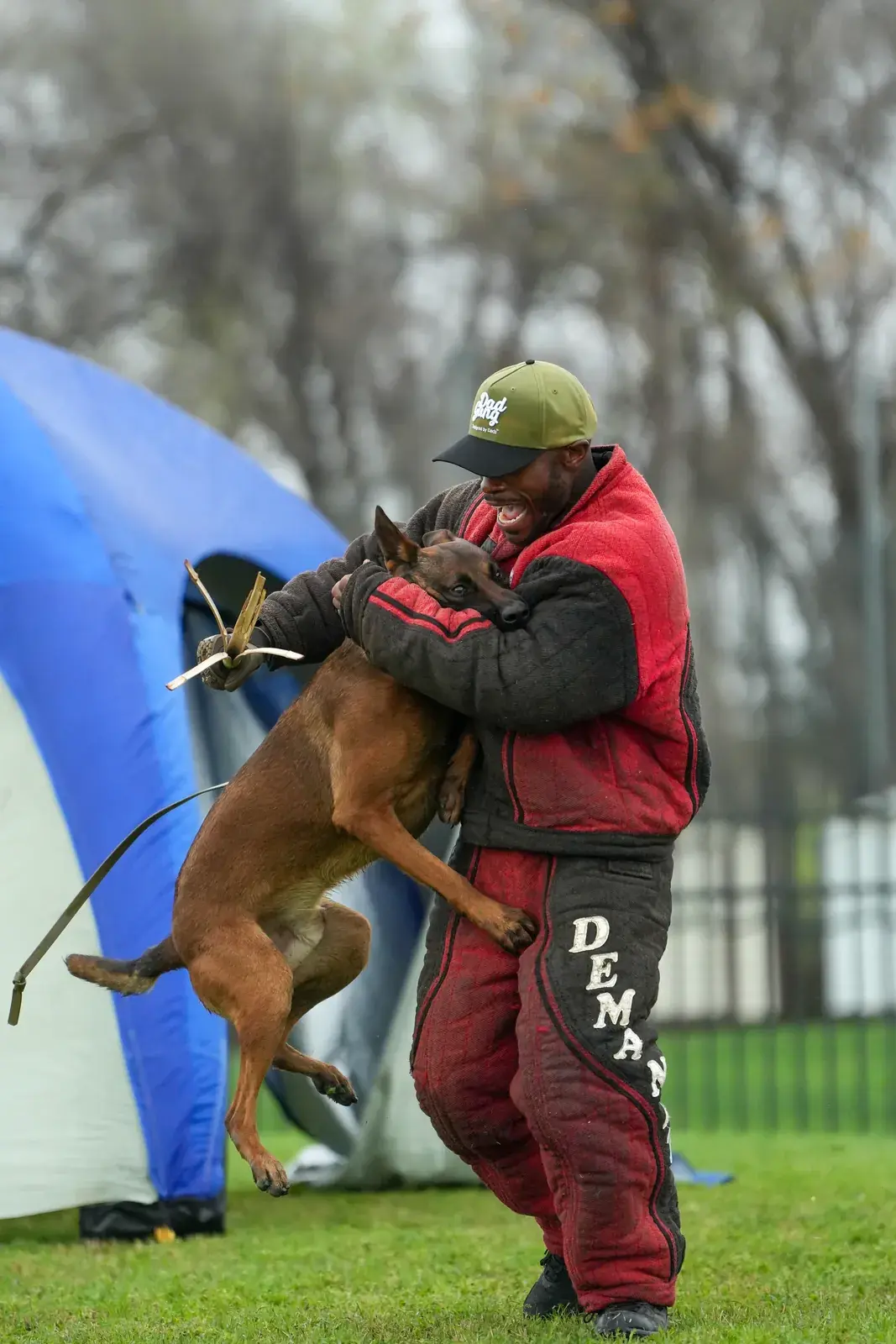
It changes the smell. Jute and french linen soak up everything. A club suit has been bitten by every dog on that field for years and carries their saliva in the weave. To a dog that has worked in it, the suit smells like the game, and that scent arrives before the man does. This is one reason an unfamiliar decoy in a familiar suit is a weaker test than people assume — you changed the person and left the cue.
It changes what the mouth gets. A padded forearm is five or six inches through and compresses under the teeth, so it fills the mouth and lets the dog close from the molars forward. A human forearm in a shirt sleeve is a third of that, and it is bone rather than jute. A dog with hundreds of repetitions on the thick thing frequently takes a shallow, front-teeth grip on the thin one, because that is all it can get. Shallow grips are uncomfortable, and uncomfortable grips get re-chewed or released.
It changes how the clothing behaves. A suit does not tear and does not come off. A jacket does both. A dog that grips a sleeve of ordinary fabric can end up standing there with a mouthful of coat while the man walks out of it, which in practical terms is a miss. Nothing in sleeve work prepares a dog for material that gives way.
It changes how the man can move. In a full suit you cannot properly crouch, cannot reach your own ankles, cannot sprint, and cannot change direction quickly. Everything is high, wide, slow and legible. Real people are none of those things. They are low, close, fast in the wrong directions, and frequently not standing up.
And it changes what the decoy is free to do. This is the part that cuts both ways. The suit makes it safe for a man to run at a dog in a straight line, offer a limb, stay in the fight and lose it on purpose — behaviour no actual person has ever produced. The equipment does not only protect the decoy. It licenses a performance, and the dog is learning the performance.
None of that is an argument against equipment. There is no way to build a full, calm, hard grip without it, and anyone who tells you otherwise is ruining dogs. The point is that everything the equipment gives you, it also teaches.
Sleeve, Suit, Hidden Sleeve, Muzzle, Street Clothes
A correct program is a sequence of removals. Each step takes something out of the picture and asks whether the behaviour survives without it. The later steps are the expensive ones — in time rather than money — which is precisely why they are the ones that quietly go missing. This maps onto how we describe the levels a dog moves through, and the distance between step three and step five is most of what separates a green dog from a dog that is genuinely finished.
01 — The Sleeve
A padded forearm the decoy presents deliberately. It exists to build mechanics: a full grip from the molars forward, a calm mouth that does not chew, an entry that does not glance off. Nearly every dog starts here and there is nothing wrong with that. What a sleeve cannot test is anything about the person holding it, because that person is standing behind an object he is handing to the dog. A dog can be brilliant on a sleeve and never once have had an opinion about a human being.
02 — The Bite Suit
Full-body padding, so the dog can be paid on a leg, a back, a shoulder, whatever presents. That matters more than buyers realise: it is the first step where the dog gets a vote about where the bite goes, and the first where the decoy can take a real hit and keep working. It is still padding. The suit is bulky, it smells of every dog that has ever bitten it, and it announces itself from across the field before anybody has moved.
03 — The Hidden Sleeve
A slim sleeve worn under a jacket or a hoodie, so the dog bites something that looks like clothing. This is the first honest test of whether the dog will commit to a normal-looking person, and dogs that were fine a minute earlier sometimes stall here — they arrive, circle, bark, and wait for the picture they know. Be clear about its limit. The hidden sleeve is still an arm, still on the same side, and still presented. It moves the question rather than answering it.
04 — Muzzle Work
No sleeve, no suit, no bite. A conditioned basket muzzle and a man in ordinary clothes, and the dog has to go in anyway. This is the only step where there is nothing in it for the dog — nothing to grip, nothing to carry, nothing to win. It is also the only step that cannot be flattered by giving the dog a bite, because there is no bite to give. Everything before it can be skipped by some dogs. This one cannot.
05 — Civil Work In Street Clothes
The dog engages a person who is not presenting equipment and is dressed like a person. Say plainly how the safety works, because the marketing never does: the decoy is wearing a hidden sleeve, a hidden leg, or a covert suit under those clothes, or the dog is muzzled. Nobody in this industry stands in front of a trained dog with nothing on. A vendor implying otherwise is either lying to you or hurting somebody, and both are worth knowing before you write a cheque.
Which steps can a dog skip? One and two, in principle — some dogs are started straight into a suit and are none the worse for it. Three, four and five are not optional, and a dog that has only ever done one and two has not been asked the question you are paying to have answered.
Muzzle Work, And Why It Is Missing From The Video
Put a conditioned basket muzzle on the dog, take the equipment off the man, and send it. That is the whole exercise, and it proves something no bite in a suit can prove, for one structural reason: there is no reward available. The dog cannot grip, hold, carry or win an object, because there is no object. Whatever makes it go in and stay in has to come from somewhere other than the thing it has been paid with for the last two years.
It also cannot be flattered the usual way. The biggest lever a decoy has for making an ordinary dog look finished is feeding the bite — delivering the arm into the mouth at the exact moment the dog arrives, so a mediocre entry closes clean. In muzzle work that lever does not exist. The others still do, and he can take pressure off or work on friendly ground. He cannot hand the dog the answer.
Conditioning is a prerequisite, and it is where the time goes. A muzzle has to be fitted and introduced over weeks, until the dog can pant, drink and take food in it and stops noticing it is on. A dog muzzled for the first time on the day will fight the muzzle rather than the man — pawing at it, rubbing it on the ground, shutting down. That tells you nothing about the dog and everything about the preparation, and confusing the two is a common way for a buyer to reject a perfectly good animal.
What committing looks like. The dog closes the distance without a hitch in the last few strides, strikes with the front of the muzzle, drives with the chest and back legs, and comes back for a second and third strike without being re-sent. The head stays up and forward. It is targeting the man because there is nothing else left to target.
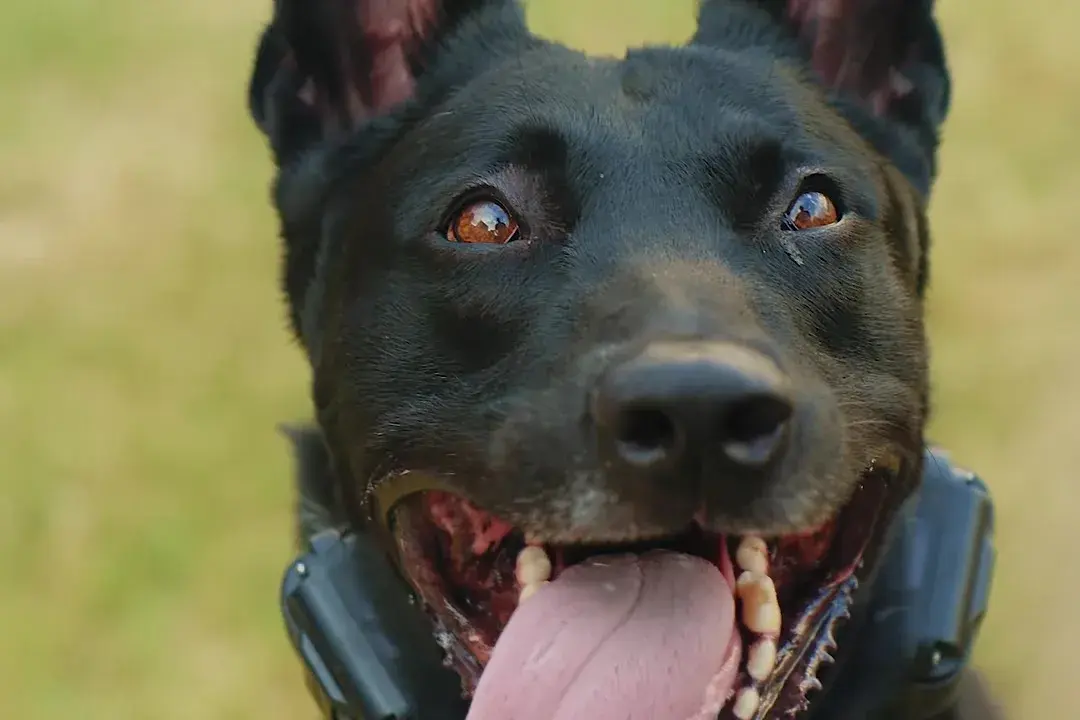
What quitting looks like. The dog goes in once, hits, feels no reward, and the picture comes apart. It backs off and barks from distance. It circles looking for an angle it recognises. It goes to the man’s right forearm out of pure habit, finds nothing, and stops. Or it turns and looks back at the handler — the same look you get whenever a dog has run out of trained picture and is asking where the game went.
Why it is missing from the video. Because it looks worse. No crash, no full grip, no dog hanging off an arm being swung around — just a dog hitting a man with its face. It does not cut into fifteen seconds that make anybody want to spend money. The footage that sells is sleeve footage; the footage that answers your question is the one nobody posts.
Ask for it anyway. If a dog has never been muzzled that is an honest answer, particularly for a younger dog still mid-sequence, and it is not by itself a reason to walk. It does mean you should not be told the dog is proven on people, because it has not been asked.
Why The Dog Keeps Looking For A Right Forearm
Dogs bite where they have been paid. That is not a criticism of the dog; it is how reinforcement works, and it is the same mechanism that makes a retriever bring things to your hand rather than to the kitchen. A dog that has taken eight hundred bites on a presented right forearm holds an eight-hundred-repetition opinion about where a bite lives, and that is not a thought it can talk itself out of.
The side preference is real, and it is usually the decoy’s doing rather than the dog’s. A right-handed decoy tends to present the same arm, at the same height, on the same side of his body, session after session. The dog builds its approach line around it. Change the side and some dogs hesitate, adjust late, or arrive and re-orient before committing — half a second of confusion that is invisible on video and obvious in person.
Height is the variable buyers underestimate most. Almost all equipment work happens with a man standing up. Very little of what worries you at three in the morning does. A person crouched at a car door, sitting on a step, half through a window, or already on the ground presents nothing at the elevation the dog has learned to aim at. Some dogs sort it out and take what is there. Others arrive, stall over the top of the person, bark, and wait for the picture to reassemble itself. Our video of a staged car-jacking training scenario shows a dog meeting a decoy in bite-suit trousers who reaches in through an open vehicle window. That is the awkward angle described here, though not the unsuited case.
The countermeasure is not complicated, and it is the one real advantage a suit has over a sleeve: vary the target early and keep varying it. Legs. The back. The side the dog does not prefer. A decoy who is kneeling, or moving away rather than toward. Programs that do this produce dogs that arrive and take whatever is available — and a dog that takes whatever is available is the one that still functions when nothing is presented at all.
Breed is not the interesting variable here. We see equipment fixation in all three of the breeds we place, and we have seen dogs of all three come through the muzzle step without blinking. What differs between them is temperament and how each holds up under sustained pressure, which is covered on the Belgian Malinois, Dutch Shepherd and German Shepherd pages. Targeting is a training history, not a pedigree.
Prey And Defence, Without The Mystique
This vocabulary gets used to sound expert and it is actually simple. Three words cover most of it, and knowing which one you are watching tells you more about whether a dog transfers off equipment than any single bite will.
Prey
The dog is playing a very serious game of catch and the man is the thing being thrown. Loose body, high carriage, a fast high-pitched bark, no hesitation on the approach, and a calm full grip once it owns the object. It wants to keep the thing and carry it. Prey is not fake and it is not a defect — it is where a good grip comes from, and a dog with no prey drive is harder to build rather than more serious. Prey is only a problem when it is the whole dog.
Defence
The dog has decided a person is a genuine problem and is dealing with it. The bark drops in pitch and gets choppier. The weight shifts back and forward rather than straight through. Hackles come up. It may hold at a longer distance, and the grip is often further forward and gets adjusted. It is trying to make the man leave rather than to possess an object. Too much of it, too early, in a dog without the nerve to carry it produces a frantic dog rather than a serious one.
Fight
The mature version, and the one worth paying for. The dog stays in the confrontation because it is comfortable being in one. It does not need an object to want and it does not need to be afraid to keep going. Pressure arrives — the decoy stops, stands tall, comes forward, makes noise — and the dog reads it, deals with it, and stays. This is the property that survives the equipment coming off, and the one a demonstration is least likely to show you unless you ask.
Now the part that matters for this page. A dog running purely on prey drive is not doing the job the buyer thinks they bought, and the reason is mechanical rather than mystical: prey needs a moving object. Take the movement away and the behaviour has nothing to attach to. That is exactly what a real situation does. Nobody flaps a padded arm and runs in a straight line. People stop, stand still, come forward, shout, swing something. Each of those removes the prey picture, and a dog with nothing underneath it comes off, or holds at a distance and barks, or takes the bite and lets go the moment it stops being a game.
Here is the trap: a purely prey-driven dog is the dog that looks best on a demonstration field. Fast, loud, confident, hard-hitting, full grip — because everything on that field is arranged to keep the game going. The dog that will still be there once the game stops often looks less spectacular in the first ten seconds. Ask for the movement to be removed and the pressure to be turned up, and watch what is left.
What To Ask To See, And What A Refusal Means
Five requests, all narrow, all aimed at this one question. The full protocol for a visit — what a decoy can flatter, what to change, what to watch after the bite — is its own subject and has its own guide. Take this short list on top of that one.
- Muzzle work, with a decoy in ordinary clothes. If the dog has never been muzzled, that is a real answer for a young dog — and it means the question you came to ask is still unanswered.
- A bite on the other side. If every repetition you have been shown is a right forearm, ask for the left, and then ask for a leg.
- A target that is not standing up. A man crouched beside a car, sitting, or half through a doorway is a different picture at a different height, and dogs generalise height badly.
- Presentation one way, body the other. The decoy offers the equipment to one side and takes his body the other. An equipment dog follows the gear; a dog working the man follows the man.
- Pressure with the movement removed. Have the decoy stop dead and come forward at the dog instead of running from it. A dog running purely on prey has nothing left once the game stops.
On refusals, be fair before you are suspicious. There are legitimate no’s here. Muzzle work on a dog that has not been conditioned to a muzzle is unsafe and uninformative, and a trainer saying so is telling you the truth. A dog that is mid-progression has not done step five yet, which is a schedule rather than a secret. Both answers arrive with a specific reason attached and usually with something else offered instead.
The answer that should stop you is the one with no reason in it. “He doesn’t need that.” “That’s not how we do it.” “The bite work speaks for itself.” Nobody who has actually run a dog through muzzle work is vague about it, because it is a memorable thing to have done. A seller who cannot describe how this dog behaved the first time it went in with nothing in its mouth is telling you it has not happened.
Biting A Man In Street Clothes Is Not Proof Either
Everything above pushes in one direction, so here is the counterweight, and it is not a small one. A dog that will readily bite a person in ordinary clothes is not by that fact a good dog. There is a version of this animal that engages people easily because it finds people threatening — poor thresholds, weak nerve, a low bar for deciding something is a problem. That dog passes the test on this page with distinction. It will also engage your neighbour, the meter reader, and the friend who let himself in through the side gate.
An indiscriminate dog is a liability, not an asset, and it is a liability that is hard to unwind. The dogs that end up in lawsuits are almost never the ones that failed to bite. Capability is the cheap half of this purchase. The expensive half is the off switch: a dog that can engage a person with no equipment anywhere in sight, will not do it until told, comes off cleanly when told, and walks past that same person on a loose lead ten minutes later without a scene. Both halves in one animal is the whole product. Either one alone is a problem with a price tag.
Which is the honest reason we spend so much of a first call talking people out of this. Whether a trained dog is the right answer to your situation at all sits upstream of every technical thing on this page, and we wrote a whole guide arguing most people should not buy one. Read that first if you have not. This page only tells you how to evaluate a dog once you have decided you genuinely need one.
And if you want to know why we are the ones writing this rather than a copywriter: both of us are listed decoys at PSA-sanctioned trials, so our read on whether a dog is working the man or the equipment comes from being the man. It is a claim you can check rather than take on faith, and it is set out with its source on our story.
When We Publish Something Worth Reading
No sequence, no drip, nothing automated. One email when we have written something a buyer would actually use — which is a handful of times a year, not a handful of times a month. Leave and we stop.
Bring This List To Whoever You Are Buying From
Including us. Ask what our dogs have done in a muzzle, with a decoy in street clothes, on ground they had never seen — and expect a specific answer rather than a reassurance. The plainer questions about cost, upkeep and terminology live in our FAQ and on the pricing page.