
Raising a Protection Dog Puppy:
Eight Weeks to a Working Adult
Buyers ask three questions before they ask anything else. How old is the puppy when it comes home, how long until it can actually do the work, and what are the odds it never gets there. The industry answers the first one confidently, the second one optimistically, and the third one almost never. What follows is the published evidence — veterinary literature, federal and state law, kennel-club and sport rulebooks, and the government working-dog programs that are obliged to report their numbers. Where a number does not exist, this guide says so rather than inventing one.
Eight weeks is a floor, not a rule — and the law is messier than it sounds
The eight-week norm has a real legal anchor, but it is narrower than most people assume. The federal rule, 9 CFR § 2.130 under the Animal Welfare Act, is a transport rule: no dog "shall be delivered by any person to any carrier or intermediate handler for transportation, in commerce" unless it "is at least eight (8) weeks of age and has been weaned." Age and weaning, both — and it governs shipping, not every sale.
State law is uneven. The Michigan State University Animal Legal & Historical Center table counts roughly 28 states plus D.C. with a minimum-age provision, many reaching only pet dealers or licensed breeders. Two sit below eight weeks: the table records Virginia's threshold (Va. Code § 3.2-6510) as "under seven weeks old without its dam" and Wisconsin's (W.S.A. 173.41) as "under seven weeks old." Florida is the clean blanket ban — § 828.29(4) says "A person may not transport into the state for sale or offer for sale within the state any dog or cat that is less than 8 weeks of age." California is routinely stated backwards. Penal Code § 597z — makes selling a dog under eight weeks a crime only "unless, prior to any physical transfer of the dog or dogs from the seller to the purchaser, the dog or dogs are approved for sale, as evidenced by written documentation from a veterinarian licensed to practice in California." The offense attaches to physical transfer, and a veterinarian's written approval defeats it.
Texas deserves a warning label. Its eight-week provision lives in the Dog or Cat Breeders Program and binds licensed breeders, and licensure is triggered by a possession threshold — the Texas Department of Licensing and Regulation's plain-talk summary published for the September 22, 2023 Texas Register proposed requiring a license from January 1, 2024 for anyone who possesses "five or more intact adult female dogs or cats" and breeds for sale, regardless of volume. Two caveats, stated plainly: TDLR's document describes this as a proposed rule change, and adoption as written was not confirmed for this guide; and the raw statutory and administrative-code text could not be retrieved from Texas state servers, so the substance here rests on the Animal Legal & Historical Center's reproduction of Occupations Code Chapter 802. A small working-line breeder below the threshold is not covered by the breeder rule at all.
The registry does not treat eight weeks as a hard line either. The AKC says "most veterinarians and breeders would put the optimum age at somewhere between 8 to 10 weeks old," and notes that some breeders keep puppies longer for extended socialization or early training, "especially for working or performance dogs."
What happens when a puppy leaves too early
Working-dog buyers are, measurably, the buyers most likely to break the rule. A prospective UK cohort of 1,844 puppies published in the Veterinary Record (Kinsman et al., 2020) found "A quarter (461/1844) of puppies were acquired under eight weeks of age," and that "owners who intended their puppy to be a working dog" had increased odds of acquiring under eight weeks.
The behavioural evidence runs the other way. Pierantoni, Albertini and Pirrone, also in the Veterinary Record (2011), compared dogs separated at 30–40 days with dogs kept to 60 days and found that "The odds of displaying destructiveness, excessive barking, fearfulness on walks, reactivity to noises, toy possessiveness, food possessiveness and attention-seeking were significantly greater for the dogs that had been removed from the litter earlier." That study is owner-reported and cross-sectional, not a randomised trial, and should be read as such.
The folk claim that taking a puppy early bonds it harder to you does not survive contact with the data. Slabbert and Rasa, in the Journal of the South African Veterinary Association (1993), reported that "early separation had no significant advantage to socialisation with humans, provided that separated and nonseparated pups had daily human contact. Early separation therefore did not improve dog/human bonding processes but lowered condition and increased mortality in separated pups." The published abstract describes the subjects as pups and young dogs and does not name a breed, so no breed-specific reading is warranted from it.
Purdue's Center for Animal Welfare Science makes the practical point in its extension bulletin Implications of weaning age for dog welfare (Hurt, Stella and Croney, 2015): a fixed date is itself a risk, because "abrupt weaning at a specified age (e.g., six weeks) for all puppies may adversely affect those that are not as physically or psychologically ready to cease nursing entirely." The same bulletin cites the one finding that ties litter time to later work — Slabbert and Rasa (1997) found puppies of nine to 12 weeks allowed to watch their dams perform narcotics searches "were better narcotics detectors at six months of age."
The stages, and where the research stops
The current stage list comes from a 2022 PRISMA systematic review in Animals by McEvoy, Baqueiro Espinosa, Crump and Arnott (Animals 12(21):2895, 22 October 2022): prenatal, neonatal (birth to two weeks), transition (two to three weeks), socialisation (three to 12 weeks), juvenile (12 weeks to six months), and pubertal (seven to 24 months). Adolescence in a working breed is not over at a year.
Two honest notes about that review. The phrase "fear period" does not appear in it — not once, across the 29 studies it screened. The two fixed windows trainers teach, at eight to 11 weeks and again at six to 14 months, are not in the peer-reviewed socialisation literature in that form. The review also states that "Much of the experimental research was carried out at least 50 years ago," and that "The maximum and minimum levels of socialisation required to produce emotionally robust adult dogs are currently unknown."
What the data actually show is a gradient with breed-dependent onset. Morrow and colleagues, in the Journal of Veterinary Behavior (2015), tested puppies from four to five weeks through 10 weeks and found fear responses in 78 percent of Yorkshire terriers, 53 percent of Cavaliers and 26 percent of German Shepherds — concluding that "the onset of fear-related avoidance behavior, varies among breeds of domestic dogs." Because testing stopped at 10 weeks, that study says nothing about any later window.
The window closes because fear catches up with sociability, not because learning stops. The AVSAB position statement on puppy socialization puts it directly: "Because the first three months are the period when sociability outweighs fear, this is the primary window of opportunity." AVSAB also sets the earliest class age at seven to eight weeks with "a minimum of one set of vaccines at least 7 days prior to the first class" — the same week most puppies go home, which is the answer to whether to wait out the vaccine series.
The largest dataset on the cost of getting it wrong is Finnish: in roughly 6,000 pet dogs, Puurunen and colleagues reported in Scientific Reports (2020) that "The level of socialisation during puppyhood (between seven weeks and four months of age) had the strongest association with both fear of dogs and fear of strangers" — stronger than breed, sex or neuter status. One finding in that paper cuts against a simple "keep them longer" reading: weaning age was included only in the fear-of-strangers model, where "dogs weaned later than eight weeks of age had a higher likelihood to be afraid of strangers than dogs weaned at a normal age (from seven to eight weeks of age; OR = 0.80, p = 0.014)." The authors offer two explanations — less socialisation at the breeder, or reverse causation, since a fearful puppy may simply wait longer to be adopted.
At eight months, the dog stops listening to you specifically
This is the least intuitive finding in the whole literature and the one families most often misread. Asher, England, Sommerville and Harvey, in Biology Letters (2020), tested the same dogs at five and eight months and found that dogs "responded less to the 'sit' command during adolescence, but only when the command was given by their carer, not a stranger" — odds of repeated non-response to the carer rose (OR 2.14) while response to the stranger improved (OR 0.40) over the same period.
It reverses. Carer-rated trainability fell from five to eight months and then rose above baseline by 12 months, while the professional trainers who saw the dogs less often rated them as more trainable at eight months. Two competent people can watch the same adolescent dog and honestly disagree. The authors' summary is that "adolescent-phase disobedient behaviour exists, but does not last," followed by the warning that "this corresponds with the peak age at which dogs are relinquished to shelters." The underlying shelter data supports it: Salman and colleagues, studying 12 US shelters, reported that "The majority of the surrendered dogs and cats were between 5 months and 3 years of age" — 1,023 of 2,160 dogs with reported ages, about 47 percent, against 8.8 percent under five months.
One breed-specific finding matters here more than any other. Serpell and Duffy, in Frontiers in Veterinary Science (2016), followed 978 prospective guide dogs and found that German Shepherds — and only German Shepherds among four breeds — "showed increases in 'stranger-directed aggression' between 6 and 12" months, with 3.70 times the odds of the reference breed. The trait that washes a dog out of a guide programme and the trait a protection buyer is hoping for share a developmental clock. That is not permission to let it run; it is the reason the adolescent months need supervision rather than optimism. The same authors concede that adolescence "is probably the most poorly studied" period in terms of its effects on adult behaviour, and the 2019 AAHA Canine Life Stage Guidelines put the hard stretch at "~6 mo and 3 yr of age."
How long it takes, according to organisations that publish their timelines
There is no single number, and anyone who gives you one is guessing. There are, however, published minimums and published programme lengths, and they cluster.
Sport bodies set floors. The FCI's International Utility Dog Regulations, effective 1 January 2025, require 18 months for IGP 1, 19 for IGP 2 and 20 for IGP 3, and state that "No exceptions are permitted"; the protection-only SPr trials carry the same 18-month floor, and the prerequisite temperament test can "never be under 12 months of age." The United Schutzhund Clubs of America sets its BH/VT at 15 months and offers IGP-V at 15 months — the earliest trial in that system containing real gripping. PSA sets a flat 14 months for every level. FCI Mondioring sets 12 months. The strictest published minimum found anywhere is the Dutch KNPV: dogs entering for the police dog 1 certificate "must be at least 2 years old on the date of entry" and must meet the requirements "for a healthy, solidly built adult dog." A title minimum is a starting gate, not a finish line — see sport titles versus real protection.
Government programmes publish the fuller picture. The RCMP raises puppies with volunteer imprinters and starts formal training "between the ages of 14 to 18 months," after which the handler course runs five months — putting a dog at roughly 19 to 23 months at completion — with a "mandatory 6-month follow-up component" and annual revalidation of every profile thereafter. New Zealand Police publish a six-stage process ending when dogs "graduate at 18 months of age," with puppies going to foster homes at eight weeks for a typical 7 to 12 months. The US Department of Defense skips puppyhood entirely: dogs were "typically 1 to 3 years of age at the time of purchase" and then trained roughly 100 days before certification testing, per Sinn, Gosling and Hilliard (2010). One state corrections policy, Minnesota DOC 301.120, specifies a 12-to-36-month acquisition window. And the USPCA's Patrol Dog I rules contain no minimum age for the dog at all — certification is on demonstrated performance and expires 31 December of the following year.
The best real-world spread comes from Swedish working-dog trials, whose four trial types include handler protection. Svartberg (2002) reported that dogs reached the middle level at an average of 714 days for German Shepherds (SD ±293.5) and 770 days for Belgian Tervuren (SD ±351.6). Mean plus or minus one standard deviation puts the ordinary range at roughly 14 to 37 months. The spread is the finding.
What OFA and PennHIP actually measure
This is where paperwork stops being paperwork. The Orthopedic Foundation for Animals states that "For certification purposes, the animal must be at least 24 months of age to be eligible." A radiograph taken days short of 24 months can only be read as preliminary. Hips fall into seven categories in three tiers — Excellent, Good, Fair, then Borderline, then Mild, Moderate, Severe — and only the three normal grades receive OFA numbers. The final grade is a consensus: three randomly selected board-certified radiologists evaluate each dog "considering the breed, sex, and age." Chemical restraint is recommended but, in OFA's own words on that page, "is not required by OFA." Borderline is not a verdict — OFA recommends repeat films about six months later, and says over half of Borderline dogs end up normal.
An absent OFA record is not evidence of a good result. OFA's FAQ states that all normal of-age results post to the web by default with no exceptions, while abnormal results post only if the owner initialed the abnormal-release block on the application.
Cardiac, eyes, DNA, and what a CHIC number does not mean
When protection foundations begin, and what actually decides it
Age alone does not answer this, and the veterinary consensus document says why. The 2021 AAHA Working, Assistance, and Therapy Dog Guidelines define the job precisely — these dogs "are not 'attack' dogs but are trained to bite and hold (and release) an individual as a method of restraint" — and list the physical demands: sprinting, jumping obstacles, "turn sharply at top speed, scale walls and fences, move on unstable surfaces, and perform powerful bite and hold maneuvers." The same guidelines recommend delaying desexing "until past closure of growth plates to decrease the risk of orthopedic issues later," language that appears in both the protection and detection columns of their table.
Growth plates give a hard physical marker. A peer-reviewed table in Today's Veterinary Practice (Balsa and Robinson, 2016) puts the last closures in a 25-to-30 kg dog at 10 to 12 months for the proximal humerus and tibial tuberosity, with the proximal femur and tibia closing by 12 months. Full closure lands near a year — just before the earliest sport minimums and well before the 18-to-24-month marks used by FCI and KNPV.
The foundation phase is not bite work. The RCMP is unusually specific about what imprinting contains: socialization, familiarization, informal obedience, tracking, and "Prey and defence drives." Criminal apprehension is not on that list — it belongs to the formal course starting at 14 to 18 months. Nor does the RCMP decide from one puppy test: dogs "are monitored monthly and are evaluated at 49 days, 4 months, 8 months and 12 months."
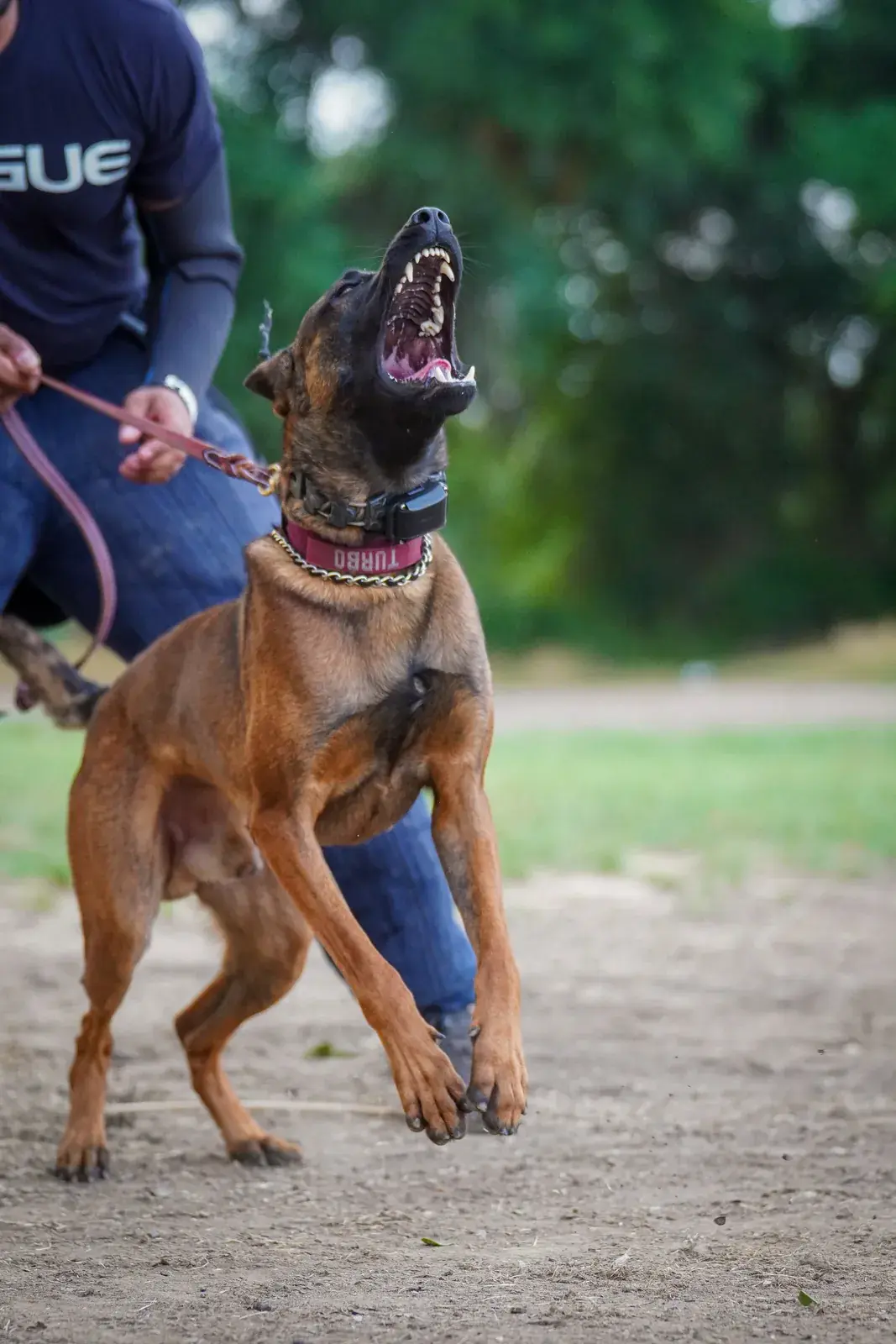
What protection work evaluates is not bite mechanics. The FCI's basic requirements name "instinctive behaviour, self-confidence, ability to cope with stress, grip performance and obedience," assessed across the whole phase, and its termination criterion names the exact failure a dog started too early will show: "the dog does not withstand the pressure from the helper and comes off the sleeve and backs up." The same rulebook bars "Insecure and frightened" dogs, "Nervous, aggressive, dogs sounding an alarm, fear biters" from the trial entirely, and lets a judge exclude a dog later even after it passed. Aggression born of fear is disqualifying, not qualifying.
Early testing does not predict the adult dog. In the DoD study, "certification outcomes could not be predicted by breed, sex, or early test behaviors" — only behaviour measured at the final test period, in an adult dog immediately before training, improved prediction, and by only 2 to 7 percent. (Those models included only dogs that completed all three test periods, which excludes dogs rejected along the way.) A 2021 review in Frontiers in Veterinary Science is fair about the state of play — early screening at 12 weeks or younger is "not very effective in predicting working dog success," though some studies find modest value. The traits that did predict police-dog qualification in a 2,107-dog study were courage, hardness, prey drive, defence drive and nerve stability, and those dogs were assessed at 450 to 600 days — 15 to 20 months, not eight weeks. Svartberg found boldness works as a threshold rather than a gradient, that bolder dogs reached success younger, and — notably — that boldness scores did not differ between dogs succeeding at handler protection and dogs succeeding at tracking or searching, "suggesting the personality dimension predisposes trainability in general." What that means in practice for the first months at home is covered in the first 90 days with a protection dog.
How often the dog does not make it
No published washout figure exists for civilian family protection dog programmes. That sentence is the honest answer, and the rest of this section is proxies — all of them from programmes with different selection, different jobs and different denominators.
Of 660 military working dogs that finished training at Lackland over two years, "fully 36.5% of this two-year sample failed either one or both phases" — and those were adult dogs already screened at a vendor site. The RCMP publishes both sides of its own history: before it began breeding in 1999, "Only one out of six of these dogs successfully completed training as a police service dog," while today "Fifty percent of the puppies born at the Centre will become working dogs" of some kind. The TSA reports 80 percent of assigned canines graduate — but the denominator is dogs already procured and assigned to an 11-week course, not puppies followed from eight weeks. TSA also builds attrition into its planning, using "a projected program attrition rate" to set yearly training requirements (DHS FY2018 report to Congress).
The assistance-dog literature is the closest thing to a family-raised comparison. In 2,033 dogs at The Seeing Eye, 56 percent graduated and 39 percent were passed back — and German Shepherds "had the highest chance to be passed back" and "the lowest, probability for graduating," while also doing better when given longer than the standard training period (Ennik et al., 2006). Canine Companions, the largest US assistance-dog provider, reports a 13-year average success rate of 43 percent excluding breeders and medical releases (Frontiers, 2019). The study that ties health screening to washout is Bogaerts et al., PLOS ONE (2019): of 537 dogs bought as puppies, "only 60 percent of the originally enlisted dogs (n = 324) actually became assistance dogs," with 18 percent rejected for orthopaedic disorders and 17 percent for behaviour. Within the orthopaedic rejects, hip dysplasia was implicated in 65 percent and elbow dysplasia in 39 percent. Every one of those puppies had been behaviour-tested at purchase, and 17 percent still failed for behaviour later.
Detection programmes report 20 percent (Lazarowski et al., 2018, where 62.5 percent of washouts failed "for insufficient environmental soundness" rather than task performance) and 37.5 percent (Zheng et al., 2026). Lazarowski also notes that an ~80 percent combined success rate "exceeds previous reports of working dog program success rates of 30% or less." One number in that literature is routinely mangled: Wilsson and Sundgren's 4.9 percent is a composite success rate for search tasks, not a general washout rate, and must never be written as "95 percent of working dogs fail." Guiding Eyes publishes where in development it loses dogs — roughly 20 percent at the seven-to-eight-week puppy test, only about 3 percent during the long raising phase, and about 7 percent at the final training test around 18 months (Frontiers, 2025). The decisions cluster at the very start and at maturity.
What happens to the dogs that do not make it is worth reading before you commit. Canine Companions publishes its policy in full: transfer to another working agency first, then release as a family pet, with the volunteer raiser as default adopter, "Most Canine Companions released dogs are between one and two years of age," and any adopter who cannot keep the dog "must agree to return them to Canine Companions to be placed." The TSA rehomes free but requires permanence: "Dogs cannot be returned once adopted." One legal correction, because it is stated backwards constantly: 10 U.S.C. § 2583, which grew out of Robby's Law, covers end of useful life, extraordinary circumstances, or animals "otherwise excess to the needs" — training failures are not named — and its priority order is former handlers first, then other capable persons or organisations, then law enforcement agencies. Robby's Law itself, enacted 6 November 2000, requires DoD to report annually how many dogs were adopted, await adoption, and were euthanized. Federal programmes must publish their disposition numbers. The civilian protection dog industry is required to publish nothing.
What the family does every day, and what happens if it does not
The word in the veterinary guideline is daily. AAHA's 2019 life-stage guidelines state that "gentle handling and structured environmental exposures on a daily basis during this time period can have significant benefits later in life," and give the honest baseline against which to measure yourself: a recent survey found "only one-third of puppies were receiving exposure to people and dogs outside the home during critical periods."
The failure mode is not too little enthusiasm. It is exposure without watching the dog. AAHA is blunt: "Exposure without evaluation of the puppy's response to the situation may result in increased problem behaviors as a result of sensitization instead of positive socialization," and "puppies generally do not 'outgrow' their problems." The Serpell and Duffy guide-dog data quantifies that. A single reported incident of the puppy being frightened by a person, familiar or unfamiliar, carried 4.60 times the odds of stranger-directed fear at 12 months — marginal means moving from 0.08 to 0.29 — and "Having been frightened by a person was also associated with lower likelihood of successfully completing training." Being threatened by an unfamiliar dog carried an odds ratio of 1.59 for dog-directed fear. Those two survived Bonferroni correction. Two household findings did not, and should be reported as suggestive only: teenagers in the household associated with dog-directed aggression at OR 1.44, and with touch sensitivity at OR 1.39. What did hold: "growing up in households with more experienced puppy raisers, and in the company of at least one other dog, were both associated with positive effects," while inexperience and a pet-free household went with less successful training outcomes.
Solitude is part of the job, not the opposite of bonding. AVSAB recommends scheduled time for puppies "to play alone with their favorite toys... or take naps in safe places such as crates or puppy pens," specifically to prevent over-attachment.
The physical routine has orthopaedic consequences before three months of age. In a 501-dog prospective cohort, Krontveit et al. (AJVR, 2012) found stairs increased hip dysplasia risk while off-leash exercise decreased it, concluding that puppies under three months "should not be allowed access to stairs, but should be allowed outdoor exercise on soft ground in moderately rough terrain." The evidence-based version of "do not overdo it" asks for more free movement, not less — just not on stairs.
For a concrete benchmark of the commitment, two working-dog programmes publish theirs. Guiding Eyes for the Blind asks raisers to confirm "I am willing and able to walk the dog up to 3 miles per day" and that "Everyone in your household must be supportive." The Guide Dog Foundation specifies relief opportunities "at least every 4-5 hours during the daytime until they are six months of age," then every five to six hours, plus required monthly classes. The Department of Defense breeding programme at Lackland places puppies in foster homes at about eight weeks and takes them back at about seven months (DVIDS). That is the shape of the commitment across the industry, whatever route you take — raising from a puppy or buying a trained adult. Which one suits a given household is the question in should you actually buy a protection dog.
What Nobody Publishes
No published washout rate exists for civilian family protection dog programmes. Every failure figure in this guide comes from police, military, guide dog or detection programmes with different selection criteria and different denominators, and none of them is a substitute.
Nobody knows how much socialisation is enough. The 2022 systematic review says it outright: the maximum and minimum levels required "are currently unknown," and most of the underlying experimental work is over fifty years old.
The discrete fear period, as trainers teach it, is not in the peer-reviewed socialisation literature. AAHA uses the term clinically but attaches no specific weeks to it. That is the honest position.
Adolescence is the least-studied stage in the dog's life, per the authors of the main study of it. Confident adolescent-phase protocols are going beyond the evidence.
The lifetime penetrance of the degenerative myelopathy SOD1 variant is unknown. OFA says research is ongoing to estimate what percentage of at-risk dogs will develop the disease.
Texas's raw statutory and administrative-code text could not be retrieved for this guide — state servers returned JavaScript shells and errors — so the Texas breeder rule here rests on a law-school repository's reproduction. TDLR's five-intact-female licensing threshold was published as a proposed rule change; adoption as written was not confirmed here. Verify both against raw text before relying on them.
The commonly cited ~10 percent military working dog course attrition figure could not be confirmed at any .mil primary source; every Air Force page attempted returned HTTP 403. It is reported by Task & Purpose citing the 37th Training Wing, and is not used as a fact in this guide.
Sources contradict themselves in three places worth naming. OFA's preliminary-evaluations page says radiographs are accepted "as young as 4 months" while its FAQ says "over 4 months"; OFA's hip-screening page carries two differently worded statements about chemical restraint in different sections; and the PennHIP training manual reports 84 percent in one passage and 82 percent in another for the same OFA Good comparison. Where the record is inconsistent, this guide says so rather than picking one silently.
Raising One
Yourself
None of the above describes any one company’s programme, including ours. Build Your Own Pup sets out our side of it, and a finished dog is the alternative if the years above read as more than your household wants to take on.