Those Levels Are Vendor Marketing

If you searched for “what is a level 3 protection dog” and expected to find a standard behind it, there isn’t one. No governing body defines those tiers. Nobody administers an exam for them. There is no database where you can type a dog’s name and confirm it holds a level. The number exists because it is a convenient way to sell three or four packages instead of one, and because a buyer who has just been handed a number feels like they have been handed a fact.

The practical consequence is the part that costs people money: one company’s level two is another company’s level three, and a third company starts at level four because it sounds further along. The tiers are internally consistent within a single price list and meaningless across two. Comparing a level three from one seller against a level three from another is comparing two sales brochures, not two dogs.

None of that makes tiered packages dishonest by itself. A company selling several configurations of the same service needs names for them, and “level two” is a reasonable name. It becomes dishonest at the point the number is presented as a qualification the dog earned rather than a package the company assembled. A level is a description of what the seller says the dog will do. It is not a result the dog produced in front of anybody impartial.

It Is A Price Ladder Wearing A Capability Costume

That said, the ladders are not random. Underneath the marketing there is a genuine progression, because some skills really are harder and slower to build than others, and the tiers usually climb in roughly the order those skills get finished. The honest version of the ladder is a list of capabilities, not a list of numbers.

The clearest public illustration we have found is a company in Georgia that publishes its full price list and states what each tier excludes as well as what it includes. Its bottom rung, at $32,500+, is explicitly not a finished protection dog — it is obedience, socialization and foundation bite work. Its top rung, at $95,000+, adds building searches and multiple-attacker work. That is a real ladder, published, with the exclusions visible. Our pricing page walks through that list in full, with sources, alongside what the rest of the market charges.

Read any tier list that way. The number is noise. The sentence that says what the tier leaves out is the only part carrying information, and a seller who will not write that sentence down is not selling you a level — they are selling you a feeling about a level.

What Actually Separates A Cheap Dog From An Expensive One

Here is the ladder as capabilities, in plain terms. Some of these you should be paying for. Several of them most families will never use, and a seller pushing you up a tier for them is selling you a feature, not a solution. Read it as a checklist for the conversation rather than a menu.

Obedience with something at stake

Every dog for sale will heel on a quiet field. The question is whether it holds a down while a stranger walks past with a dog of its own, whether it recalls off a squirrel, and whether it takes the command the first time rather than the third. Obedience that only survives in a familiar place is not obedience, it is a routine. This is the single largest difference between a cheap dog and an expensive one, and it is the least photogenic.

Neutrality — doing nothing, correctly

Most of a protection dog’s life is uneventful, and the hardest thing to buy is a dog that is genuinely boring in the house. A dog that stares down every visitor, barks at the mail, or cannot switch off is not more protective, it is less useful and more dangerous. Ask to see a dog asleep on a floor while people move around it. That footage is rarer than bite footage, which tells you something.

Alert on command, and quiet on command

A dog that barks when told to bark is a deterrent you control. A dog that barks whenever it feels like it is a smoke alarm with teeth. The paired skill matters more: the dog has to stop on the first word and go back to neutral, not simmer. Vendors sell the bark. The part you should be testing is the silence that follows it.

Handler defense away from home

The scenario people actually buy for happens in a parking garage, a driveway at night, a trailhead, a gas station. That is a different problem from the training field: strange footing, strange smells, poor light, and a handler who is frightened and therefore handling badly. A dog that only works where it was trained has learned the field, not the job. Working strange environments is where a great deal of the money goes.

The out

Releasing on command is the behavior that separates a trained dog from a liability, and it is the one most often glossed over in a sales demo. A dog that has to be physically removed from a decoy has told you what it will do in your driveway. Ask for the out, ask for it cold, and ask for it after a hard engagement rather than a soft one — that is when it is genuinely difficult.

Vehicle work

Carjacking response is a real, separable skill and it is usually where the price steps up. The dog has to exit a vehicle on command into chaos, or engage from inside it, around glass, engine noise, seatbelts and a handler who is pinned in a seat. Plenty of dogs that work beautifully on foot are unsure the first time a car is involved. If a tier includes vehicle work, ask to see it in a car, not described in a brochure.

Building and property searches

Sending a dog to clear a house alone is a genuinely advanced ask. It means working out of sight of the handler, holding purpose through empty rooms, dealing with slick floors and stairs and doorways, and indicating rather than acting on its own. Most family placements never need this. It appears near the top of vendor ladders because it is legitimately difficult, not because most buyers should be paying for it.

Multiple threats and re-engagement

A dog that commits to the first person it engages and ignores the second has solved half the problem. Handling more than one threat means disengaging from a fight it is winning, which is against the instinct the training just built. It is also the skill most likely to be claimed and least likely to be demonstrated, because it takes several trained people to show it honestly.

Children, guests and trades

A dog can be superb at all of the above and still be wrong for a house with a seven-year-old in it. Tolerance of noise, grabbing, running, screaming, sleepovers, and a plumber under the sink is a temperament question, not a training level. No tier on any vendor ladder measures it, and it is the thing that decides whether the placement works. It is why we test households rather than sell packages.

Holding all of it a year later

Protection work is a perishable skill in every dog, at every price. A dog delivered at the top of somebody’s ladder and then left alone for twelve months is not a top-of-the-ladder dog any more. What you are buying is a starting point and a maintenance obligation, and any seller who does not tell you that has sold you an appliance rather than an animal.

Notice how much of that list is about restraint, not aggression. The expensive part of a protection dog is almost never the bite. It is everything the dog has to be able to not do, in a house, on an ordinary Tuesday, for years. What the list does not cover is whether the dog will engage a person wearing no equipment at all, and we gave that question its own page — what happens when the sleeve comes off, written from the receiving end of the bite.
Titles Are Judged By Somebody Who Isn’t Selling You The Dog

There is a category of credential in this world that does mean something, and it is worth understanding precisely why it is different. IGP, PSA, KNPV, Mondioring and French Ring are sanctioned trial programs. Each has a published rulebook, trials run by clubs under an organization, judges certified by that organization, and results the organization records. A dog either passed on the day or it did not, and the person who decided had no financial interest in the answer. We went through those rulebooks and wrote up what an IGP, PSA or KNPV title does and does not transfer to a house, because the acronym on a pedigree is the credential buyers most often mistake for a level.

That is the whole difference. A vendor tier is a claim made by the seller about the seller’s own dog. A title is a claim that was tested by somebody else and can be looked up afterwards. One is falsifiable and one is not, and in a market this full of adjectives, falsifiable is the only quality worth paying attention to.

What a title does tell you

  • The dog performed a published set of exercises to a stated standard on a stated day, in front of a judge the seller did not hire.
  • It worked away from home, on an unfamiliar field, surrounded by strangers and other dogs — the exact conditions a demo on the seller’s own property avoids.
  • It has been under real pressure from a decoy who was not on its team, and kept its head well enough to score.
  • Somebody trained it to a deadline they could fail publicly. That is a statement about the trainer as much as the dog.
  • The result is recorded by the organization, not by the person selling you the dog, so you can go and check it.

What a title does not tell you

  • That the dog is pleasant to live with. Sport asks nothing about how a dog behaves at 7pm in a kitchen full of children.
  • That the dog will work outside the pattern. Trials are rule-bound, and a smart dog learns the sequence, the field and the equipment along with the exercise.
  • That it is neutral to strangers who are not decoys — to a contractor, a babysitter, a neighbor leaning over a fence.
  • That an untitled dog is worse. Many excellent family dogs were never entered in a trial because nobody involved wanted to spend weekends on a field.
  • How the dog handles being wrong. Scoresheets record what happened, not what the dog was thinking while it happened.

So do not overcorrect. A titled dog is not automatically the right dog for your house, and an untitled dog is not automatically a lesser one. A sport title tells you the dog has been under genuine pressure and kept working, which is real and useful information about nerve and trainability. It does not tell you the dog will be steady when your daughter’s friends arrive in a group and one of them screams. Those are different tests and only one of them is scored.

Both of our owners are listed decoys at PSA-sanctioned trials, which is the reason this page reads the way it does. A decoy is the person in the suit taking the bite, so the read on a dog comes from the receiving end rather than from behind a camera — commitment, grip, whether the dog is fighting the man or chasing the equipment, and how quickly it clears its head afterwards. None of that appears on a scoresheet and none of it appears in a tier. The trials we are listed on are on our about page, with a link to the organization’s own listing so you can check it rather than take our word for it.

Ten Questions For Anyone Who Quotes You A Level

You do not need to know the sport to have a productive conversation with a seller. You need questions that cannot be answered with an adjective. These are the ones we would ask, including about us.

If the answer to several of those is some version of “trust us, we have been doing this a long time”, that is itself an answer. Experience is real and worth paying for, but it should make a seller more able to answer specific questions, not less willing to.

We Would Rather Describe A Dog Than Number It

We do not sell levels, and this page is the reason. When we have a dog we think suits your household, what you will get is a description: what it does reliably, what it does not do yet, where it has and has not been worked, what it is like in a house when nothing is happening, and what we would want you to keep up after delivery. That is longer than a number and considerably harder to write, which is probably why the number is so popular.

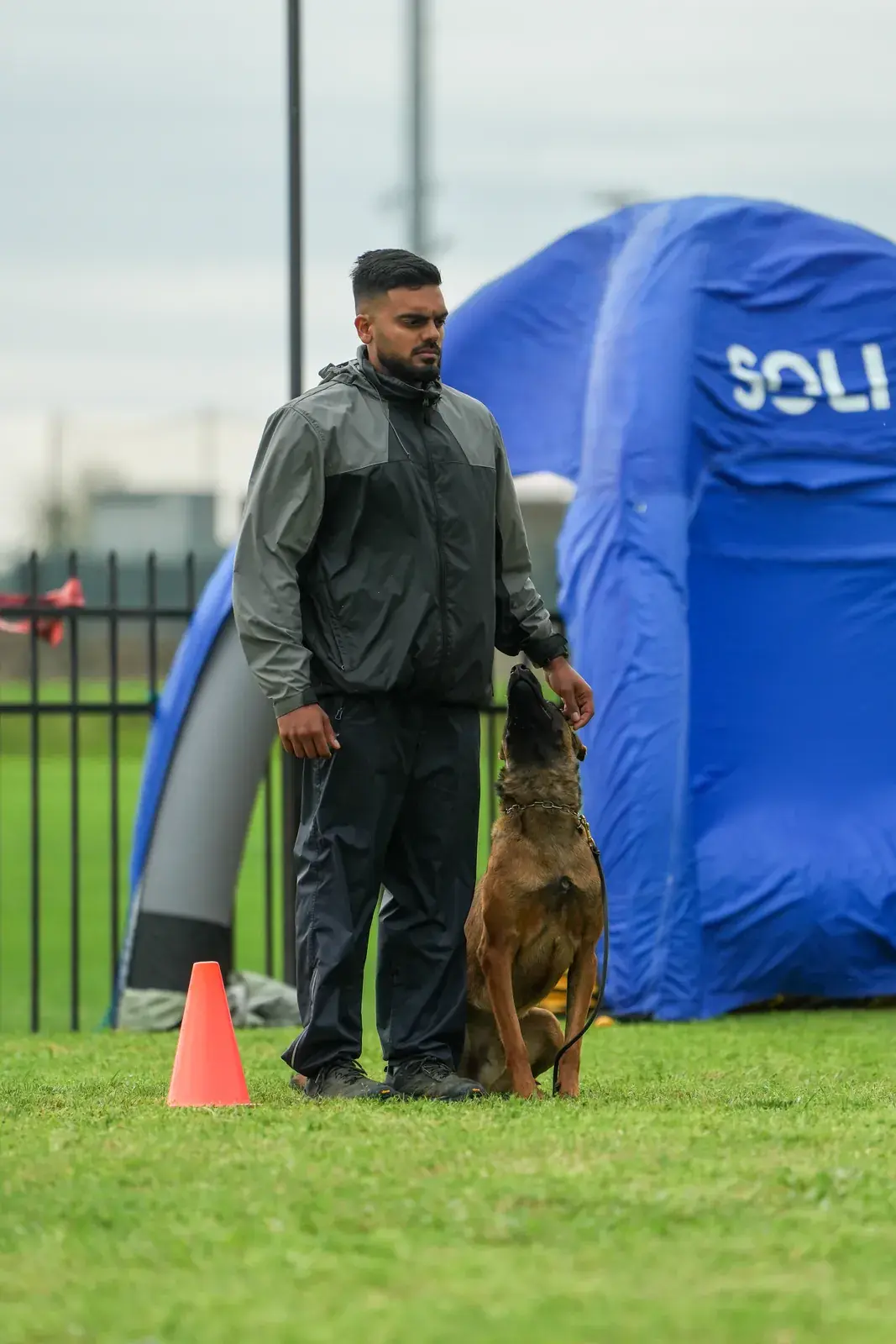
A Belgian Malinois sits tight against its handler’s leg on a grass field, eyes on the handler
Holding position at the handler’s leg. This is the control the bite work rests on.

It also means we will sometimes tell you that the honest answer is a well-bred family dog and a better alarm system. Both of our programs — a finished dog or a puppy you raise with us — start from the same conversation, and some of those conversations end with us telling you not to buy one. Our FAQ answers the rest of it plainly, including cost, upkeep, and what happens when a placement is not working.